Newsletters


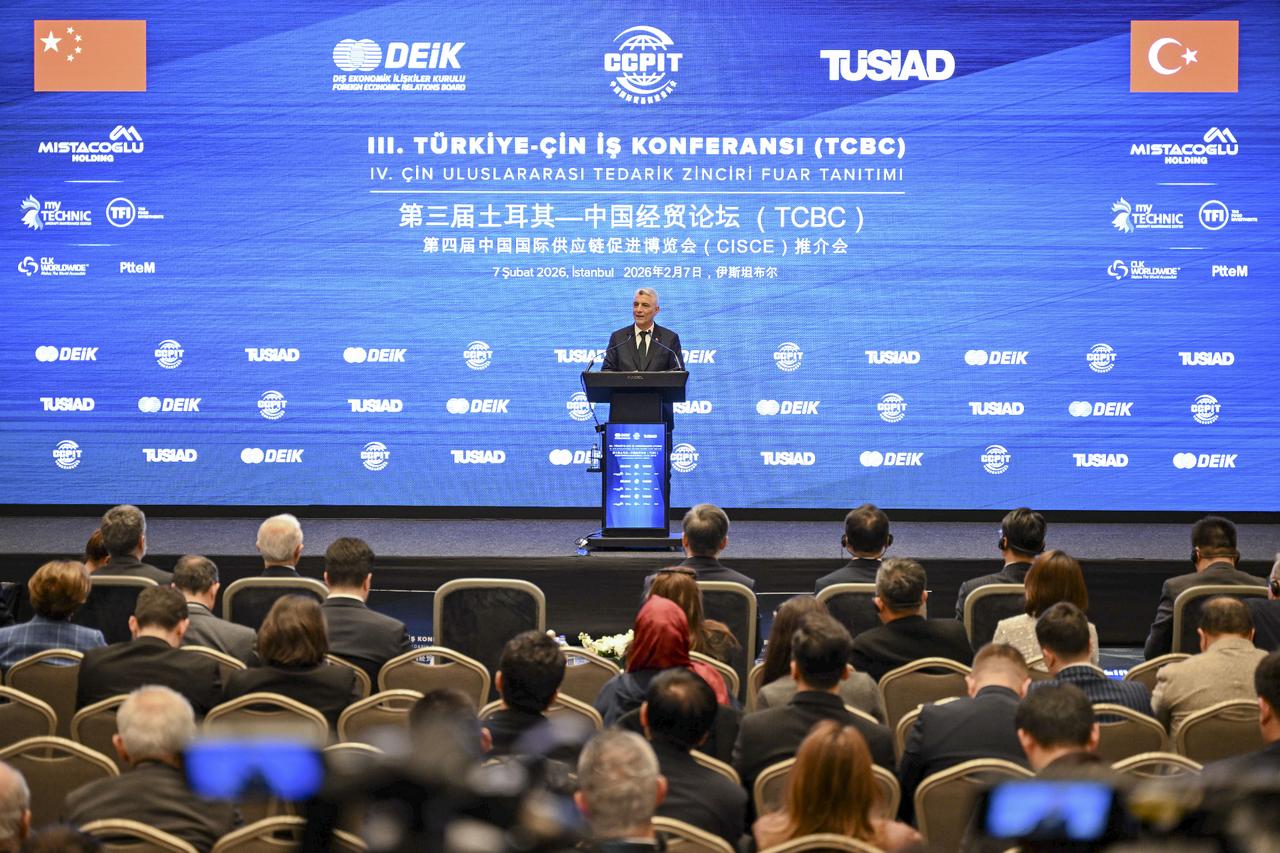


Business leaders and government officials from Türkiye and China convened in Istanbul for the third Türkiye-China Business Conference, focusing on expanding cooperation in technology, investment and tourism while addressing a significant trade deficit favoring China.
The conference, organized by the Foreign Economic Relations Board (DEiK), the Turkish Industry and Business Association (TUSiAD), and the China Council for the Promotion of International Trade (CCPIT), brought together Trade Minister Omer Bolat, Chinese Ambassador to Ankara Jiang Xuebin, and representatives from major business organizations from both countries.
Bilateral trade between the two nations reached $53 billion in 2024, but the relationship remains heavily imbalanced in China's favor. Minister Bolat announced that Türkiye has proposed a structural transformation to address the gap, noting that Turkish exports to China rose 32 percent to $335 million in January 2025 compared to the previous year.
"Our aim is not to narrow trade, but on the contrary, to ensure Türkiye is more visible in the Chinese market, to increase its share, to provide product diversity, and to establish the structural foundations of balanced trade with high value-added products based on the win-win principle," Bolat said.
The investment relationship between the two countries shows similar imbalances. According to Bolat, 1,419 Chinese companies operate in Türkiye with investments totaling $3.2 billion, primarily in finance, energy, services, transportation and telecommunications. Meanwhile, approximately 1,465 Turkish companies operate in China with investments of just $175 million.
Chinese officials acknowledged Türkiye's strategic importance. Wang Kang, Vice President of the Export-Import Bank of China, noted that Türkiye ranks as China's fourth-largest trading partner and third-largest export market in West Asia, while China serves as Türkiye's second-largest trading partner and primary import source.
 1 min read

Business leaders from both sides emphasized opportunities beyond traditional trade metrics. TUSiAD President Ozan Diren highlighted potential alignment between China's 15th Five-Year Plan, which emphasizes high-quality, innovation-driven growth, and Türkiye's industrial capabilities.
"New cooperation areas compatible with China's high-quality and innovation-focused growth approach within the 15th Five-Year Plan can add significant depth to our relations," Diren said.
DEiK President Nail Olpak pointed to China's high-technology investments as a potential balancing factor, suggesting collaboration on promoting the Turkish Industry and Technology Ministry's HIT-30 program, which supports high-tech product investments. He also stressed the strategic importance of the Belt and Road Initiative, stating that both countries need to approach the project with a strategy that allows everyone to benefit.
CCPIT President Ren Hongbin noted growing Chinese consumer interest in Turkish products through e-commerce platforms, particularly dried fruits, olive oil and hazelnuts, suggesting these could help reduce the trade imbalance.


Türkiye seeks to significantly expand Chinese tourism, which remains minimal despite the country's attractiveness as a destination. In 2024, 425,000 Chinese citizens visited Türkiye, representing only 1 percent of China's total outbound tourism.
To encourage growth, Türkiye granted visa exemptions to Chinese citizens effective January 2, 2026. Bolat said both countries are cooperating to increase flight frequencies and connectivity, adding that Türkiye expects reciprocal visa facilitation for Turkish business travelers.
Ambassador Jiang emphasized that despite rising unilateral trade protectionism and tariff wars globally, countries cannot return to isolation. He cited Chinese President Xi Jinping's initiatives on global development, security, civilization and governance as frameworks for more open and balanced cooperation.
Conference participants explored synergies between China's Belt and Road Initiative and the Middle Corridor, which connects Asia and Europe through Türkiye and Central Asia. Diren called the harmonization of these two initiatives valuable for diversifying supply chains and strengthening Europe-Asia connectivity.
The conference concluded with the signing of cooperation agreements between DEiK and CCPIT, TUSiAD and CCPIT, and China International Expo Center and ATA Holding. Organizers also introduced the fourth China International Supply Chain Expo during the event.


 Set as preferred source
 Set as preferred source


 1 min read