Newsletters


Turkish Foreign Minister Hakan Fidan said Wednesday that the NATO summit being held in Türkiye once again demonstrates the country's strategic importance and its role within the alliance.
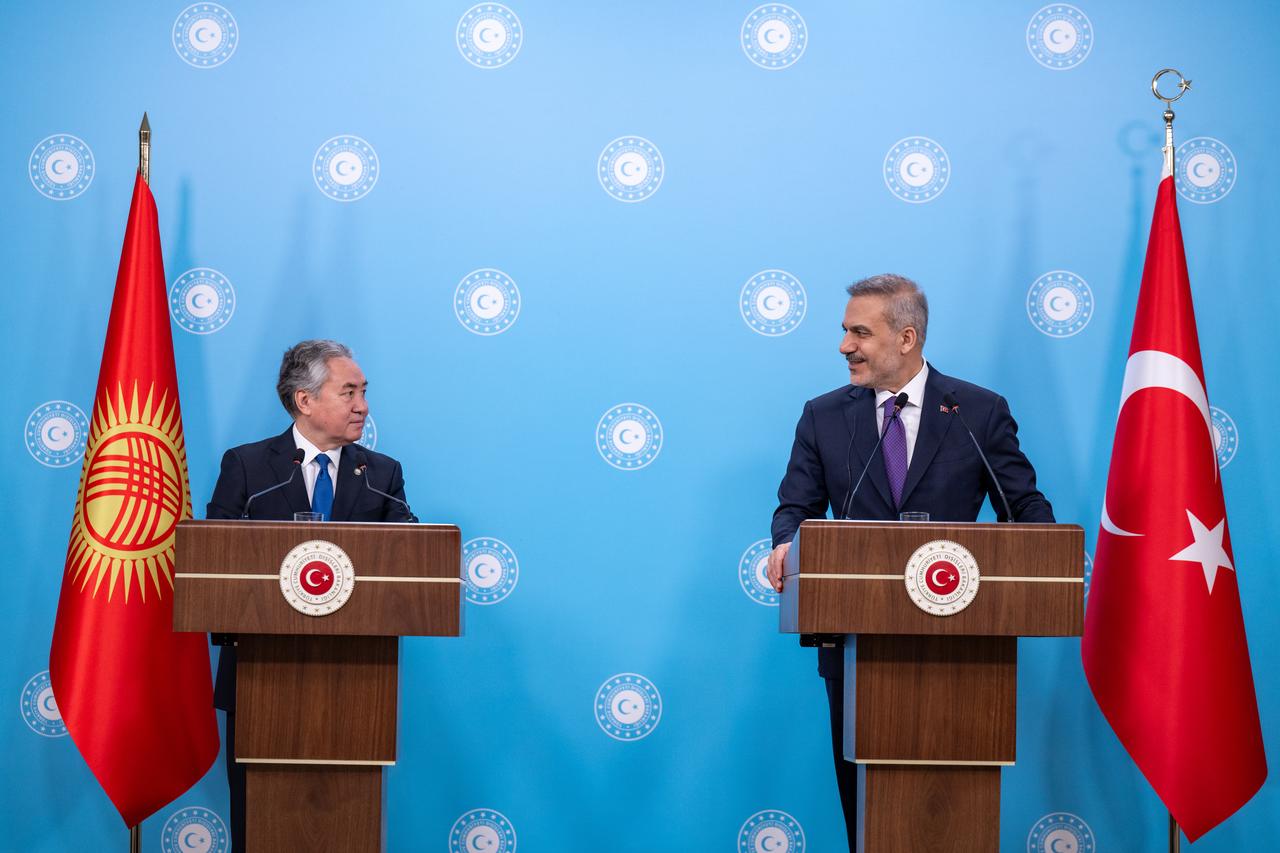
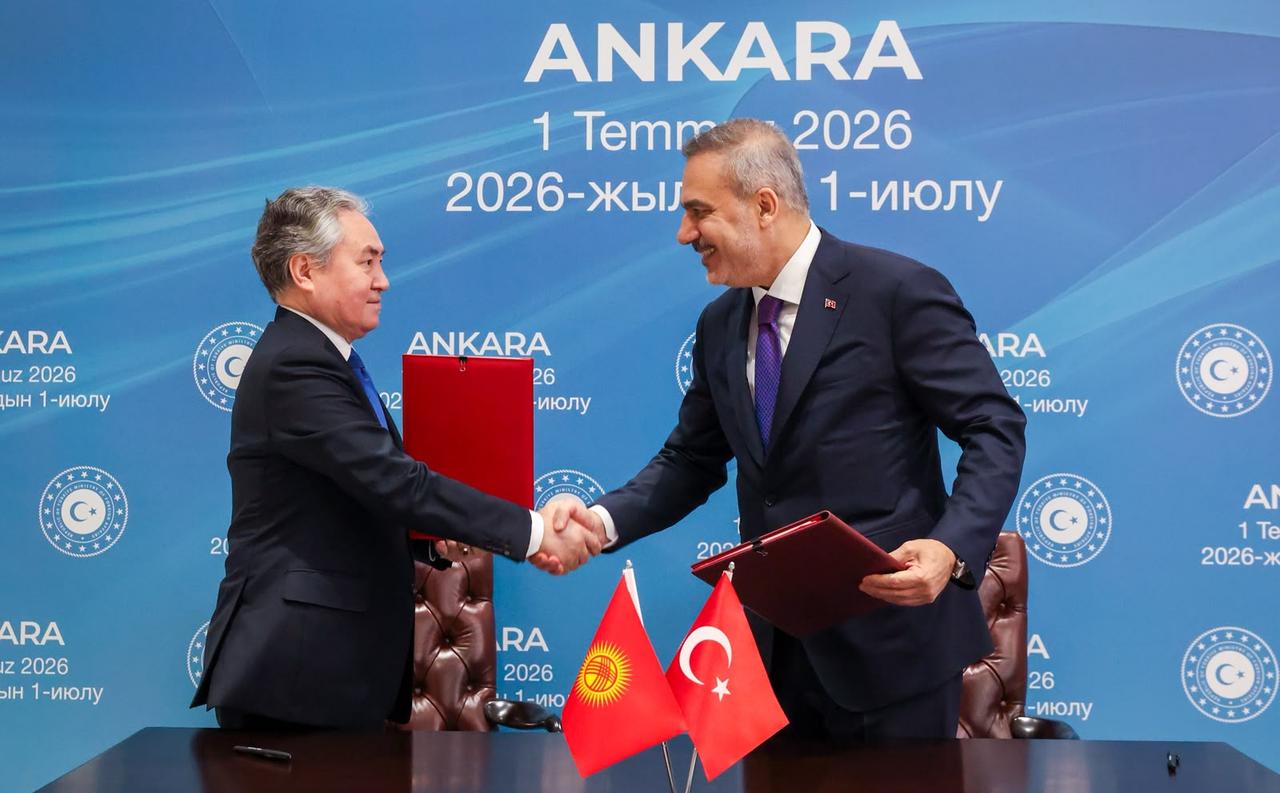
Fidan spoke at a joint news conference after the seventh meeting of the Türkiye-Kyrgyzstan Joint Strategic Planning Group in Ankara, co-chaired by Fidan and Kyrgyz Foreign Minister Jeenbek Kulubayev.
Responding to questions from reporters, Fidan addressed Türkiye-EU relations, the upcoming NATO summit in Ankara, regional connectivity, defense industry cooperation and ties with Kyrgyzstan.
Asked about his meeting with European Union officials in Ankara on Tuesday and the course of Türkiye-EU relations, Fidan said Türkiye's full membership in the bloc remains one of Ankara's strategic goals.
"Türkiye's full membership in the EU is one of our strategic goals. Our president has had a strong will and vision on this issue from the very beginning," Fidan said.
Fidan said that as the minister responsible for the issue, he was working to put that vision into practice.
"Yesterday's visit by the EU delegation was truly an important visit. The fact that three commissioners visited at the same time and that we had the opportunity to put many issues on the table was an important stage for us as well," he said.
Fidan said the Türkiye-EU relations had recently been moving "on a more constructive path with a certain momentum," adding that Ankara was pleased with the increasing level of contacts and constructive steps.
He said high-level Türkiye-EU dialogue meetings had been restarted in several areas, including the economy, trade, migration, security, science, research and technology. He added that the European Investment Bank had partially resumed its activities in Türkiye.
"Türkiye has an interest in SEPA, which we call the Single Euro Payments Area. The relevant financial and technical units are working on this issue," he said.
Fidan said he discussed foreign policy, connectivity, energy, transportation, trade, migration and visa issues with EU foreign policy chief Kaja Kallas, EU Commissioner for Enlargement Marta Kos and Commissioner for Home Affairs and Migration Magnus Brunner.
He said the talks also covered global and regional security, ongoing crises and wars, Russia-Ukraine, Iran, the Strait of Hormuz and what he called Israeli expansionism.
"On connectivity, the EU very clearly assesses both the significant benefit of the transportation infrastructure Türkiye has put forward and the role Türkiye can play in connectivity geographically," Fidan said.
"It also very well assesses the vision and capacity of the leadership in Türkiye on this issue," he added.
Fidan said the sides discussed how to activate new logistics routes on north-south and east-west axes and how to make better use of existing routes.

Fidan said there was strong interest on both sides in modernizing the Customs Union, but that the Greek Cypriot administration continued to block progress.
"But because the Greek Cypriot administration has a certain blockage on this issue, steps cannot be taken at the desired pace," he said.
Fidan said some EU decisions require the participation of member states, while others can be taken by majority vote. But he said member states sometimes block one another's priorities when they fail to get what they want in other areas.
"What we see is this: The overwhelming majority of the EU is in favor of updating the Customs Union," he said.
Fidan said the current trade volume, which is approaching $250 billion, has the potential to double or triple, adding that updating the Customs Union would benefit both sides.
He said Ankara and Brussels were exploring how to move the issue forward under current conditions.
Fidan said migration and visa issues were also important as Türkiye's integration with Europe deepens and travel increases among businesspeople, students, artists and tourists.
"There is demand from Türkiye on this issue. They think they are doing their best in their own way, but we think there should be even further cooperation on this issue," he said.
Fidan said the EU introduced gradual visa facilitation, known as the cascade system, last year, but added that it should be taken further.
He also said certain conditions need to be implemented for a visa liberalization agreement to be concluded, adding that the sides had shared programs on the matter.
Fidan said Ankara expected relations with the EU to advance further institutionally and in a more planned and result-oriented way.
"Our expectation is that our relations with the EU will advance further in institutional terms and be in a structure that is more planned, programmed and produces concrete outputs," he said.
He said all Turkish ministries and institutions had been instructed by President Recep Tayyip Erdogan to work in this direction.
"As you know, our bilateral relations with EU members are truly exceptionally good, except for one or two," Fidan said. "Commercial, political, economic—there is no problem. But when they come together as an institution, we see that the average of these relations cannot be reflected in the EU's institutions."
Fidan said Türkiye would identify those problems and work to overcome them systematically.
Fidan said Türkiye would host a NATO summit again 22 years after the alliance's 2004 summit in Istanbul.
He said decisions taken at the last two summits would be reviewed at the Ankara summit, particularly under the heading of burden-sharing.
"In particular, under the heading of burden-sharing, how the principle that NATO members enter into a common burden-sharing and put forward common effort for the security of the alliance is being implemented in practice will be put on the table again," he said.
Fidan said perspectives on "NATO 3.0," an alliance approach adapted to new global conditions, would also be discussed.
He said European deterrence was increasingly coming to the fore.
"The main problem at the moment is the threats of war and instability in the region where Europe is located," Fidan said, adding that NATO's possible and existing challenges in this area would be addressed.
"The fact that this is being held in Türkiye once again demonstrates and reinforces Türkiye's strategic importance and its role within NATO," he said. "This is truly a matter of pride on behalf of our state and our nation."
Fidan said Türkiye's hosting of major historic summits was a result of Erdogan's long-term leadership.
"Leadership that is respected in the world emerges before us as a game-changing tool in Türkiye's foreign policy and regional policy," he said.
Fidan said Turkish civil society organizations, institutions and think tanks would organize events alongside the NATO summit, including the NATO Defense Industry Forum.
He said defense industry issues had become one of NATO's most important agenda items.
Fidan said previous NATO discussions had focused mainly on the assessments and military preparations of combat units and intelligence elements.
"But recent wars have now shown that productivity, efficiency, diversity and the rate of dependency in the defense industry are equally important issues," he said.
"This is now showing itself both at the level of leaders and at the level of events," he added.
Kyrgyz Foreign Minister Jeenbek Kulubayev said he held a productive and comprehensive meeting with Fidan.
"Our talks took place in an atmosphere of full mutual understanding, openness and trust," Kulubayev said. "This clearly demonstrates the common will of our countries to further strengthen and develop cooperation."
Kulubayev said the sides reviewed the current state of Kyrgyzstan-Türkiye relations and discussed concrete steps to deepen cooperation.
He said preparations were also discussed for reciprocal visits by Kyrgyz President Sadyr Japarov to Türkiye and Erdogan to Kyrgyzstan.
Kulubayev said trade, economic and investment cooperation were among the priority agenda items.
He said the two countries confirmed their readiness to provide strong political support for mutually beneficial investment initiatives and create favorable conditions for joint projects.
Kulubayev also said Kyrgyzstan attached special importance to developing cooperation with Türkiye in cultural, humanitarian and educational fields.
"We also exchanged views on creating more favorable conditions for our citizens to live, work and study, and on further facilitating mutual visits between the brotherly Kyrgyz and Turkish peoples," he said.
Kulubayev said he believed his visit would make a major contribution to relations between the two countries.
"I sincerely believe that today's visit and the existing agreements will give new momentum to the further development of the comprehensive strategic partnership between Kyrgyzstan and Türkiye, and will further strengthen the friendship, mutual trust and understanding between our brotherly peoples," he said.
"We always support the reforms in Türkiye and Türkiye's mediation efforts," he added.
Kulubayev said Türkiye plays an important mediation role in ensuring peace in the region and resolving crises.
"I wish success to Mr. Recep Tayyip Erdogan and Mr. Hakan Fidan in these efforts," he said.
Kulubayev thanked Fidan for his hospitality and invited him to pay an official visit to Kyrgyzstan.
Kulubayev also highlighted the strategic importance of regional transportation projects.
"For us, the Middle Corridor is one of the most important routes," he said.
He said Kyrgyzstan aims to connect to the Middle Corridor through the construction of the China-Kyrgyzstan-Uzbekistan railway.
"In the meeting, we expressed our intention to open up to Europe and Arab countries through Türkiye via this line," he said.
Kulubayev said the sides also discussed Kyrgyzstan's non-permanent membership of the U.N. Security Council for the 2027-2028 term.
He said regional and global security issues were discussed in detail.
"We agree on ensuring global and regional security. We agree that conflicts in the world should be resolved through peace, dialogue and diplomacy," he said. "We agreed that issues should be resolved through diplomacy within the framework of international law."
Kulubayev thanked Türkiye for its support for Kyrgyzstan's election as a non-permanent member of the U.N. Security Council for the 2027-2028 term.
"I take this opportunity to express my gratitude to our honorable minister, the Turkish Foreign Ministry and embassies in all countries for their contributions to this strategic achievement," he said.
Kulubayev said Kyrgyzstan aims to serve as a constructive member that can build bridges between different views and interests.
"We adopt an approach that prioritizes dialogue, cooperation and diplomacy instead of conflict," he said.
He said Kyrgyzstan was determined to contribute to strengthening the effectiveness of the U.N. in maintaining international peace and security.
Kulubayev said Kyrgyzstan's priorities at the Security Council include stronger defense of the interests of mountainous countries, landlocked developing countries and small island states.
He said Kyrgyzstan was ready to continue close cooperation with African, Pacific, Latin American and Caribbean countries.
"As Kyrgyzstan, we are ready to share with the international community our experience in resolving border issues through peaceful means and building mutual trust through diplomatic methods," he said.


 Set as preferred source
 Set as preferred source


 2 min read
 1 min read