Newsletters




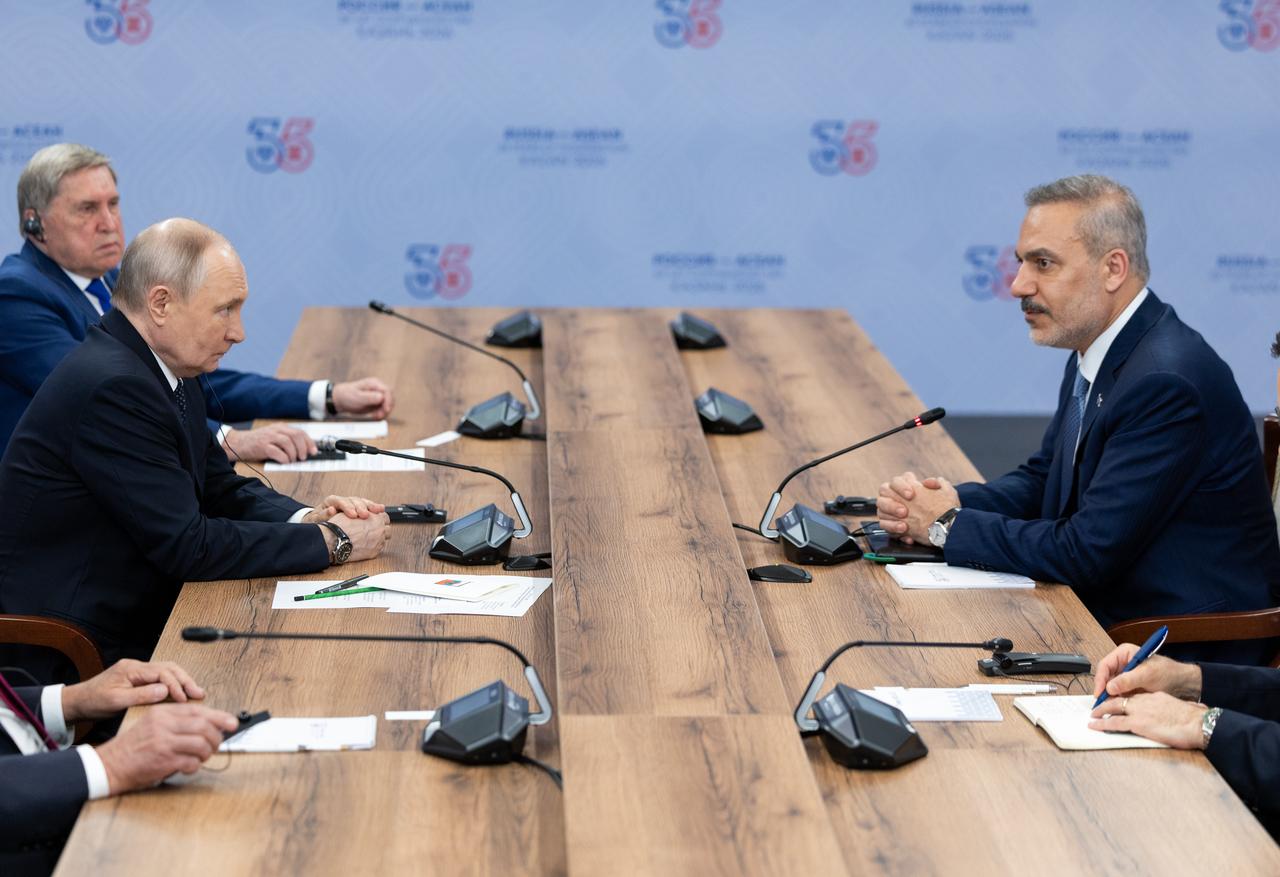
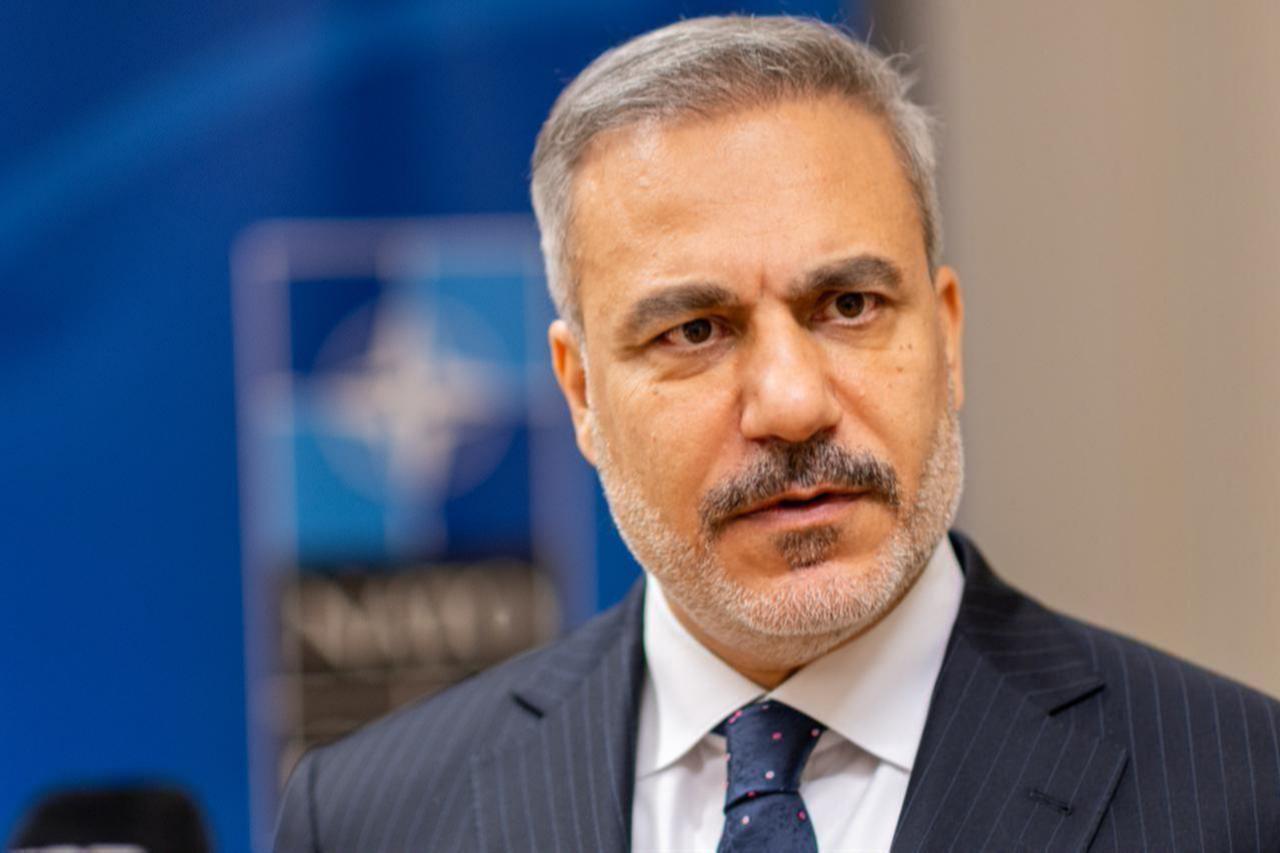
Foreign Minister Hakan Fidan met with Russian President Vladimir Putin in Kazan on Wednesday during an official visit to Russia that also saw him receive an honorary doctorate from one of Moscow's most prestigious diplomatic academies.
Putin received Fidan at the Tatar capital alongside Foreign Minister Sergey Lavrov and Kremlin foreign policy adviser Yuriy Ushakov.
Opening the meeting, Putin struck an overtly warm tone, saying relations between the two countries were "developing steadily" and that bilateral contacts had "already gone beyond the official framework and acquired a friendly character," crediting that shift in large part to President Recep Tayyip Erdogan.
Putin asked Fidan to convey his "best wishes" to Erdogan and said Russia was "always glad to welcome him" in Moscow.
Fidan passed along Erdogan's greetings and noted the breadth of issues pressing on both governments. "There is a very intense agenda in our region and in the world," he said.
"Your experience on this matter is extremely important. There are many issues we need to consult on."

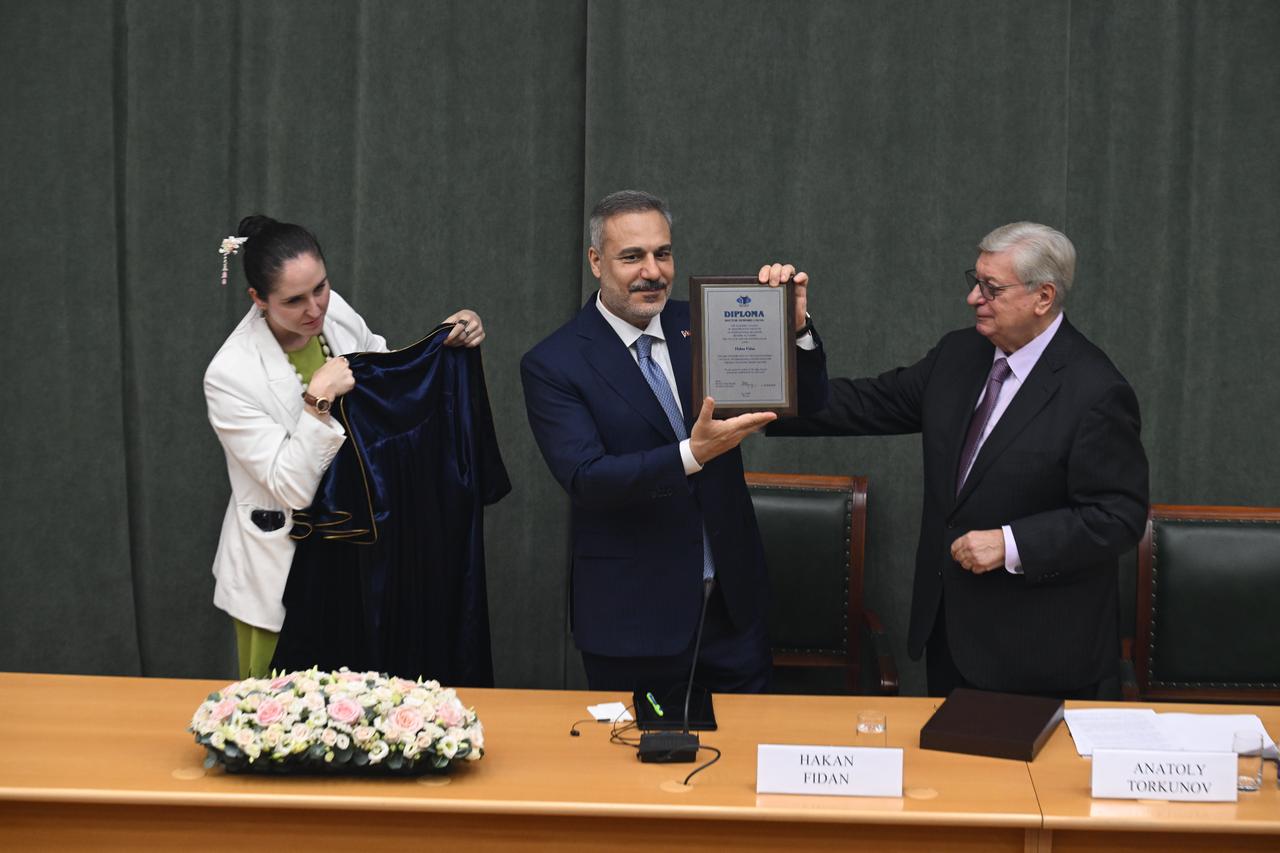
Earlier in the visit, Fidan was awarded an honorary doctorate by the Moscow State Institute of International Relations, known by its Russian acronym MGIMO, during a ceremony presided over by Rector Anatoly Torkunov.
Founded in 1944 as a diplomatic training school under the Soviet government and now operating under Russia's Ministry of Foreign Affairs, MGIMO has produced generations of senior Russian diplomats and statesmen, including Lavrov himself.
The institute has previously conferred honorary degrees on foreign leaders including former French President Nicolas Sarkozy and former European Commission President Romano Prodi.
Fidan used his acceptance speech to deliver an expansive account of where he sees the Türkiye-Russia relationship standing and where he believes it must go.
He framed the honor not merely as personal recognition but as a symbol of respect for "the long-standing relationship between Türkiye and Russia and the mutual understanding linking the two peoples."
He paid tribute to the late Russian Ambassador Andrey Karlov, a fellow MGIMO graduate, saying his legacy remained proof of "the unifying power of diplomacy."
Karlov was shot and killed at an art exhibition in Ankara in December 2016, an assassination that both countries blamed on elements seeking to drive a wedge between them.
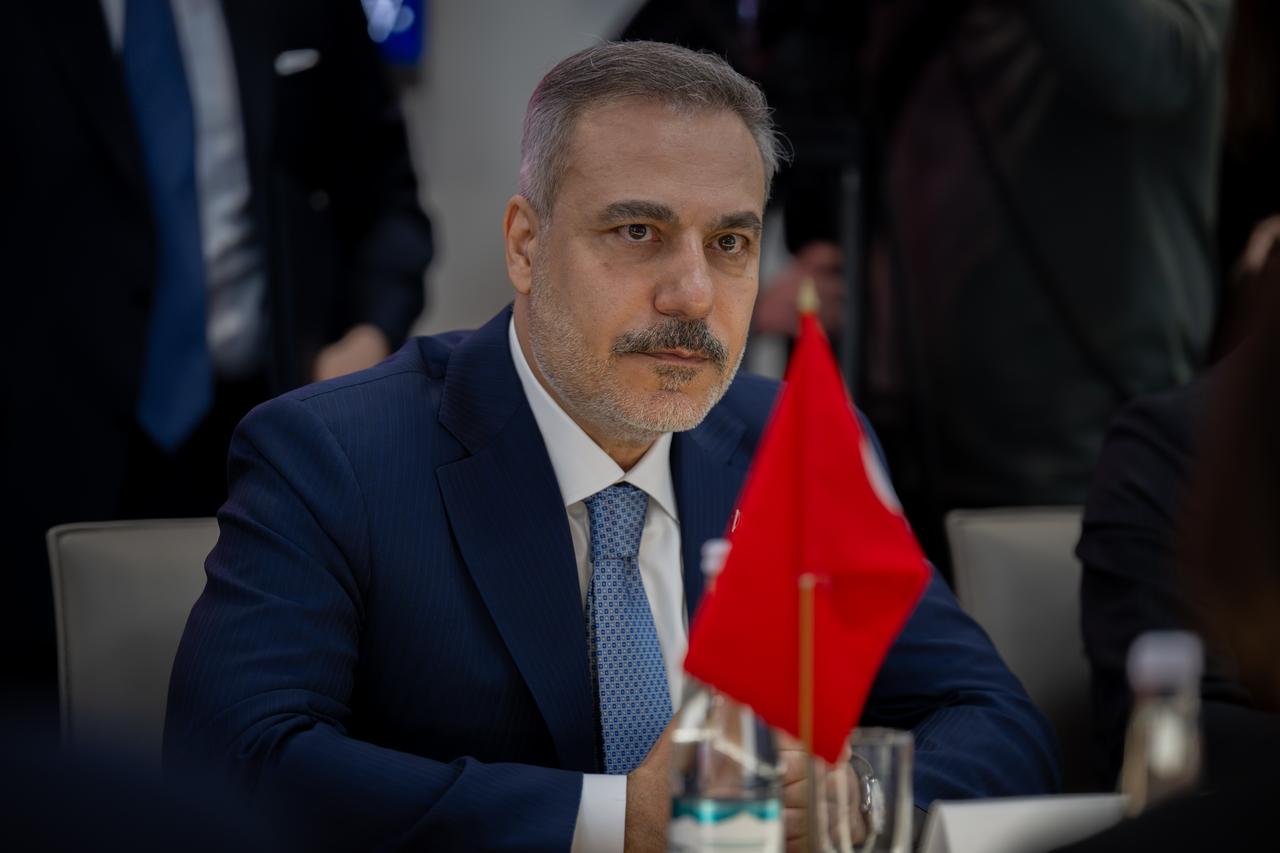
Fidan told his audience that the world was moving toward a multipolar order but warned the transition carried serious dangers.
As the old global paradigm loses influence and a new one has yet to fully form, he said, the margin for strategic miscalculation had become "dangerously narrow."
He addressed the recent tension between the United States, Israel and Iran directly, saying the crisis had placed significant pressure on countries across the region.
Fidan welcomed a US-Iran deal as "a relief," saying Türkiye and regional partners had worked actively toward that outcome, and called for the understanding to be converted into a lasting and comprehensive peace arrangement.
"This region must never again be exposed to such tension," he said, stressing that diplomacy remained the only effective instrument for resolving disputes.
He also argued that durable security for the Middle East could not be delivered by outside powers.
"Lasting stability cannot be based on a framework that leaves one of the continent's main actors outside the equation," he said, a line he applied equally to the question of Russia's place in any future European security architecture.
Ankara's position, Fidan said, had always been that any European security arrangement that did not address Russia's role would remain fundamentally incomplete.
Fidan pointed to the breadth of practical ties underpinning the relationship.
Bilateral trade between the two countries now exceeds $50 billion, he said, while economic interdependence had reached what he described as a highly advanced level.
Energy cooperation continued to deepen, with the Akkuyu Nuclear Power Plant, being built by Russia's state nuclear company Rosatom on Türkiye's Mediterranean coast, serving as the clearest symbol of the strategic partnership.
Nearly seven million Russian citizens visited Türkiye last year, Fidan noted, with hundreds of thousands living, working or studying in Turkish cities.
He described Türkiye and Russia as neighbors positioned at "the strategic center" of the world's most consequential regions, from the Black Sea and the Caucasus to the Middle East and wider Eurasia, and argued that stability in those areas was essential to the national security and economic prosperity of both countries.
On the war in Ukraine, Fidan pointedly observed that Türkiye had remained the only regional actor to maintain meaningful contacts with both Russia and Ukraine throughout the conflict.
He noted that some of those who once criticized Ankara for hosting direct talks between Moscow and Kyiv were now themselves debating the need to reopen channels of communication with Russia.
"This maturity was not built overnight," Fidan said of the bilateral relationship, describing it as the product of "sustained diplomacy, mutual respect and trust between the two countries' leaders."
He closed by saying the Türkiye-Russia strategic partnership had already expanded beyond continental boundaries, with the two countries' strategic interests and concerns intersecting across virtually every major item on the international agenda.


 Set as preferred source
 Set as preferred source


 2 min read
 1 min read