Newsletters




Women made up about 44% of scientists and engineers in Türkiye in 2025, according to Eurostat figures released Tuesday.
The data show 707,200 women among 1.59 million professionals in the field. The share is above the 41% recorded across the European Union in 2025, when women made up 8.2 million of the bloc’s 20.2 million scientists and engineers, according to Eurostat.
Men numbered 882,300 among Türkiye’s scientists and engineers.
Istanbul, classified as region TR1 under the Nomenclature of Territorial Units for Statistics (NUTS 1), the standard system for dividing countries into regions for statistical purposes, had the highest number of women in the field. The region counted 175,500 female scientists and engineers out of 393,500, a 45% share.
West Anatolia, which includes the capital Ankara, followed with 123,700 women out of 272,100, also a 45% share. Aegean had 94,400 women out of 224,400, a 42% share, and Mediterranean had 85,200 out of 178,100, or 48%.
East Marmara recorded 70,200 women out of 168,300, a 42% share.
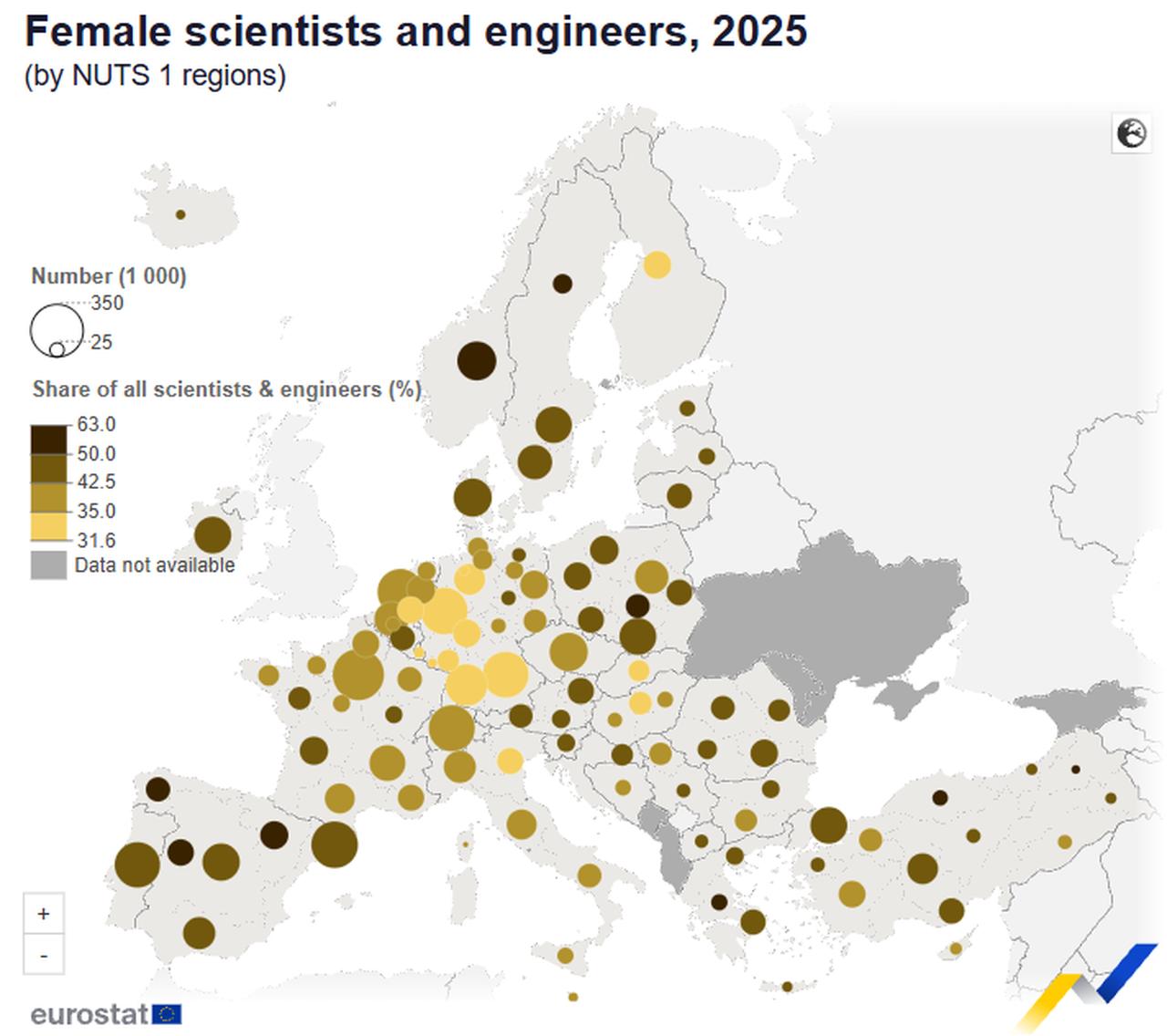

Women made up slightly more than half of scientists and engineers in two regions. In West Black Sea, 32,000 of 63,800 were women, a 50% share. In Northeast Anatolia, 10,100 of 20,100 were women, also 50%.
Central Anatolia had a 47% share, with 26,900 women out of 56,800, and the East Black Sea region had 47%, with 17,200 out of 36,700. Southeast Anatolia had the lowest share among the 12 regions, at 36%, with 27,100 women out of 75,600.
The figures on the EU come from Eurostat, the European Union’s statistical office, which compiles them from the EU Labour Force Survey, a household survey of employment conducted across member states.
The data cover 2025. In the EU, women made up 40.8% of scientists and engineers that year, up only 0.5 percentage points over the past decade, though their number rose 54.4%, from 5.3 million in 2015 to 8.2 million in 2025, Eurostat said.
Germany had the largest number of scientists and engineers in the bloc, at 4.2 million. Country-level data for 2024 show wide differences among European nations.
Women’s share was highest in:
The lowest shares were in:


 Set as preferred source
 Set as preferred source


 1 min read


 1 min read