Newsletters




Twenty-five years ago this week, the world changed. Or so everybody said.
In New York, Washington, and 65 miles southeast of Pittsburgh, the wreckage was still smoking when the machinery began to move. America was going to war. Alliances were summoned. Maps unfolded. Old friendships were tested.
Türkiye stood tall with the United States.
It was NATO’s great Muslim power, guardian of the alliance’s southeastern flank and, for Americans, proof that the coming war was against terrorism, not Islam.
Indeed, less than a year after 9/11, a Turkish general took command of the international security force in Kabul. He was already agonizing about the next war.
“If there’s a war in Iraq,” Major General Hilmi Akin Zorlu forewarned, “there may be many sympathizers throughout Afghanistan.”
Operation Enduring Freedom had taken America to Afghanistan. Operation Iraqi Freedom would take it somewhere far more dangerous for its relationship with Türkiye.
In March 2003, Washington expected Türkiye to let American troops invade Iraq from the north.
Türkiye's Parliament said no.
Chalk it up as the first great rupture of the post-9/11 alliance.
Washington had learned that terrorism required projecting power outward. Ankara had learned something different: American power could set fire to the neighborhood.
Years later, former U.S. ambassador Ross Wilson said the vote sent relations “into a tailspin and shattered our concept of strategic partnership.”
The important word was "concept."
The alliance survived. The assumptions beneath it did not.
Former Iraqi President Saddam fell. Iraqi Kurdistan consolidated its autonomy. The regional order cracked open. Ankara watched the pieces move along its border.
Then Syria exploded.
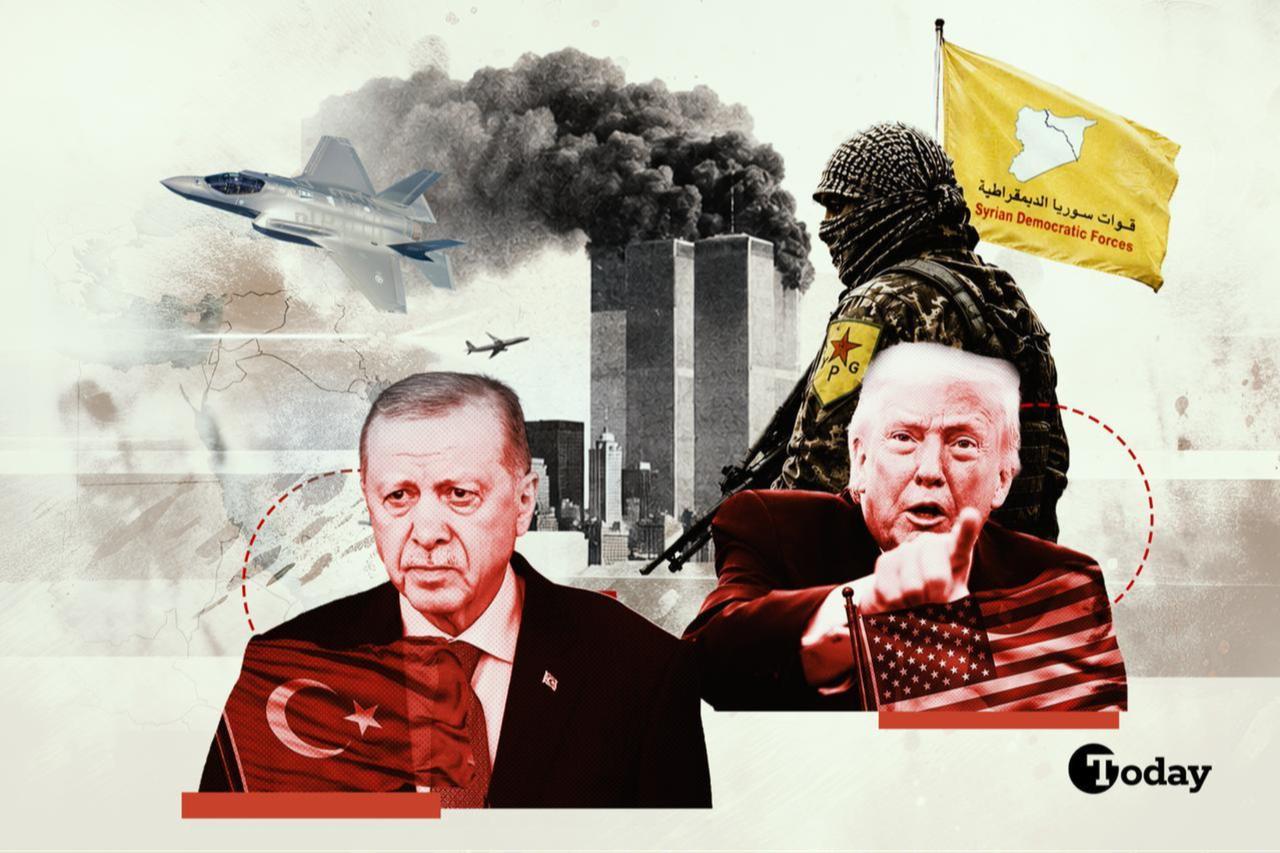
By 2014, Daesh (known in the West as ISIS) had carved out its obscene empire across Syria and Iraq. America needed men willing to fight on the ground. Washington found them among Syria’s Kurds.
The Kurdish-led Syrian Democratic Forces became America’s indispensable partner against Daesh.
There was a problem.
Türkiye regarded the SDF’s main Kurdish component, the YPG, as an extension of the PKK, its mortal enemy.
By now, the war had become an alphabet soup of menace: PKK, YPG, PYD, SDF, and Daesh—enough acronyms to make the average American reach for the remote and surrender unconditionally. In Washington, they meant crucial distinctions of war and diplomacy; back home, they might as well have been airport codes from hell.
The War on Terror had begun to eat its own logic.
Two NATO allies agreed that terrorism was the enemy. They could no longer agree on who the terrorists were.
American soldiers worked alongside Kurdish fighters. Türkiye was considered a grave threat. Turkish troops crossed into Syria to push those same fighters from its border.
By 2018, President Recep Tayyip Erdogan had stopped disguising his anger.
"Think of our strategic partner engaging in such acts," he told PBS, adding that it was sad for the country to see this and that "it was wrong."
For Washington, the Syrian Kurds had helped defeat Daesh.
For Ankara, America had chosen an armed group over its NATO ally.
Both statements could be true.
Somewhere between Kabul and Kobani, the old logic of the alliance disappeared.
The mistrust spread. After the failed Turkish coup of 2016, Ankara grew still more suspicious of Washington. Then Türkiye did something once almost unimaginable for a major NATO power.
It bought a Russian S-400 missile system.
Washington threw Türkiye out of the F-35 program and imposed sanctions.
Consider the distance traveled. In 2002, a Turkish general commanded the international mission in Kabul, born from the aftermath of Sept. 11.
Seventeen years later, America expelled Türkiye from its most advanced fighter program for buying Russian weapons.
It looked like the end, but geography has a sense of humor.
Here we are in 2026. Former Syrian President Bashar al-Assad is gone. Syria has been transformed. The Kurdish autonomous project Washington supported for years is being dismantled as its forces more or less integrate into the new Syrian order. Türkiye has emerged as one of the most powerful outside players in Damascus.
And Washington needs Ankara again.
It needs Türkiye in NATO, on the Black Sea, and in any calculation involving Russia. It needs Turkish influence in Syria. Ankara, for its part, still needs American weapons, markets, and political weight. The two governments are again searching for a way through the S-400 dispute and the wreckage it made of Türkiye's place in the F-35 program.
After a quarter-century of quarrels, sanctions, and strategic whiplash, U.S. President Donald Trump offered a rather different diagnosis during his July visit to Ankara: “The relationship with Türkiye right now is probably better than it's ever been.”
Neither side has forgotten what happened.
Neither can afford simply to walk away.
The circle has not closed. But it has turned.
Sept. 11 pulled America and Türkiye together. The wars it unleashed helped drive them apart. Now, the world those wars created is pushing them toward each other again.
That’s perhaps the real legacy of these 25 years.
The old alliance was built on simple things. Both countries belonged to NATO. Both opposed the Soviet Union. Türkiye guarded the southeastern frontier. America supplied the muscle.
Sept. 11 ended that simplicity.
Afghanistan showed how closely they could cooperate. Iraq showed how differently they saw the world. Syria turned those differences into open conflict. Russia showed how far Ankara would wander when it believed Washington had stopped listening.
Still, Türkiye remains where it has always been: between Europe and Asia, Russia and the Middle East, and the Black Sea and the Mediterranean.
There's an episode in the 1967 film “Cool Hand Luke” when the prison captain surveys the wreckage of his relationship with Paul Newman’s defiant Luke and delivers one of cinema’s immortal verdicts: “What we have here is failure to communicate.” Later, Newman throws the line back at him.
Washington and Ankara could have been writing the sequel.
For 25 years, they have talked past each other about Iraq, Kurds, Syria, Russia, terrorism, and what, exactly, an ally owes an ally. Each believes the other should have understood by now.
Neither has left.
That is why this alliance will eternally survive its own funeral.
It’s not a marriage. Much of the time, it’s barely a friendship.
It is two countries chained to the same dangerous geography. They distrust each other. They disappoint each other. Occasionally, they infuriate each other.
And when the next crisis arrives, they pick up the telephone.
Twenty-five years after Sept. 11, that is what remains of the strategic partnership.
Not trust. Not Affection. Necessity.


 Set as preferred source
 Set as preferred source


 1 min read
 1 min read