Newsletters


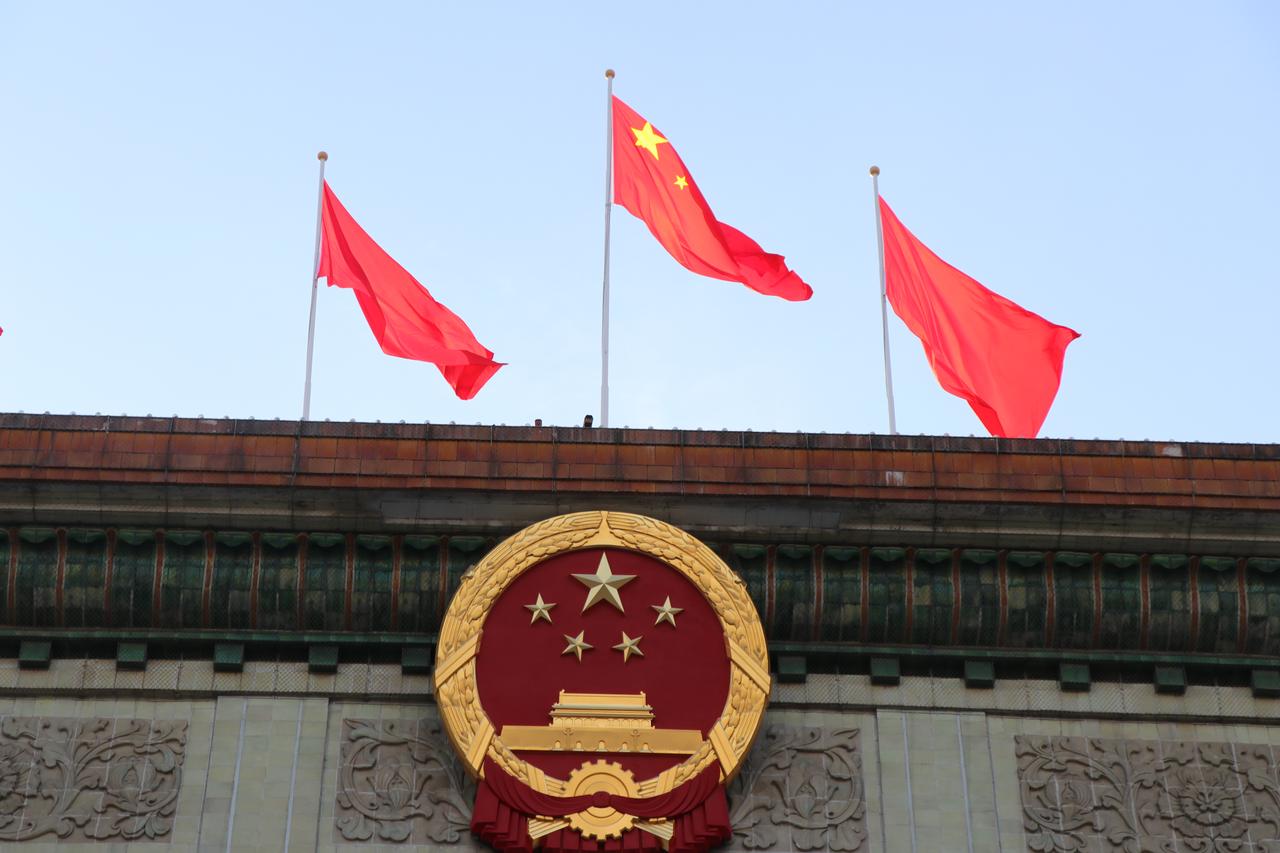


China's decision to court Taiwan’s opposition Kuomintang while freezing out its elected government is not a sincere move toward reconciliation, but a calculated maneuver to exploit internal divisions.
By rewarding political alignment with its own preconditions, China is systematically reshaping the terms of cross-strait dialogue to suit its own interests.
The most revealing aspect of KMT Chairwoman Cheng Li-wun's April 2026 visit to Beijing is not who was in the room, but who was deliberately excluded. The KMT—Taiwan's largest opposition party and the political heir of the nationalist government that fled to the island in 1949—has historically favored closer ties with Beijing.
The governing Democratic Progressive Party (DPP), led by President Lai Ching-te, maintains the opposing stance. The party asserts a distinct Taiwanese identity and rejects Beijing's territorial claims over the island.
China cut off high-level contact with Taipei after the DPP's 2016 presidential election victory and has maintained that freeze ever since, refusing to deal with any DPP administration on the grounds that its leaders are separatists. A decade later, nothing has structurally changed.
This is not diplomacy in any conventional sense. A government that’s truly serious about making peace would sit down with the people actually in charge. Instead, Beijing treats meetings with President Xi Jinping and invitations to the Great Hall of the People like prizes. They’re rewards handed out only to those willing to sign off on their ultimate deal-breaker: the 1992 Consensus.
That consensus, which grew out of informal talks in Hong Kong back in 1992, rests on the idea that there is only "one China" and that both Taiwan and the mainland belong to it. Crucially, however, it leaves room for interpretation, allowing each side to define exactly what "one China" means according to its own perspective.
For Beijing, this ambiguity is useful; it plants the flag of sovereignty while permitting temporary flexibility. During their meeting, Cheng herself echoed the precondition directly, calling for both parties to uphold "the common political foundation of adhering to the 1992 Consensus and opposing Taiwan independence", the exact framing Beijing has always demanded.
Xi underscored this point by making it clear that he is only willing to engage with Taiwanese political parties if they stand on that same foundation. In his view, it remains the non-negotiable price of admission for any dialogue. While the KMT has long been willing to meet those terms, Cheng aligns with Beijing on the core opposition to Taiwanese independence. He maintains that both sides belong to one China, even while stopping short of endorsing full unification.
The historical backdrop deepens the irony. As Rana Mitter, a historian of modern China and professor of U.S.-Asia Relations at the Harvard Kennedy School, explains, the two political systems have diverged significantly since the 1990s. Taiwan democratized fully by the early 1990s and today operates as a multiparty liberal democracy with a free press and regular competitive elections.
China, by contrast, has consolidated one-party rule under the Chinese Communist Party, tightening political control further under Xi since 2012. This divergence makes Beijing's insistence on shared identity increasingly an assertion of political will rather than an observable reality. By rewarding the KMT and punishing the DPP, Beijing is not bridging this gap; it is trying to determine which political force governs Taiwan by controlling the terms under which engagement is possible.
On the final day of Cheng's six-day visit, April 12, Chinese state media unveiled a package of 10 policy measures framed as a gesture of goodwill toward Taiwan. The announcements have been widely interpreted as an economic opening. On the surface, some measures have genuine appeal: they include plans to resume individual tourist travel to Taiwan by residents of Shanghai and Fujian Province, a resumption that has been suspended since the COVID-19 pandemic, and a push for the full normalization of direct cross-strait passenger flights that were severely reduced during the same period.
Beijing also signaled willingness to lift bans on certain Taiwanese aquaculture imports, a particularly sensitive issue for fishing communities in southern Taiwan that have repeatedly borne the brunt of Chinese trade restrictions. The KMT welcomed the package enthusiastically, with party vice chairpersons forming a task force to coordinate implementation.
But Taiwan's own government institutions offered a colder reading. The Mainland Affairs Council (MAC), the government body responsible for overseeing Taiwan's China policy, said that Beijing's so-called unilateral concessions are merely poisoned pills packaged as generous gift packages. It added that while Taiwan supports healthy cross-strait exchanges, these should never be subject to political preconditions.
The MAC also drew attention to a troubling historical pattern: virtually identical measures, covering imports, tourism, and flights, have been rolled out and then suspended by Beijing multiple times in the past, each time without any institutional framework to protect Taiwanese businesses, farmers, or workers from sudden reversals.
That pattern is not accidental. China's own official position, as stated in documents from its Ministry of Foreign Affairs, holds that Taiwan is a sacred and inseparable part of Chinese territory and that peaceful reunification is a historical mission of the Communist Party. The "one country, two systems" framework, the same arrangement once promised to Hong Kong before Beijing systematically dismantled that city's political autonomy after the 2019 protests, offers Taiwan a degree of local autonomy in exchange for accepting Chinese sovereignty.
Taiwan's public has rejected this model, particularly after watching its application in Hong Kong collapse in real time. The 10 measures are best understood as the soft edge of that same framework: economic normalization dangled before Taiwanese industries and voters to gradually shift domestic calculations and create pressure on whichever government is in power to accommodate Beijing's terms.
Cheng Li-wun's visit was not simply driven by ideological proximity to Beijing. It was also a response to a specific and anxious geopolitical moment.
The Trump administration has sent mixed signals about America’s commitment to Taiwan’s security, creating uncertainty over arms sales and diplomatic support. This has led to genuine unease among the Taiwanese public, with many questioning whether the island can still rely on Washington as its primary security guarantor.
George Yin, a senior research fellow at the Center for China Studies at National Taiwan University, told NPR that the visit is less a peace initiative than a political positioning exercise. Cheng is channeling public unease about American unpredictability into an argument that Taiwan needs a party capable of keeping channels to Beijing open, regardless of who sits in the White House.
Cheng framed the trip publicly as a peace mission and a demonstration that communication with Beijing is possible. She sidestepped direct questions about unification, saying her goal was reconciliation rooted in shared history and culture.
Yet the language she chose in her public remarks was strikingly close to Communist Party talking points: she praised Beijing's record on poverty alleviation, a signature achievement in Xi's domestic narrative, and invoked the concept of the "great rejuvenation of the Chinese nation," a phrase that carries unmistakable ideological weight in the CCP's political vocabulary. That rhetorical alignment gave ammunition to critics at home.
An April poll showed the KMT commands less than a third of public support in Taiwan, a figure that reflects both the party's minority status and the broader public wariness toward overtures that appear to compromise Taiwan's political autonomy.
The structural difficulty for the KMT is that its position, opposing independence without endorsing unification, seeking dialogue without fully accepting Beijing's preconditions, occupies a shrinking and unstable middle ground. Taiwan's Presidential Office responded to the visit by stating that cross-strait exchanges should not be subject to political preconditions and should not be used as tools for political maneuvering by specific parties. The statement was directed not only at Beijing but implicitly at the KMT, signaling that the ruling DPP government views the trip as an attempt by the opposition to conduct a parallel foreign policy that undermines Taiwan's official stance and gives Beijing a domestic lever to pull.
The meeting between Xi Jinping and Cheng Li-wun at the Great Hall of the People was symbolically striking, the first KMT chairperson to lead a delegation to mainland China in nearly a decade, greeted by the most powerful Chinese leader since Mao Zedong. But symbolism is itself a tool of statecraft, and Beijing deploys it with precision. What emerged from the visit is less a new chapter in cross-strait relations than a restatement of the terms China has always insisted upon: engage on our framework, or not at all.
The 10 measures may ease life for some industries and travelers on both sides of the strait, and the KMT may gain short-term political capital from being the party that kept a door open.
Yet Taiwan’s democratic institutions have seen this script before. The long arc of cross-strait history—from the 1949 split to the eroded promises of Hong Kong’s autonomy—reveals a consistent strategy. Today, that strategy pairs periodic economic incentives with near-daily military incursions into Taiwan’s airspace. It is a story of engagement that is always conditional, tied to an outcome Beijing has already decided upon. In the end, the KMT visit didn't change this calculus; it perfectly illustrated it.


 Set as preferred source
 Set as preferred source


 7 min read