Newsletters


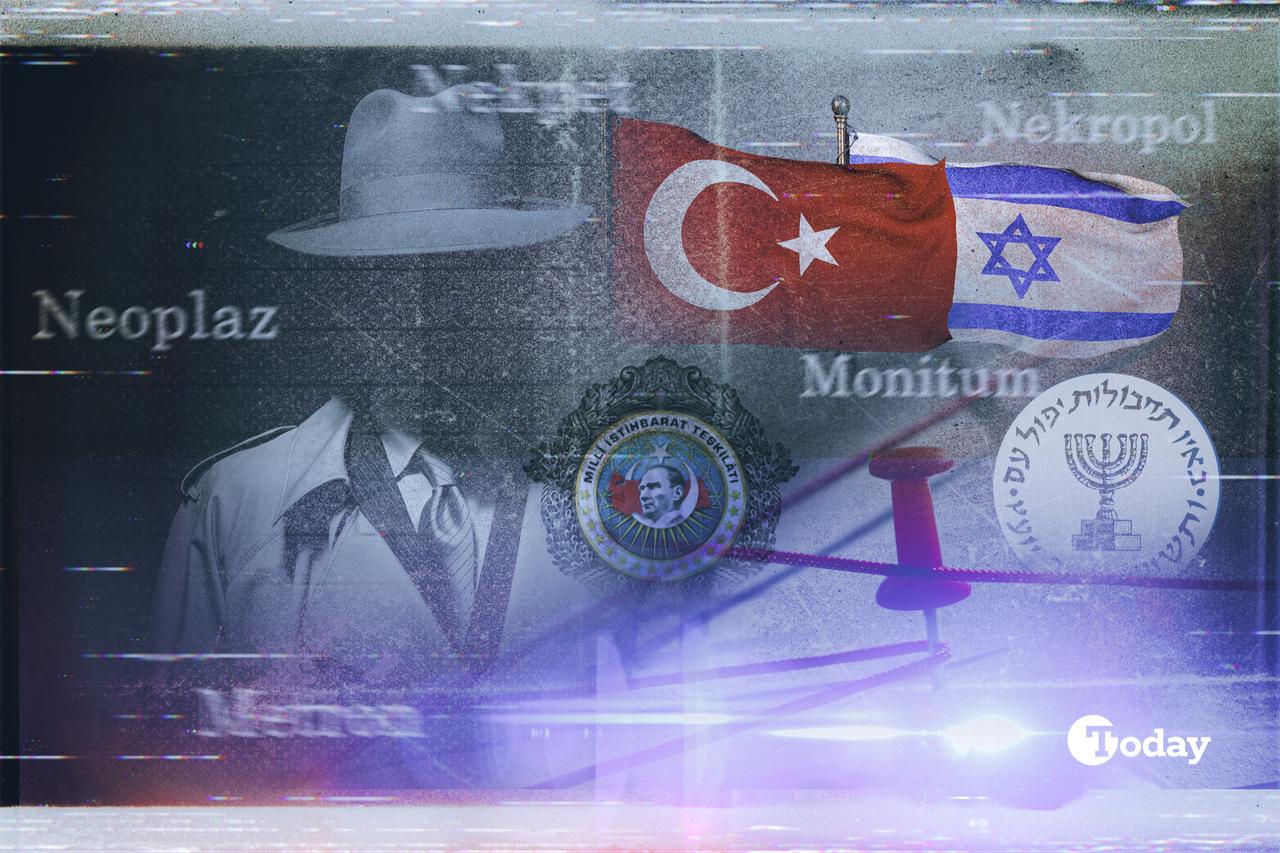


Since 2021, Türkiye’s National Intelligence Organization (MIT) has been carrying out a series of operations targeting networks linked to Israel’s Mossad operating inside the country. The investigations revealed that Mossad’s activities in Türkiye focused primarily on monitoring and tracking Palestinians and Iranian individuals living there.
Authorities also found that these operations did not rely only on people from the Middle East. Mossad networks allegedly recruited local assets as well—Turkish citizens who had access to Palestinian targets and could help gather information.
Taken together, the findings suggest that the intelligence rivalry playing out on Turkish soil has moved beyond purely technical surveillance. It now reflects a deeper structural and strategic contest between intelligence services.


The process began in 2021 with the operation codenamed Muteni and later expanded through Neoplaz, Nekpet, Nekropol, Metron, and Monitum, reflecting a broad counterintelligence campaign carried out by the MIT.
Through these operations, MIT systematically sought to detect, decipher, paralyze and eliminate Mossad’s network in Türkiye, while also assessing its overall impact and delivering a strategic message. The code names were not simply technical labels; they served as conceptual markers that reflected the different phases, objectives, and strategic direction of the operations.
The first operation in 2021, Muteni—an Arabic-derived term meaning “solid” or “resilient structure”—highlighted the robust and layered nature of Mossad’s cellular network in Türkiye. At the same time, it marked the initial phase of penetration and contact aimed at dismantling the structure. It was followed by Neoplaz, meaning “new formation,” which signaled the identification of the network’s growth, its areas of expansion, and the connections linking its different elements.
The next phase, Nekpet, marked the stage where the identified structure’s operational capacity was directly targeted—its communication lines disrupted, mobility restricted, and overall functionality neutralized. This was followed by Nekropol, literally meaning “city of the dead,” symbolizing the complete collapse and systematic elimination of the intelligence network from the field.
The operations did not end with their impact on the ground. They were followed by a phase of analytical evaluation. In this context, Metron, meaning “measurement and balance,” represented the assessment of operational impact, damage analysis, and the identification of remaining risks.
The final stage, Monitum—derived from Latin and meaning “warning”—showed that these actions were not only security operations but also carried a clear strategic message and deterrent signal to the opposing side. Taken together, these code names indicate that MIT’s operations were not random, but part of a phased, systematic and strategic counterintelligence doctrine.

Despite these operations, it is clear that Mossad’s interest in targeting Palestinians and Iranians in Türkiye has not fully disappeared. The situation shows that intelligence rivalry is constant; dismantling a single network does not eliminate the underlying strategic objective.
Even when operations successfully break up networks in the field, the mindset and operational habits that created them often remain. That is why intelligence competition should not be seen as a series of isolated operations, but as a constant and continuing struggle.
At this stage, the real challenge is not only operational success, but understanding how the other side thinks, how it makes decisions, and when it is willing to take risks. This kind of insight is key to spotting future threats early and stopping similar efforts before they begin.
The mindset of Katsas operating within Mossad is shaped not by routine intelligence habits but by a strong sense of responsibility, initiative, and high motivation. They are expected not only to carry out orders, but also to think independently, question situations, and take initiative when needed—even making high-risk decisions.
Over time, however, this intense motivation can also create a downside. In some cases, it can turn into over-motivation, gradually weakening a person’s sense of risk.
In this framework, preventing intelligence failures depends less on rigid structures and more on strong individual norms and values. In Mossad’s culture, operational success is closely tied to the individual—especially their mental agility, courage, and decision-making. The roots of this approach go back to historical shocks that shaped Israeli security thinking, particularly the Yom Kippur War.
A defining feature of this intelligence culture is strong individualism, as clearly reflected in Katsas's behavior. They are trained not simply as parts of a system, but as operatives capable of stepping beyond it when necessary to get results.
Risk-taking and moral courage are central to this mindset. But under constant threat perception, there is also a downside: over time, operators may begin to normalize risk and see high-risk activities as routine.
This mindset is closely tied to Israel’s security narrative, which sees the country as living under constant existential threat. Within this perspective, operational risks that many other states would consider unacceptable can be viewed as justified. As a result, Katsas may see operating inside another country’s sovereign territory as a strategic necessity.
But this mindset also carries a side effect: the gradual erosion of risk perception. Operators who repeatedly take part in high-risk missions—and succeed—can begin pushing their limits further each time. Over time, the line between operational courage and overconfidence can start to blur.
Traits such as moral courage and directness reinforce this culture. Katsas are encouraged to give decision-makers blunt, unfiltered assessments, while “chutzpah”—audacity—remains one of the defining characteristics of the system.

The mindset of Mossad Katsas is shaped by constant alertness and a deep sense of responsibility—as if they carry the burden of national security on their shoulders like Atlas. But this is also where a critical problem can emerge: when motivation goes unchecked, it can turn into risk blindness.
This is exactly where Türkiye’s MIT has found room to gain an advantage in the field. Mossad’s greatest strength—its operational boldness—can also become a visible vulnerability.
Speed, initiative, and aggressive field reflexes can create results. But when they are not balanced by strong oversight and multiple layers of verification, they can also open gaps that counterintelligence services can exploit.
In this context, the “mission-first at all costs” mindset of Katsas makes them highly effective field operatives. At the same time, it can lead them to fall into predictable patterns when they encounter carefully planned countermeasures.
In the end, this is not just a competition between intelligence services, but also a clash of mindsets. In such a struggle, the side that manages to combine disciplined patience with bold action gains the real advantage in the field.


 Set as preferred source
 Set as preferred source


 1 min read


 1 min read