Newsletters




Old habits die hard but what about newly acquired ones?
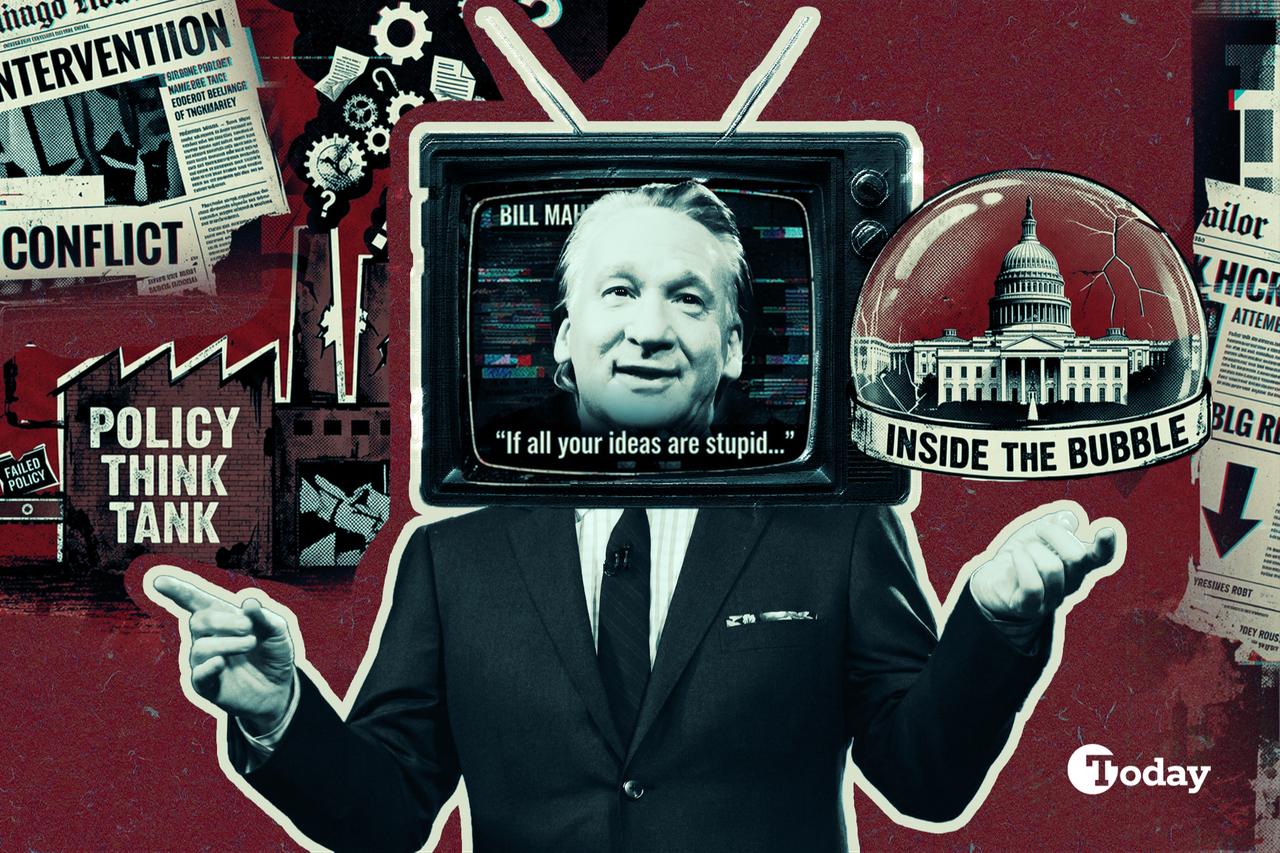
Amid the messiest moment of the U.S. occupation of Iraq in 2006, American comedian Bill Maher delivered a line that should have shattered the “D.C. bubble.”
“You can’t call yourself a think tank if all your ideas are stupid,” Maher said in the “New Rules” section of his HBO popular show, “Real Time,” on Oct. 20, 2006.
His targets were the foreign policy "experts" and Bush administration architects who had spent years cheerleading for an occupation on U.S. media in 2002-2003.
Unfortunately, those same "stupid ideas" seem to have gotten into liberal Democrat Maher’s head lately, given his support for the ill-advised “forever wars” the U.S. has backed since October 2023, most recently against Iran.
Last month, Maher said he was “cautiously optimistic” about U.S. President Donald Trump’s war on the Islamic Republic and called out the war’s liberal opponents: “I just don’t get what liberals don’t get about liberation,” claiming he saw “so much happiness” from the Iranian people.
Maher’s views on the genocide in Gaza are hardly beyond reproach either. He told the journalist Ana Kasparian in December on his “Club Random” podcast, “I know you’re going to say ‘genocide,’ and I’m going to say, well, you don’t know what the word means.”
Not surprisingly, the disastrous results of the U.S.-Israel war on Iran—skyrocketing energy prices, uncertainty in global markets, especially in food prices—have had a sobering effect on the American public and even Maher himself.
Several dynamics might explain how an otherwise cerebral comedian like Maher became what he once criticized. His late mother was Jewish, so he has an understandable sensitivity toward antisemitism and the Iranian government’s decadeslong threats of “marg bar Israel” (death to Israel).
Like most comedians, Maher probably also likes being a contrarian—the U.S. Democratic Party’s poorly conceived and even worse executed turn to the “woke left” fueled his disdain of the Palestinian cause, which the American left has been championing for a while and even elements of the right are coming to terms with.
While Maher is slowly showing signs of “buyer’s remorse” with the Iran war and admitting Israel’s war crimes in Gaza, most of America has already turned against Israel.
A recent CNN poll shows that Israel is as popular as an STD among the U.S. public these days. In a sense, the old habit of unconditional U.S. support for Israel, which actually started in the 1980s, is dying fast.
There are several ways to expedite the normalization of U.S.-Israel ties in a manner that corrects the behavior of future Israeli governments without destabilizing the Middle East. Achieving this balance could also serve to stem the tide of rising antisemitism globally.

First, it is important to name the problem accurately. Many people around the world, including in Türkiye, erroneously talk about a “Jewish lobby” in the United States, even though a majority of American Jews support a two-state solution to the Israel-Palestine question, according to one poll.
Meanwhile, 56% of Jewish Americans also express “little to no confidence” in Israeli Prime Minister Benjamin Netanyahu and his government, according to a Pew Research Center survey.
On the other hand, half of American evangelical Christians, a critical component of Trump’s coalition, say they support Israel because they think it will hasten the “end of times” prophecy, according to the Washington Post.
The problem, in other words, is not “the Jews.”
Even the “Israel lobby” moniker, the title of the seminal 2007 book by professors Stephen Walt and John Mearsheimer (based on their 2006 paper) that investigated how pro-Israel groups in the U.S. affect overall American foreign policy, might be misleading.
There is hardly anything “pro-Israel” about enabling the Jewish state’s worst actions, as seen in the occupied Palestine territories, Lebanon, Iran, and much of the region, really and letting it share the stage with China, North Korea, and Iran for “the world’s most hated country.”
Friends don’t let friends become the world’s most hated country.
In recent years, critics of Israel in the U.S. have begun using the more accurate “Israel First” label to describe groups and individuals who subordinate U.S. interests in the Middle East to the whims of Israel’s far-right coalition government. Their ranks include organizations such as AIPAC, FDD, JINSA, and ZOA.
Because “Israel First” could be problematic because it evokes images of “dual loyalty” conspiracies that antisemites often level at Jews, one might also go for “pro-Likud” (Netanyahu’s party) or “ultra-Zionist” lobbies as well.
After naming the problem, we should shame the actors and enablers. Whether it is Senator Chuck Schumer, who once claimed the lack of peace persists because “Palestinians don’t believe in the Torah,” or Senator John Fetterman—two more liberal Democrats—or the majority of Republicans in Congress whose base is increasingly skeptical of this status quo, the "stupid" must be named and shamed. These figures often treat the mounting casualties in the region with the detached voyeurism of a spectator at "Jurassic Park."
As Coldplay reminds us, “Everything’s not lost.” One source of optimism amidst the horrors of the Gaza genocide, the ethnic cleansing in southern Lebanon, and the death and destruction in Iran is that there are still sensible thinkers on both sides of the U.S.-Israel “special relationship,” even though they are not in positions of power.
Nonetheless, they deserve more recognition and support from the U.S. public and international observers.
The progressive American group “J Street,” which advocates for a peaceful solution to the Israel-Palestine question and is often criticized for its opposition to the pro-Palestine “Boycott, Divestment, and Sanctions” movement against Israel, recently announced that the Jewish state should fund its own defense without billions of dollars of U.S. aid.
Former Chicago mayor and President Barack Obama’s former Chief of Staff Rahm Emanuel, who served as an aid worker in Israel during the 1991 Gulf War, took a similar position on Maher’s “Real Time.” Those are big moves for otherwise staunch Israel supporters.
On the Republican side in the U.S., Congressman Thomas Massie of Kentucky has consistently opposed funding U.S. military aid to Israel or treating the Jewish state like a super-duper special ally.
On the Israeli side, groups such as B’Tselem, a Jerusalem-based organization that advocates for human rights and opposes the construction of Israeli settlements in the occupied Palestinian territories, and Mitvim Institute, which seeks sensible diplomatic solutions to regional conflicts, ought to be given much bigger platforms and backing.
If you have not heard of these people and groups (especially those in Israel), that is the point: Amid the death and destruction of war, it is easy to lose sight of people and organizations doing the right thing.
David Ben-Gurion adopted a dual strategy during WWII, opposing British restrictions on Jewish immigration (White Paper of 1939) while simultaneously supporting the British war effort against Nazi Germany.
He famously declared in 1939, “We must assist the British in the war as if there were no White Paper, and we must resist the White Paper as if there were no war.”
Another way to suck the "stupidity" from the Israel First/pro-Likud/ultra-Zionistis to disarm one of their primary weapons: antisemitism.
Netanyahu “hedges” his domestic and global political base—particularly in the United States—by leveraging the rising tide of global antisemitism. The harassment of Jewish people, businesses, and houses of worship serves to validate the Israeli far-right’s core claim: that Israel is the only true safe haven.
In this cynical cycle, such fear-mongering encourages more Jews to “return” to the Holy Land, ensuring the displacement of Palestinians and Lebanese people continues unabated.
Calling out antisemitism as viciously as one fights Zionist extremism—keeping in mind that few Zionists are no longer extremists—might help impress upon Israelis and their American backers a hard truth: what will save Israel is for it to stop acting like the expansionist regimes that ignited World War II and cost 75 million lives, including those of 6 million Jews.
A firm stance against antisemitism could impress upon Israel that it need not be surrounded by enemies if it stops making enemies of Palestinians and its other neighbors.
For the American people and their government, this would mean the United States would no longer have to worry about the Middle East any more than it worries about Western Europe or Africa—which is to say, not much at all.
As Bill Maher is often quoted as saying, “Our mistakes from the past are just that: mistakes. And they were necessary to make in order to become the wiser person we became.”


 Set as preferred source
 Set as preferred source



 7 min read