Newsletters


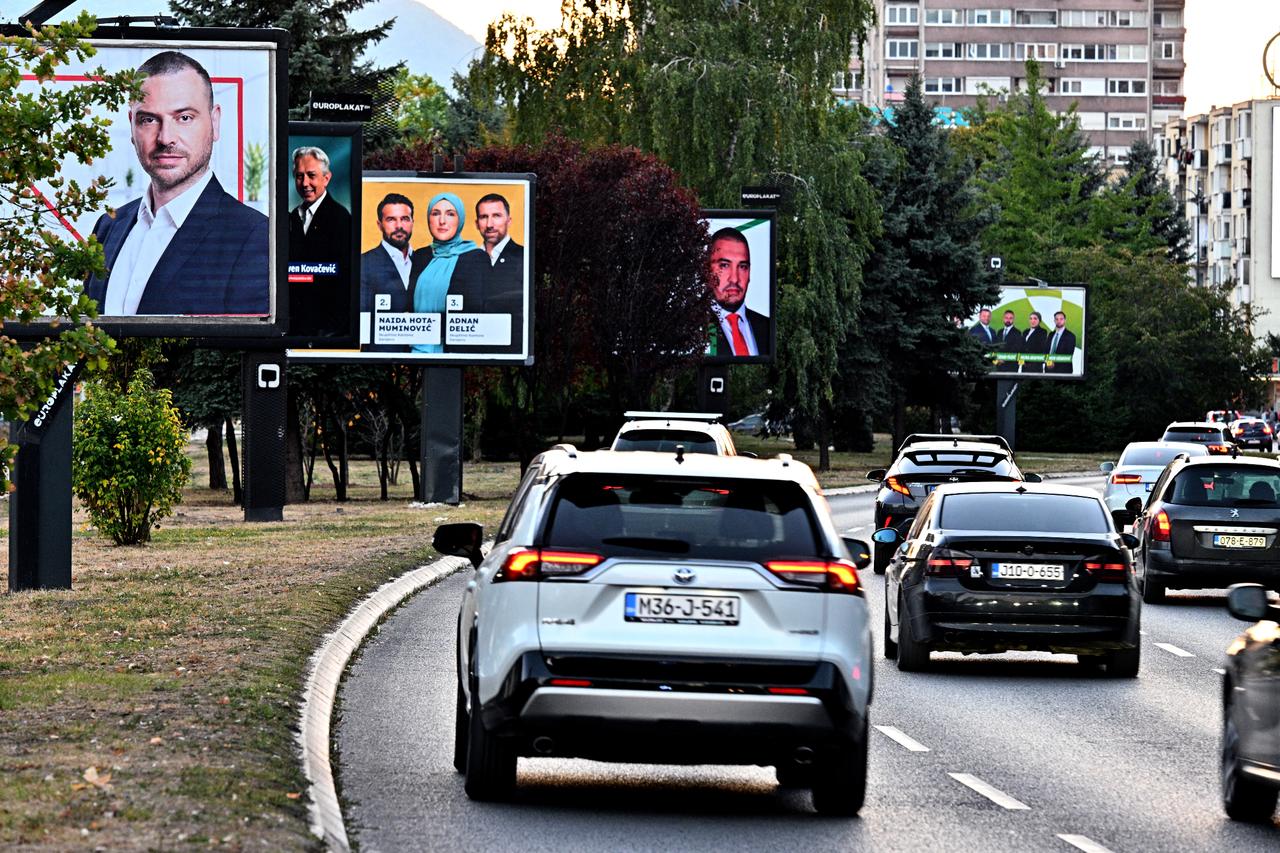


Voters across Bosnia and Herzegovina will go to the polls on Sunday to elect hundreds of officials in a general election that will, for the first time, rely on biometric voter verification and ballot-scanning technology at every polling station.
According to the Central Election Commission (CIK), 3,414,364 people are eligible to vote in the election, which will fill 518 directly elected positions spanning the country's complex, multi-layered political system.
Voters will choose the Bosniak, Serb and Croat members of Bosnia and Herzegovina's tripartite Presidency, the state-level body created under the 1995 Dayton Peace Agreement that ended the Bosnian war and established the country's power-sharing structure among its three main ethnic groups.
Also up for election are seats in the state-level Parliamentary Assembly, the House of Representatives of the Federation of Bosnia and Herzegovina (FBiH), the National Assembly of Republika Srpska (RS), the president and vice presidents of RS, and members of the 10 cantonal assemblies within the Federation.
The two entities, FBiH and RS, together make up Bosnia and Herzegovina alongside the special district of Brcko, where voters will separately choose officials to serve in the district's government.
CIK fully or partially approved applications from 75 political parties and four independent candidates to take part in the election, and cleared 29 coalitions to run.

Four candidates are competing for the Bosniak seat on the Presidency: Denis Becirovic, Bakir Izetbegovic, Semir Efendic and Fahrudin Radoncic.
The Serb seat is contested by Zeljka Cvijanovic, Marinko Bozovic and Nebojsa Vukanovic, while Darijana Filipovic, Zdenko Lucic and Slaven Kovacevic are vying for the Croat seat.
Separately, 12 candidates are running for the presidency of Republika Srpska. Voters will mark a single name on that ballot, with the top vote-getter winning outright. The contest is widely expected to come down to two candidates, Savo Minic and Branko Blanusa.
In the previous general election, held October 2, 2022, Denis Becirovic won the Bosniak seat on the state Presidency, Zeljko Komsic won the Croat seat and Zeljka Cvijanovic won the Serb seat. Bosnia and Herzegovina holds general elections every four years.
 3 min read

The election's most significant change is the rollout of biometric voter verification, ballot scanning and video surveillance across all of the country's roughly 4,500 polling stations.
Under the new system, voters will have their fingerprints scanned after an identity check. Voting will still be done with paper ballots, but voters will now pass their ballots through a scanner individually before depositing them in the ballot box. Candidate names will appear on a separate attachment rather than directly on the ballot itself.
Because scanned ballot data will be transmitted directly to CIK, the commission expects to announce initial results at 8 p.m., compared with roughly 11 p.m. in past elections.
Scanned ballots will also be counted by hand. CIK said that if a significant discrepancy emerges between the scanned and manual counts, additional checks will be carried out, and that the hand count will be treated as the official result if the discrepancy persists.


 Set as preferred source
 Set as preferred source



 1 min read