Newsletters


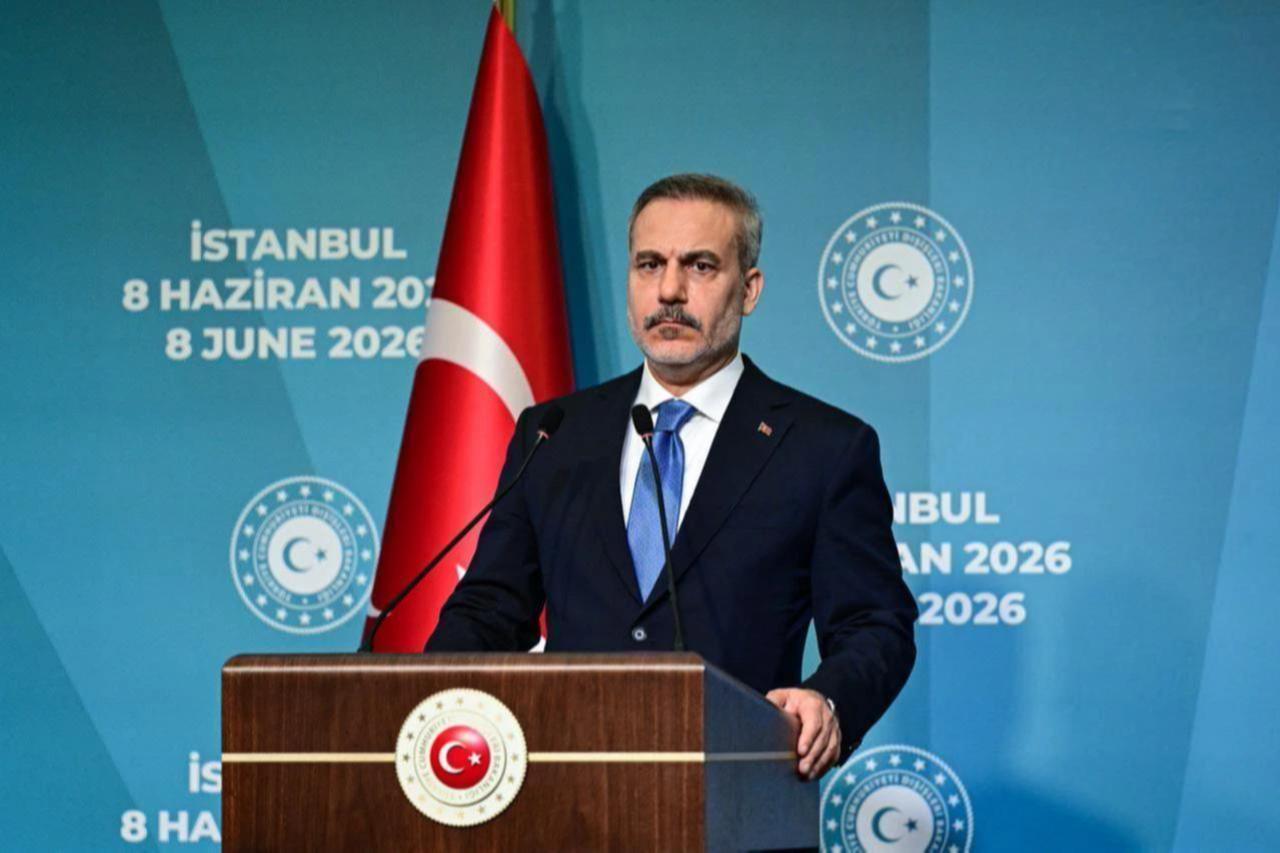


Foreign Minister Hakan Fidan has said Greek domestic politics relies on anti-Türkiye rhetoric “like an aspirin” and urged Athens to work with President Recep Tayyip Erdogan while he remains in office, drawing a series of responses from Greek officials.
Fidan made the remarks in Brussels to Maria Vasileiou of the Greek newspaper Ta Nea, who put three questions to him after his speech at the European Policy Centre.
He covered the 12-nautical-mile dispute in the Aegean, a planned undersea electricity link and the Blue Homeland maritime doctrine.
Fidan said the two governments have chosen since May 2023 to resolve existing problems, avoid tension and prioritize confidence-building measures.
Cooperation has gone “quite well” so far, he said, and the Aegean has become calmer over the past three years. “At least we no longer have dogfights,” he added.
He argued that a political need for anti-Türkiye rhetoric in Greece stands in the way of bolder decisions.
Greek governments, he said, appear to know how to approach the issues but are unwilling to bear the political cost.
He said Erdogan has repeatedly tried to work with every elected Greek prime minister on the matter and is ready to show the political will needed.
Disputes over waters and the Aegean require strong leadership from both sides, he said.
“My advice to my Greek friends is to seize this moment while he is still there,” Fidan said of Erdogan, whom he described as the only figure with the political legitimacy to deliver a solution.
Ta Nea also asked whether a 1995 resolution of the Turkish Grand National Assembly is compatible with Türkiye’s participation in the European Union’s SAFE program and other European programs.
Fidan rejected the idea that the resolution is a war threat, calling that “the Greek version.” He said it is a declaration rather than a law.
It indicates that the Turkish government should take all necessary measures if Greece extends its territorial waters to 12 nautical miles without first settling the matter with Türkiye, he said.
The resolution was issued when Greece accepted the United Nations Convention on the Law of the Sea, which Greece cites as the basis of its right to the extension, according to Fidan.
He said it has helped preserve peace and noted that Greece has never stated publicly that it will not take such a step without resolving the issue. Both sides, he said, are keeping the status quo while waiting to settle their differences peacefully.
By way of background, Greece currently applies a six-nautical-mile limit in much of the Aegean.
The Turkish parliament’s 1995 decision came after Athens ratified the convention, to which Türkiye is not a party.

Asked why Türkiye has objected to the Great Sea Interconnector, a planned electricity link involving Greece and Cyprus, Fidan said Ankara does not oppose it. He said the issue has been discussed with Greek Prime Minister Kyriakos Mitsotakis and French President Emmanuel Macron.
He recalled that Erdogan raised an alternative with Mitsotakis during a meeting in New York.
According to Fidan, the Turkish president said Greece could buy electricity from Türkiye rather than spend more than 2 billion euros in European funds to carry power over 2,000 kilometers.
Türkiye could supply water, electricity and natural gas from only 70 miles away on the mainland, Fidan said, to the benefit of Greek Cypriots, Turkish Cypriots and the whole population.
The disputed waters of the Aegean have not yet been addressed, he said.
Türkiye asks only that a vessel conducting seabed research send written notice, not just verbal notice, with the planned activities and coordinates. “That is all we want,” he said.
Ankara does not want the status quo disrupted or a new one created through a “fait accompli,” he added.
Asked whether a bill on Blue Homeland, Türkiye’s maritime jurisdiction doctrine, would advance, Fidan replied that “there is no such thing as a Blue Homeland bill” and that the marine park issue has not yet been opened for discussion.
 1 min read

Greek Foreign Minister Giorgos Gerapetritis addressed Fidan’s comments on MEGA News 104.6 radio.
He said Greece moves with an “autonomous, independent and self-sufficient compass,” arguing that its foreign policy is not set by Türkiye’s moves.
Gerapetritis nonetheless acknowledged that major crises between the two countries have been averted over the past three years, that violations have decreased and that migrant flows to the eastern Aegean islands have been limited.
He also discussed the Libyan House of Representatives’ ratification of a 2019 maritime jurisdiction agreement with Türkiye.
He called the deal contrary to international law and said Athens would activate its diplomatic mechanisms to have it condemned.
“This memorandum will not be implemented under any circumstances,” he said.
He listed financial arrangements concerning Libya, the peace mission in the country and Türkiye’s European Union accession process among possible levers of diplomatic pressure.
Asked whether the ratification was a failure for Greek diplomacy, Gerapetritis conceded that Athens had no ability to prevent it.
He said the approval adds no value “either theoretically or practically.”
On the prospect of extending Greek territorial waters to 12 nautical miles south and west of Crete, he said Greece will do so.
This is its right under sovereignty and international law, he said, to be exercised “in the manner and at the time chosen by the Greek state.”
The 2019 memorandum was originally signed between Türkiye and Libya’s Tripoli-based government, and Greece has long contested it.


 Set as preferred source
 Set as preferred source


 1 min read