Newsletters





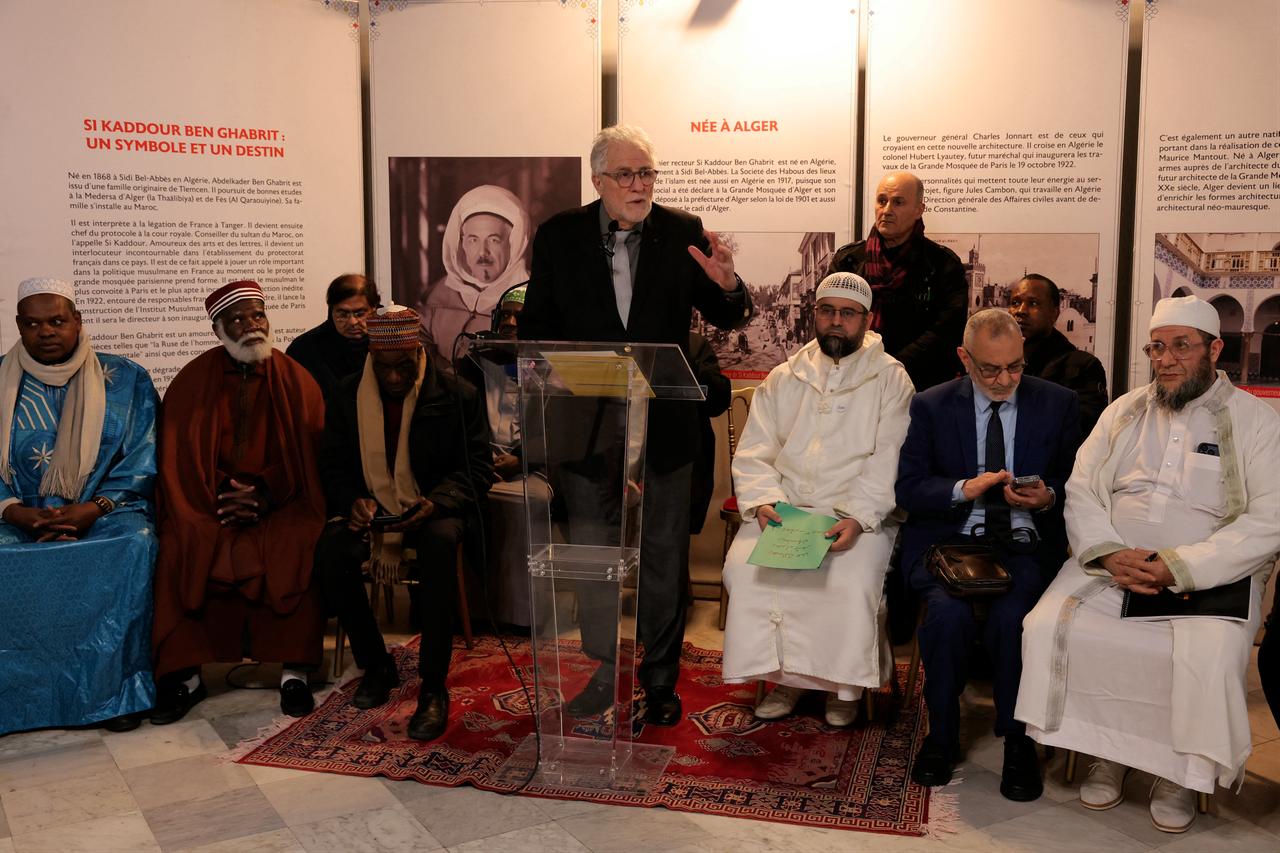
In a move that speaks to France’s ongoing struggle to Francify Islam and integrate it into the secular society, the Grand Mosque of Paris has published a 1,000-page guide on how Islam can fit within the Republic.
More than a theological text, the publication arrives as heated debates over "laicite" and the role of Muslims in French society intensify, transforming the guide into a political manifesto as much as a religious statement.
Presented as a practical handbook, the guide aims to “explain Islam to the Republic and explain the Republic to Muslims,” said Chems-Eddine Hafiz, rector of the oldest major mosque in Paris.
The guide is meant to restore the so-called "disastrous image of Islam" in the public eye. To this end, two commissions were formed to reflect on Islam and its role within a non-Muslim country, seeking to advise believers on how to practise their faith within the framework of republican values.
More importantly, the guide emphasizes the principle of “secularism," seeking to demonstrate that there is "no incompatibility between Muslim prescriptions and civil law," and that harmonious coexistence is possible.
But why has alleged Islam “maladjustment” into French society been such an issue lately?
Any discussion of religion in France requires engaging with its distinctive form of secularism known as laicite.
France’s approach to religion is shaped by laicite, a model of strict state neutrality rooted in the country’s republican history and enshrined in the 1905 law.
The law set the framework that still governs the place of religion in French public life, guaranteeing freedom of conscience while ensuring that public authorities treat all beliefs equally.
Created to counter the Catholic Church's growing influence over the state apparatus, critics argue that the principle has since increasingly served as a basis for policies that target mainly the Muslim community.
Yet, the use of the concept of secularism today is seen by some as an exploitation of the original concept. There would therefore be a difference between “secularism of control,” which opposes the free expression of religion, and “secularism of law,” which strictly limits secularism to the legal process of religious neutrality in the public sphere.
In recent years, the concept is said to have taken an ideological turn.

Muslim communities are currently facing numerous critics especially coming from right and far-right political wings, particularly concerning their “non-compliance” with the principle of secularism. Sociological studies show that in France, since the 1980s, the idea of a “Muslim problem” has become prevalent in public debate.
The Creil headscarf affair began in September 1989, when three Muslim schoolgirls were excluded from a secondary school in Creil for refusing to remove their headscarves in class. The case quickly escalated into a national controversy, sparking intense debate over secularism, religious freedom, and the role of Islam in French public institutions.
This case marked the return of the debate on secularism in France, as Islam had become the second most practiced religion in France after Catholicism, following significant waves of migration.
Above all, the controversy raised the question of whether the veil threatens the concept of secularism and how far religious freedom extends in the face of the separation of church and state.
The controversy led to the law of 2004, banning the wearing of conspicuous religious symbols in public primary and secondary schools. It applies to items such as large crosses, kippahs, and Islamic headscarves, aiming to reinforce secularism in schools.
More recently, the debate intensified when the abaya, a garment described by authorities as religiously significant, was banned in public schools, “threatening” once again the religious neutrality.
The ban exposed deep political divisions. On the right, figures such as Gabriel Attal and Bruneau Retailleau said that the garment is a religious and community marker, making the measure necessary.
On the left, however, the measure was denounced as “racist” and discriminatory, conflating culture and religion. According to LFI MP Eric Coquerel, the popularity of this long dress is simply a "cultural trend".
While many have highlighted the challenges surrounding Islam’s place in public life, it is perhaps important to recall the words of Fabien Pontagnier, a history teacher in Savoie in the Alps: "Students contrast the 1905 and 2004 laws and tend to see laicite as a coercive principle. That's why it's useful to revisit the 1905 law to remind them that it, too, was contested. In the archives of the Gard or Ariege (administrative departments), you can clearly see that the inventories of Church property were carried out under the watch of threatening crowds. Returning to that helps take the emotion out of the debate."

The media coverage rarely looks into history, putting forward an alleged incompatibility between the Islamic tradition and the laicite, yet overshadowing the fact that Islam was not the only religion to have struggled with the concept.
Lately, the increase in terrorist attacks has also sparked waves of protest, positioning Islam as a “threat” to secular French society.
The question of whether Islam fits within France’s secular framework has become increasingly central to public debate.
Others argue the issue is less about religion itself than about the social exclusion of immigrant communities, often shaped by stereotypes linking the suburbs to insecurity and terrorism.
Yet how should one act when the veil is the primary but also ostentatious symbol of a religion? Shouldn't the concept of secularism end where tolerance begins? Or does secularism take precedence over respect for religions?
While no direct causal link has been established, the rise in reported discrimination, with 34% of Muslims saying they experienced religion-based bias, up from 27% in 2016, according to the Rights Survey, has fuelled debate over whether repeated legislative scrutiny plays a role.
Whether the guide can ease the tensions surrounding the integration of Islam into French society remains an open question. Its publication is a significant step; however, it also underscores how unsettled the national debate still is.


 Set as preferred source
 Set as preferred source



 2 min read