Newsletters


Anonymous Iranian officials told the New York Times (NYT) that a suspected drone strike on a U.S.-owned LNG tanker at Egypt's Damietta port was designed to demonstrate Tehran's ability to disrupt global energy routes beyond the Persian Gulf. While Egypt confirmed fires on two vessels resulted in no casualties, U.S. President Trump warned of a "very hard" response if conflict escalates.
Two Iranians who spoke to the NYT on condition of anonymity to discuss security matters said the explosion was a drone attack intended to demonstrate that global shipping and energy supplies could be more deeply disrupted if Iran chose to escalate further.
According to the Times, the individuals did not say whether Iran itself or an Iran-allied regional militia had carried out the attack, or from where it was launched.
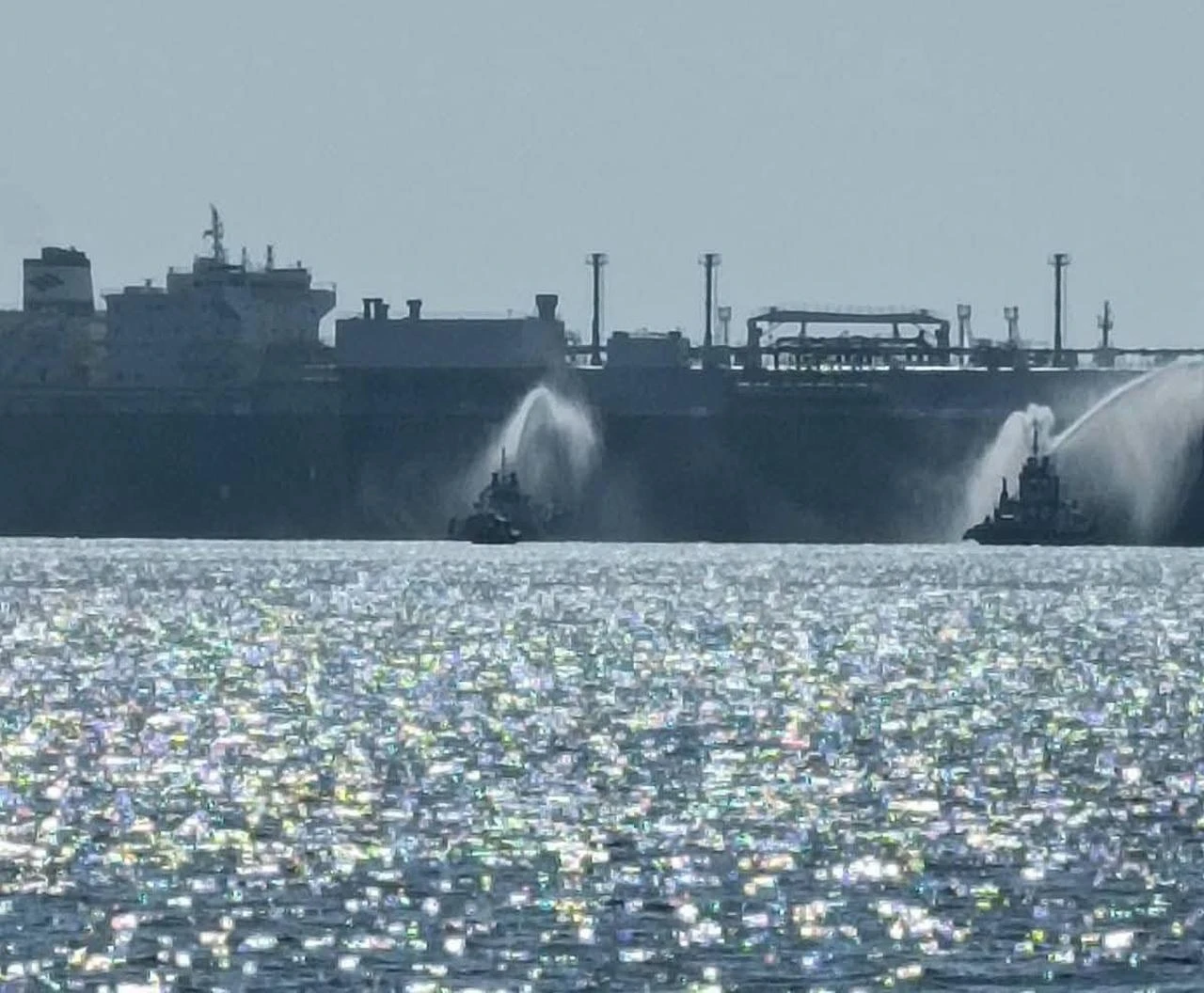
Egypt's Petroleum Ministry announced Wednesday that a fire broke out aboard a regasification vessel and a storage vessel at Damietta Port on the Mediterranean coast, and was brought under control immediately by firefighting and security teams, with no injuries or fatalities reported.
The ministry did not specify a cause and urged the public to rely on official statements. Maritime tracking firm Kpler said the explosion disrupted operations at a key LNG import hub and damaged the Energos Winter storage and regasification vessel and the GasLog Salem tanker, both of which were moved offshore as authorities assessed the situation, without attributing a cause.
Ambrey, a U.K.-based maritime risk monitor, said the two vessels, the Greek-owned, Bermuda-flagged GasLog Salem and the U.S.-owned, Marshall Islands-flagged Energos Winter, were hit by at least one unidentified drone.
Joshua Hutchinson, chief commercial officer of Ambrey, told the Times the explosion was believed to be caused by a drone strike hitting at least one of the vessels, though Ambrey has not identified the source of the attack.
Jonathan Chia, a representative for Energos Infrastructure, the U.S. company that owns the Energos Winter, told the Times the company had not been able to determine whether the vessel had been hit by a drone, but confirmed all crew members were accounted for and uninjured.
GasLog spokeswoman Marina Leonidhopoulos told the Times the cause of the explosion aboard the GasLog Salem was under investigation.
The former head of the Damietta Port Authority, Maj. Gen. Ayman Salah, told Agence France-Presse (AFP) the regasification vessel had been moored next to the LNG tanker, explaining that the regasification process occurs under very high pressure, so any leak could lead to a fire, an alternative explanation offered without attributing the incident to any particular cause.

Asked by reporters in the Oval Office whether there was any indication Iran was behind the attack, Trump said: "Well, I can give you a report. I've been briefed. It's a little more of the same, but it's going to be straightening out."
The Times reported that Trump implied Iran was responsible without offering supporting details, calling the incident "more of the same." Trump said: "We're going to be hitting them very hard, because it's our turn to hit them. They know it's coming."
Trump also referenced a reported Iranian missile attack on U.S. forces in Jordan the previous night, saying: "So, we had five rockets shot going 8,500 miles an hour, and all five rockets were knocked down to the ground, but they nevertheless took a chance. It's our turn, and we'll see if we get there with an agreement at some point. But we're going to hit them very hard."
Iran's Islamic Revolutionary Guard Corps (IRGC) said ballistic missiles had targeted a U.S. air base in what it described as a response to "the aggressive actions of the US military," while Jordan's armed forces said their air defenses intercepted and shot down five missiles launched from Iran early Wednesday morning.
Asked whether he foresaw a scenario involving Iranian attacks on U.S. installations and personnel overseas or a U.S. withdrawal, Trump said: "No, I do not see that ... We're going to hit them very hard. I mean, I can actually say that because ... there's very little they can do about it ... but you know we got to smack them a little bit."
According to the Times, the attack is unlikely to affect global energy markets as significantly as disruptions elsewhere in the Middle East, since Egypt is not a major natural gas exporter.
However, the Times noted that by striking ships in the Mediterranean, any actor responsible could further complicate global shipping calculations, forcing companies to weigh the risks of using Egyptian ports in addition to the Red Sea and Persian Gulf routes many operators have already avoided since the war began in late February.
Middle East energy facilities have been struck by drones and missiles throughout the U.S.-Iran war, but Egypt had been spared until this incident.
Traffic through the Strait of Hormuz remains at less than one-tenth of pre-war levels, while the number of vessels transiting the Red Sea's Bab al-Mandeb has fallen by one-fifth since July 20, according to maritime data firm Windward, citing the recent blockade threat from Yemen's Houthi movement against Saudi shipping.


 Set as preferred source
 Set as preferred source


 2 min read