Newsletters





Iran has moved to restore international internet access after months of restrictions that disrupted communications across the country and inflicted economic losses of up to $2.2 billion, according to estimates.
Semi-official Tasnim news agency reported Tuesday that the process began following an order from President Masoud Pezeshkian to return internet access to conditions that existed before January 2026.
Users once again gained access to international websites, while fixed broadband services, including FTTH, VDSL and ADSL, along with mobile internet, resumed operating without restrictions, according to the report.
The restrictions first rolled out during protests on Jan. 8, when authorities imposed a near-total shutdown that severely disrupted both domestic and international connectivity. The unrest had erupted in late December and intensified in January as the Iranian rial sharply weakened against the U.S. dollar amid growing economic pressure.
Internet controls tightened again after the U.S. and Israel launched attacks on Iran on Feb. 28. Authorities had briefly eased restrictions around Feb. 16 as connectivity gradually returned, but access to the global internet was cut back again following the attacks.
Although domestic platforms and local online services later resumed operating, access to the global internet largely remained dependent on Virtual Private Networks (VPNs).
Major global platforms, including YouTube and X, are still blocked in Iran, forcing many users to continue relying on VPN services.
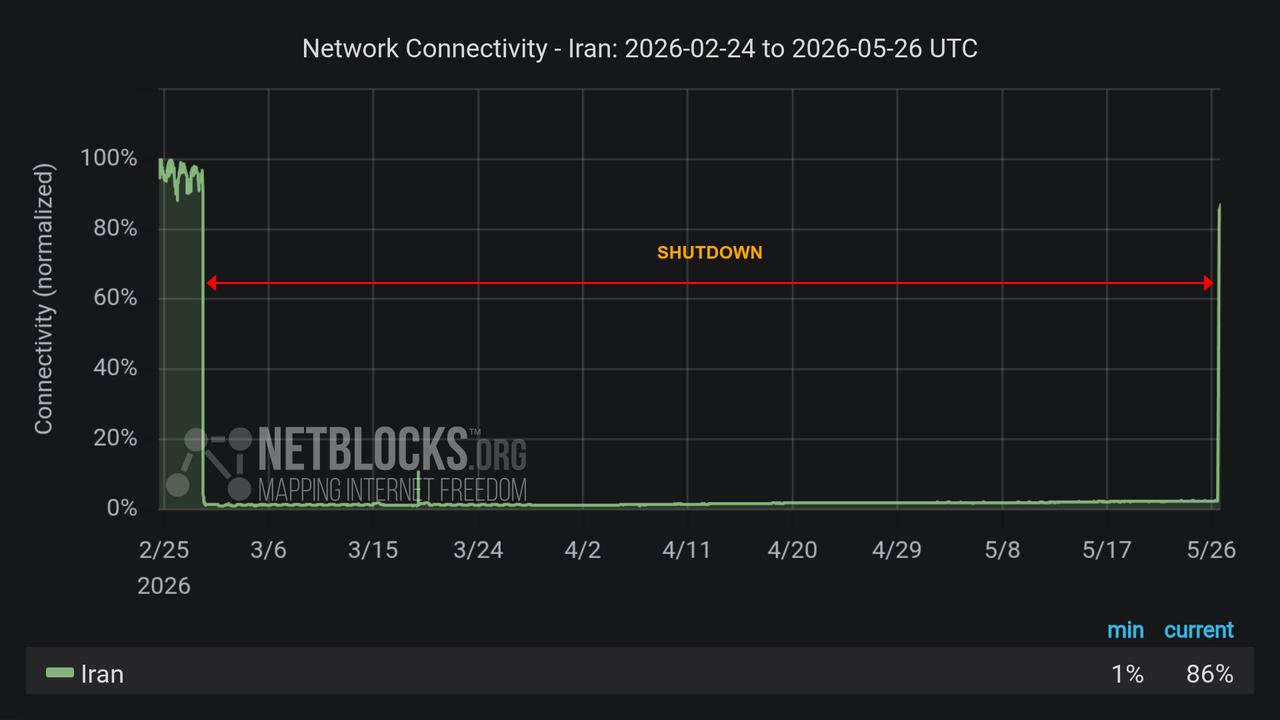

The restrictions hit businesses, online commerce and communications with the outside world, while access to international platforms grew increasingly unstable and difficult for ordinary users.
Experts previously described the measures not as a complete shutdown of Iran’s internet infrastructure, but as restrictions specifically aimed at cutting access to the global internet, while domestic systems such as banking networks and local platforms continued operating.
According to estimates released by the Iranian Organization of Computer Engineering and IT Industry Professionals during the first blackout, the restrictions caused losses of between 2 trillion and 3 trillion Iranian tomans per day.
Based on the current exchange rate of 173,000 tomans per U.S. dollar, that translates into roughly $11.6 million to $17.3 million in daily losses.
Based on the combined 127 days of restrictions between Jan. 8 and Feb. 16 and Feb. 28-May 27, the estimated economic toll reached between $1.5 billion and $2.2 billion.


 Set as preferred source
 Set as preferred source


 1 min read

 1 min read