Newsletters


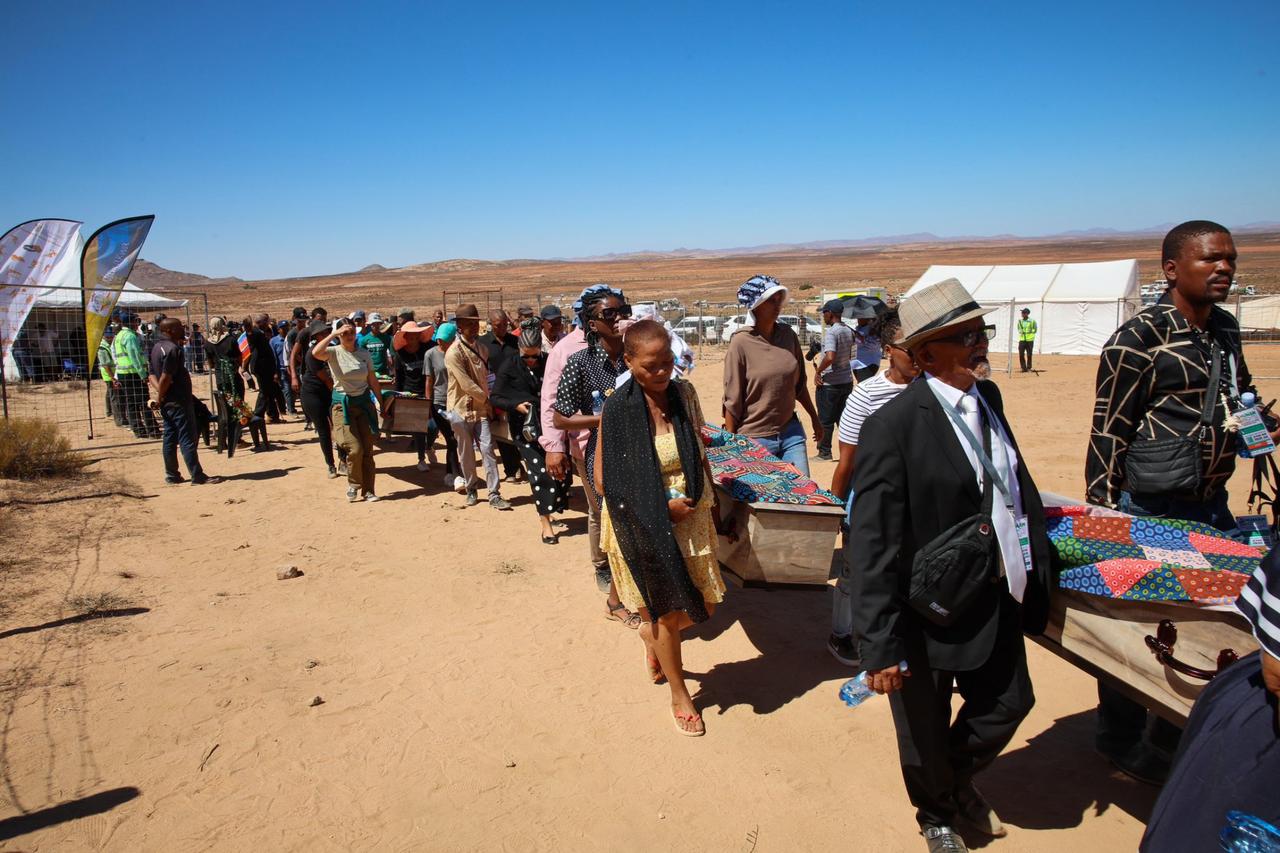


The return of the remains of 63 Khoisan individuals to South Africa has brought renewed attention to the racialized and often violent legacy of European colonialism, as well as ongoing efforts to address historical injustices faced by one of the world’s oldest human communities.
The remains, which had been taken between 1868 and 1924 and held at the University of Glasgow for use in race-based scientific research, were returned to South Africa and buried in an official ceremony attended by Cyril Ramaphosa on March 23.
For more than a century, these human remains were treated as scientific objects, reflecting a period when European institutions collected and studied the bodies of colonized peoples under the framework of racial science.
According to Professor Nigel Penn, an emeritus professor at the University of Cape Town, the Khoisan are considered among the oldest human populations not only in Africa but globally. The term “Khoisan” refers to a grouping of two distinct communities: the San, traditionally hunter-gatherers, and the Khoikhoi, who practiced pastoralism, meaning livestock herding.
For thousands of years, these communities lived across southern Africa, particularly in regions such as the Kalahari Basin, sustaining themselves through mobile and land-based lifestyles. However, their social and economic systems were profoundly disrupted following European settlement beginning in the mid-17th century.
Penn explains that after Dutch settlers arrived at the Cape of Good Hope in 1652, Khoisan communities were gradually dispossessed of their land and resources. While they were not formally enslaved, many were forced into conditions resembling servitude, as settlers took over grazing lands and seized livestock.
At the same time, San communities, who did not practice herding, were often viewed by settlers as obstacles to agricultural expansion. This perception led to repeated conflicts, which were frequently suppressed through organized armed units known as “commandos.” In these operations, men were often killed, while women and children were taken and used as labor.
Penn notes that in certain regions and periods, the intensity of violence reached levels that could be described as genocidal, although in many cases, colonial authorities ultimately sought to control rather than completely eliminate indigenous populations.
From the earliest encounters, Europeans categorized the Khoisan as among the most “primitive” peoples, placing them at the opposite end of a perceived civilizational spectrum centered around Europe and the Middle East.
Penn highlights that during the Enlightenment and into the 19th and 20th centuries, Khoisan individuals were placed at the lowest levels of a so-called “chain of being,” a now-discredited hierarchical model of life. He states that many European scientists went as far as to view Khoisan people as a “missing link” between humans and animals, an idea that helped justify the removal and study of human remains.
While the return of 63 individuals has been welcomed, Penn describes it as only a fraction compared to the number of Khoisan remains still held abroad.
He also points out that modern Khoisan communities are working to reclaim their identities and cultural heritage, often emphasizing distinct San and Khoi identities. However, their demand to be formally recognized as “first peoples” has led to tensions with the government, as such recognition could carry implications for political representation, land rights, and economic access.
A Khoisan community member identified as Matios describes the historical treatment of his ancestors as unacceptable and emphasizes that Europeans directly targeted Khoisan populations in a process that escalated into widespread violence.
He states, “Here a genocide took place, and on a very large scale. This is a hidden history. It is not openly discussed. What is presented to the public, even in school curricula, is quite limited.”
Matios also expresses discomfort over the removal of ancestral remains, explaining that the distinct way Khoisan communities lived in harmony with nature drew the attention of scientists, ultimately leading to the use of their bodies in research.
At the same time, he notes a growing awareness among younger generations, as more people begin to question what happened, why remains were taken, and how these histories have been represented.


 Set as preferred source
 Set as preferred source



 3 min read