Newsletters


Thousands of demonstrators flooded the German city of Erfurt on Saturday, blocking major roads and disrupting public transportation in an effort to shut down the annual congress of the far-right Alternative for Germany (AfD) party.
About 20,000 people gathered in the capital of Thuringia state, according to police, to protest the AfD, which is leading national opinion polls.
The protesters, organized by an alliance called "Resistance," blocked routes into the city, with some rappelling from a highway bridge. Several groups also staged sit-in blockades around the city center, Agence France-Presse (AFP) journalists reported.
Most AfD delegates, however, managed to reach the conference center, and the congress began on time.
"It's important to send a signal against the shift to the right," said Lene Krug, a 19-year-old demonstrator from Gera, east of Erfurt.
"The AfD is an anti-democratic party that spreads hate."
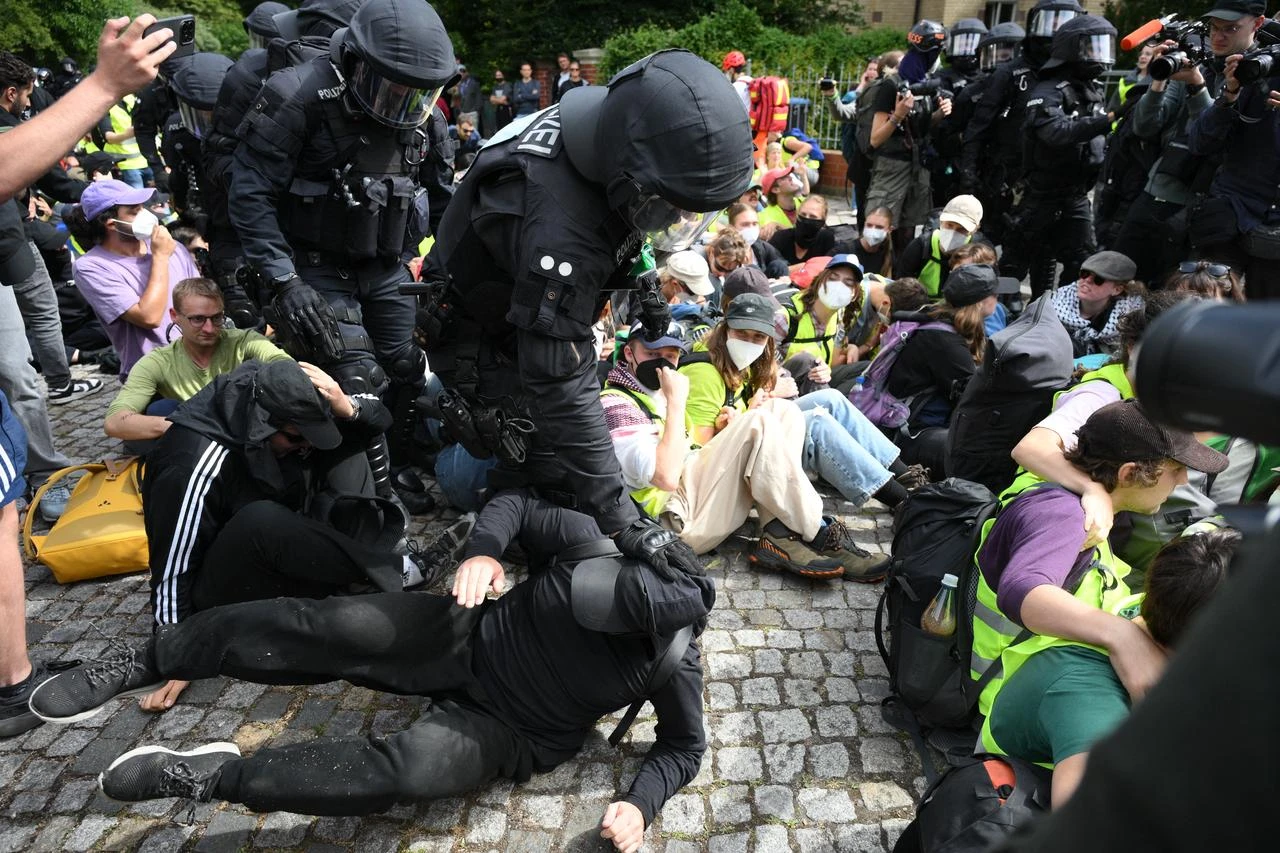

Another protester, identified only as Ella, joined a group that glued themselves to tram tracks in a city square.
"1933 to 1945 must never happen again," the 44-year-old said, referring to the period of Nazi rule.
"The democratic parties need to understand that they must impose a ban on the AfD."
The early protests were largely peaceful, though minor scuffles were reported between demonstrators and the thousands of police officers deployed for the congress.

German news magazine Der Spiegel, citing internal police documents, reported that up to 2,500 protesters were expected to arrive prepared for violence.
The AfD's rapid rise has alarmed many Germans, who say the country's Nazi past gives it a particular responsibility to confront far-right politics.
Some critics described the timing of the Erfurt congress as a deliberate provocation because it coincided with the 100th anniversary of a Nazi conference in nearby Weimar. The AfD denied the allegation.

AfD co-leader Tino Chrupalla accused establishment parties of organizing the protests.
The demonstrators had been "carted in here from all over the country by the establishment parties in trucks," he said during his opening speech.
"They are protesting against democratic decision-making. They believe they alone possess democracy," he added.
Chancellor Friedrich Merz has made reversing the AfD's rise a priority. The party remains excluded from government because all other major parties have refused to cooperate with it.
The AfD describes itself as a conservative force occupying political ground once held by Merz's Christian Democrats before former Chancellor Angela Merkel allowed large numbers of refugees and asylum-seekers into Germany about a decade ago.
Critics, however, point to AfD politicians who have downplayed Nazi crimes and to the party's links with banned right-wing extremist groups.
The AfD is seeking power for the first time this year as state elections approach in eastern Germany, its main electoral stronghold.
Polls suggest the party could win an outright majority in Saxony-Anhalt's September election.

Nationwide, the AfD has been at or near the top of opinion polls since last year's election, when it finished second with 20% of the vote.
"I would never have thought that a radical right party could be the strongest in Germany within my lifetime," said Manfred Guellner, head of polling firm Forsa.
"Lots of people, not necessarily part of the radical right, have gone over to the AfD because of dissatisfaction with the current government," he told Agence France-Presse (AFP).


 Set as preferred source
 Set as preferred source


 1 min read

 1 min read