Newsletters





The 2026 Giro d’Italia has been officially revealed in Rome, confirming a 21-day route that begins far beyond Italy’s borders and charts a demanding course across seas, valleys, and some of Europe’s hardest climbs.
For the 16th time in 109 editions, the race will start abroad—this time in Bulgaria, where three opening stages will introduce new terrain and a rare spotlight for the country’s emerging cycling culture.
The Grande Partenza begins in Nessebar, an ancient peninsula town on the Black Sea, before heading to Burgas, where the first Maglia Rosa is expected to fall to a sprinter.
A more selective Stage 2 takes the peloton inland toward Veliko Tarnovo, where the short but sharp climb near the Lyaskovets Monastery, just 9 kilometers (5.59 miles) from the line, is likely to shake up the early general classification.
The final Bulgarian stage, from Plovdiv to Sofia, appears suited to fast men, though unexpected moves could still alter the script.
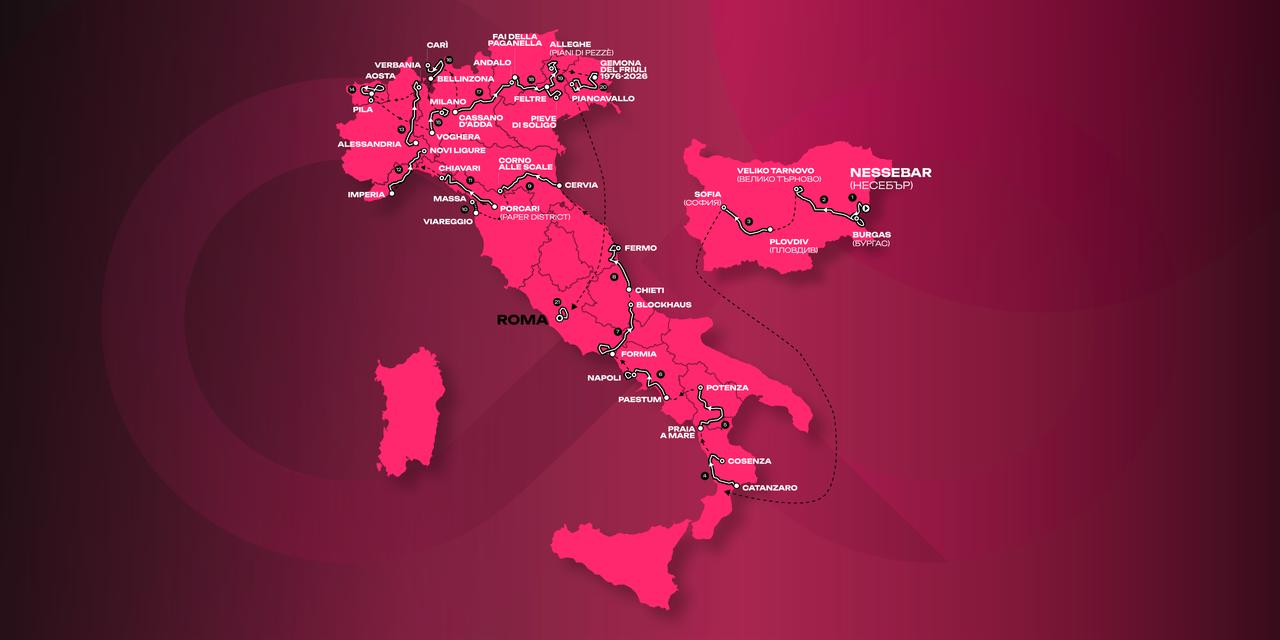

After the first rest day, the Giro enters Italy through Calabria with a stage from Catanzaro to Cosenza, another opportunity for sprinters, despite the late Cat. 2 Cozzo Tunno climb.
A tougher test follows from Praia a Mare to Potenza, where the Montagna Grande di Viggiano, featuring long sections over 10%, may deliver early damage among GC contenders.
Campania hosts Stage 6 from Paestum to Naples, where the race returns to its familiar seafront sprint finale.
The real turning point of the first week, however, is the 250 km Stage 7 finishing atop the legendary Blockhaus. The 13.6-kilometer climb at 8.4% has long shaped Giro history, and in 2026, it will offer the first true showdown between the race favorites.
The week closes with a punchy sequence: the Marches' "walls" between Chieti and Fermo, followed by the summit finish at Corno alle Scale, where the final 3 km repeatedly rise above 10%. With Blockhaus and Corno alle Scale arriving in close succession, all GC riders must be sharp from the outset.
Week two opens with a key 40 km time trial between Viareggio and Massa—a pan-flat test where specialists can claw back major seconds.
Breakaway terrain and sprinter-friendly routes follow through Chiavari, Novi Ligure and Verbania, though the late climbs in Stage 13 could still disrupt expectations.
The week’s decisive GC battle arrives in Stage 14 through Valle d’Aosta. Although not long, the stage packs 4400 meters of elevation gain, with the ascents of Saint-Barthélemy, Lin Noir and Verrogne leading into the 17-kilometer climb to Pila. Its steady gradients will expose weaknesses and could redefine the race before riders head to Milan for a high-speed city-circuit sprint.

The last week begins with a summit finish in the Swiss Canton of Ticino at Carì, a demanding 11.6-kilometer climb averaging 8.1%. Two transitional stages follow, potentially favoring attackers before the race enters its most dramatic test.
Stage 19 delivers a Dolomites epic from Feltre to Piani di Pezzè: Passo Duran, Coi, Staulanza, the fearsome Passo Giau as Cima Coppi at 2233 meters, and Passo Falzarego before the final wall to Piani di Pezzè. The combination guarantees a day of triumph and collapse in equal measure.
The penultimate stage, from Gemona del Friuli to Piancavallo, doubles the final climb: 14.5 km at 7.8% each time. Only after the second ascent will the winner of the Giro d’Italia 2026 become clear.
The race concludes for the fourth year running in Rome, where a nine-lap city-center circuit beneath millennia-old monuments will offer sprinters one last prestigious stage win—a finale previously claimed by riders such as Mark Cavendish, Tim Merlier and Olav Kooij.


 Set as preferred source
 Set as preferred source



 1 min read