Newsletters


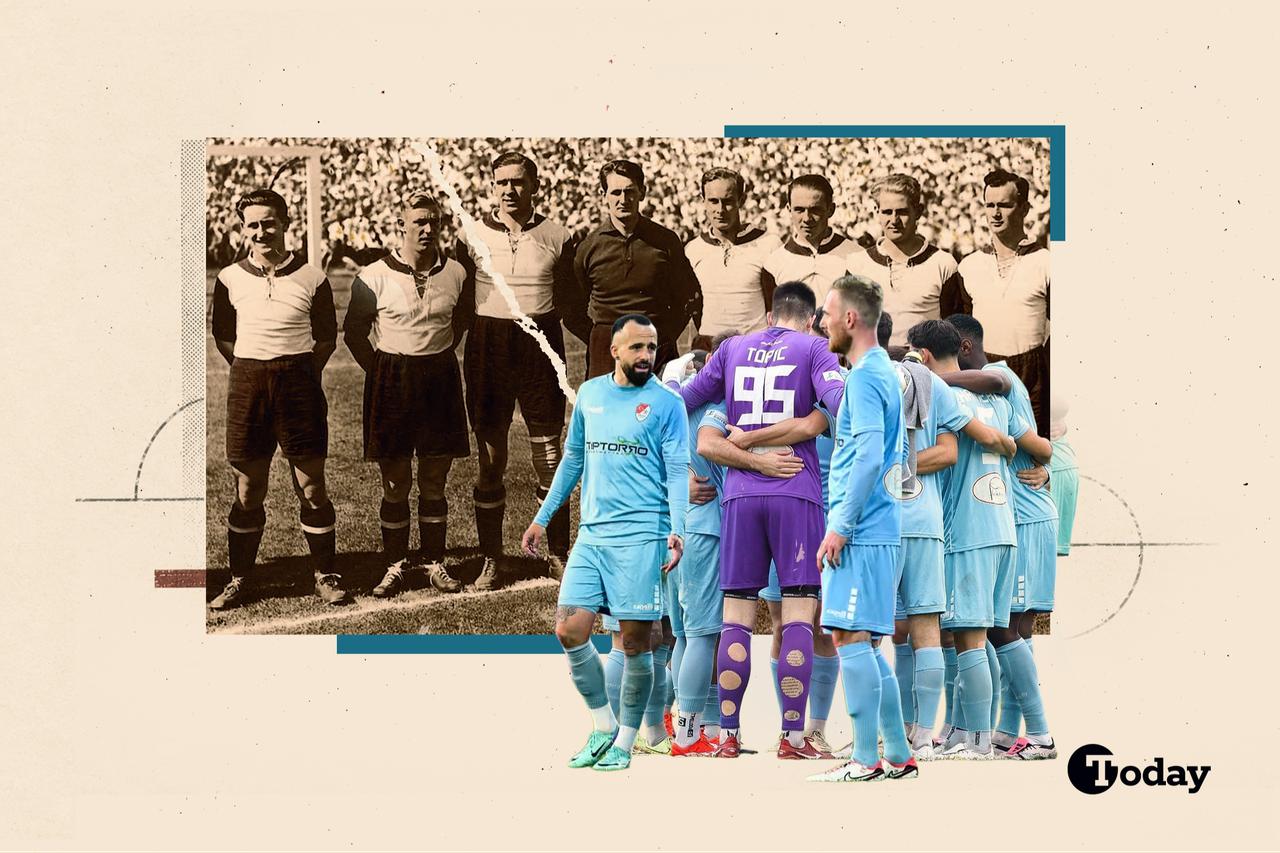


The goal scored a death sentence for a coach in a Nazi concentration camp, sent a club president fleeing into exile, and wiped its scorer from the team sheet of the living.
The ball hit the net on June 12, 1932, in Nuremberg, securing Bayern Munich its first German championship title—and earning the club a vicious Nazi slur: Judenklub, the Jewish Club.
Nearly a century later, the targets have changed, but the politics of exclusion has found its way back into German football.
This time, one of the clubs in the firing line is Turkish.
Founded by Turkish immigrants in 2009, Turkgucu Munchen rose through Bavaria’s lower leagues, only to attract the unwelcome attention of the extreme-right group Der Dritte Weg, or The Third Way.
What began with white nationalist literature escalated into physical intimidation, violence and attempts to stop matches altogether.
The echoes of Bayern's Nazi-era persecution are hard to ignore. Once again, a Munich football club was being targeted not for how it played, but for who it represented.
Politics still runs through German football like stitches in a football—interwoven, invisible, and seemingly impossible to remove.
“In Germany, the natural battleground for politics is football, because this is where you can influence young people,” says the popular German football analyst Stephan Uersfeld. “Here fans feel that they really have the power to effect change.”
After World War II, the German far right was pushed to the fringes, while its football allies largely operated under the radar. Now the sport finds itself confronting the country's biggest resurgence of extremist politics since 1945.
At the ballot box, Alternative fur Deutschland (AfD) has made sweeping gains in regions such as rural Saxony-Anhalt and Mecklenburg-Western Pomerania on the Baltic coast.
On the terraces, its ideological cousins are increasingly emboldened, and the hostility directed at Turkgucu Munchen is hardly confined to the lower leagues.
At the top of the football ladder, the AfD has launched an all-out attack on the national team for a perceived lack of whiteness. The party's deputy leader Kay Gottschalk caused a storm by posting two photographs on social media—juxtaposing an all-white German team from the victorious 1990 World Cup with a more recent lineup featuring a majority of Black players.
“Character traits, certain virtues and team spirit are cultural values that develop over centuries and are shaped by shared historical experiences,” the post declared, ignoring Germany's last two disastrous World Cup campaigns, both featuring predominantly white squads.
But all this is about optics, not tactics.
Jurgen Klopp led the counterattack, bristling at the AfD's fake nationalism.
“The idea that the German team is not white enough is complete nonsense,” Klopp trumpeted. “I have little time in everyday life for idiocy and even less on social media.”
That folly, ironically, predates social media and drew inspiration from Germany's wartime enemy, England.
There, football fans in the 1970s and 1980s encountered recruiters for the emerging National Front (NF) party and Combat 18, a hard-right fighting group that took its name from the initials of Germany's wartime leader, Adolf Hitler.
The English-inspired German fans, particularly in the former East. Saxony club Chemnitzer FC quickly rose up the far-right league table.
Its fan groups Kaotic Chemnitz and HooNaRa (“Hooligans-Nazis-Racists”) have been condemned by the club but remain visible.
Good luck picking apart football from politics here.
After scoring a goal, forward Daniel Frahn held up a black T-shirt bearing the motto “Support your local Hools.”
Frahn insisted he was unaware of the T-shirt's hard-right links but was fined. Months later, he was kicked out of the club after being seen with right-wing extremists during a game.
These hardcore clans are barely visible in the controlled, televised world of Germany's top two divisions. Here, most fan groups lean left. Grounds are joyous, noisy places. Families are welcome, beer is plentiful, and stadiums are packed—average attendance in the top-flight Bundesliga is among the highest in the world, around 42,000.
But hard-right ideology has found homes in two largely unregulated spaces: the lower leagues and social media.
And it has a billionaire cheerleader.
Elon Musk, owner of X, has declared that “only the AfD can save Germany” and warned that multiculturalism threatens to dilute German values. Addressing an AfD rally, he even complained that Germany was too focused on its Nazi past. “I think there is frankly too much of a focus on past guilt,” he told supporters.
For a country whose football clubs still bear the scars of that past, it was a chilling intervention.
Where else can citizens express such unrestrained joy, community, anger and patriotism? Football attracts fascists, certainly—but also liberals, gardeners, stamp collectors, and Capricorns.
German football's openness even extends to the boardroom. Its unique “50+1” rule ensures club members retain the majority of voting rights.
But Austrian philosopher Karl Popper's 1945 “paradox of tolerance” carries a warning for football as much as democracy: tolerate the intolerant, and they may destroy the very freedoms that protect them.
Once again, the far right is rising as Bayern Munich dominates German football, now with 35 national titles. The club's honorary president, Uli Hoeness, has denounced the AfD and invoked a past Bayern can never forget.
That 2-0 victory over Eintracht Frankfurt before 55,000 fans in 1932.
The man who struck first, Oskar Rohr, was later declared a non-person by the Nazis while fighting for the French Foreign Legion. He survived to see Bayern win nine more national titles.
Club president Kurt Landauer was driven into exile after Kristallnacht and 33 days in Dachau. He returned to lead Bayern after the war.
Youth coach Otto Beer was not so fortunate. He and his son Ernst, a Bayern youth player, perished in a Nazi concentration camp in Lithuania.
Nearly a century later, another Munich club is being persecuted for its identity.
Then, Bayern was vilified for being too Jewish. Today, Turkgucu is targeted for being too Turkish.
Different victims. The same poisonous question: who has the right to belong?


 Set as preferred source
 Set as preferred source


 2 min read
 1 min read