Newsletters


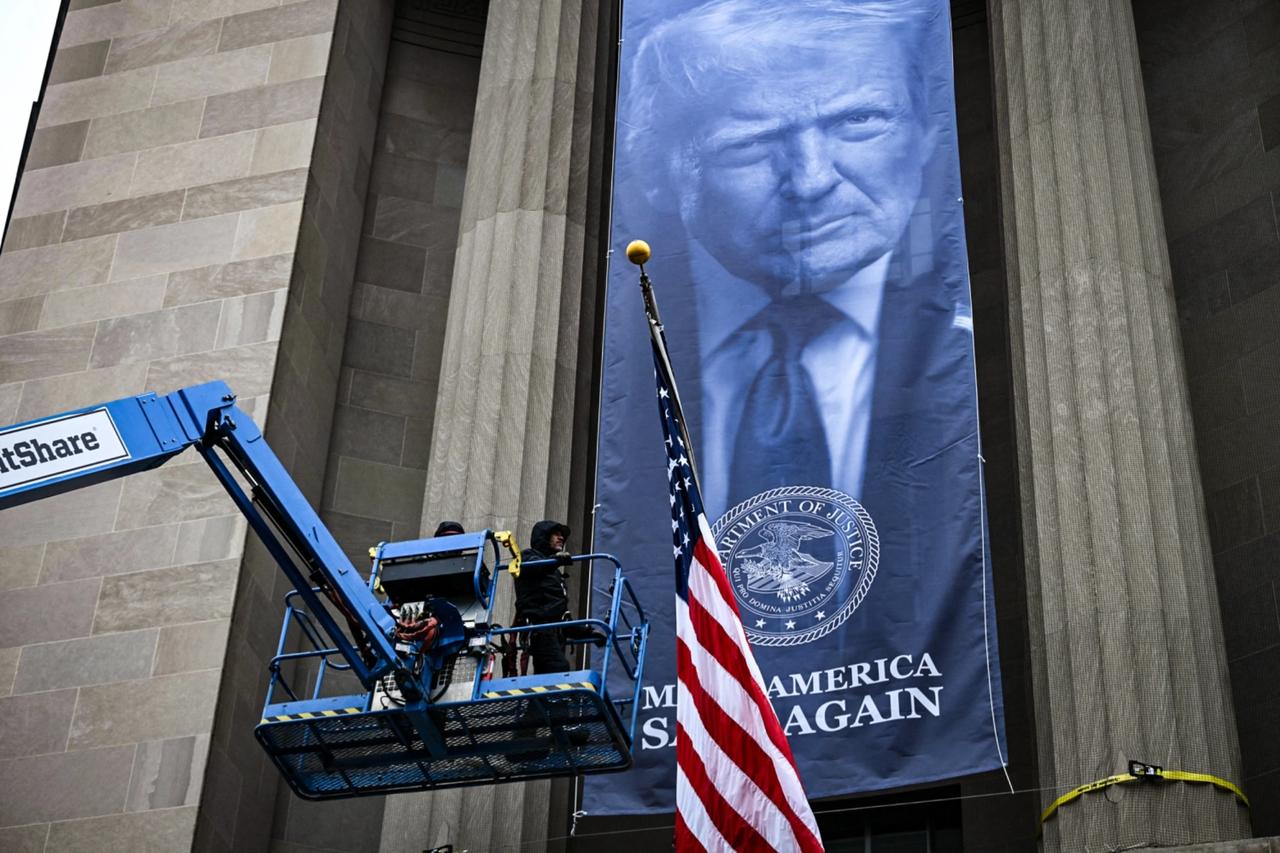


You walk up Pennsylvania Avenue expecting the Federal City, that particular Washington severity of white stone and right angles, where buildings were designed to remind you of your own smallness in relation to the state.
What you get instead, draped across the facade of the Robert F. Kennedy Department of Justice Building, is a scowl. A massive, banner-mounted scowl, staring down from the marble at anyone with the misfortune of passing by on a Tuesday morning.
It is, objectively, a strange thing to see.
And yet here we are, 18 months into a second Trump term, and the scowl has company. Across town at the Kennedy Center—technically, for the time being, the Donald J. Trump and the John F. Kennedy Memorial Center for the Performing Arts—the gold lettering has already been ordered removed by a federal judge who found the renaming illegal.
At the Institute of Peace, engravers arrived in December to chisel the president's name into stone while his administration was simultaneously gutting the institution's staff.
At the Department of Agriculture and the Department of Labor, similar banners came and went, their estimated cost exceeding $50,000 according to a Senate report published last September. A new class of Navy warships has been designated "Trump-class." The sixth-generation Boeing F-47 fighter jet carries its designation as a tribute to the 47th president. The national park pass now bears his portrait. The commemorative 2026 passport will carry his face and signature. There is, apparently, a TrumpRx.
The sheer scale of it forces a question that polite commentary keeps dancing around: Is this a real estate mogul's branding instinct running unchecked through the machinery of the executive branch, or is it something with a more durable ideological logic behind it?
The honest answer is probably both, which is exactly what makes it worth taking seriously.

The General Services Administration's own naming policy is unambiguous on the subject. Names submitted for federal spaces must be "in good taste and not inflammatory," and are meant to memorialize individuals who have "already served or passed away."
The rule exists because someone thought it necessary to write it down, a reasonable assumption being that no sitting president would need to be told not to name federal buildings after himself while still in office. That assumption, it turns out, was optimistic.
Only 9% of Americans believe it is acceptable to name government buildings after a sitting president, according to a Pew Research Center poll released last month, a figure that is lower than the 12% who believe the moon landing was faked.
The GSA policy also includes a line that cuts to the heart of the Kennedy Center dispute: "Spaces named by Acts of Congress can only be renamed by superseding legislation." The administration's response was to announce, via Truth Social, that Trump would instruct the Department of Commerce to arrange a full transfer of the Kennedy Center to Congress—a move that reads less like a principled constitutional position than like a developer walking away from a property he can't renovate the way he wants.
Beyond the renaming campaign, Trump's physical legacy projects across Washington reflect the same cult of personality in concrete and marble.
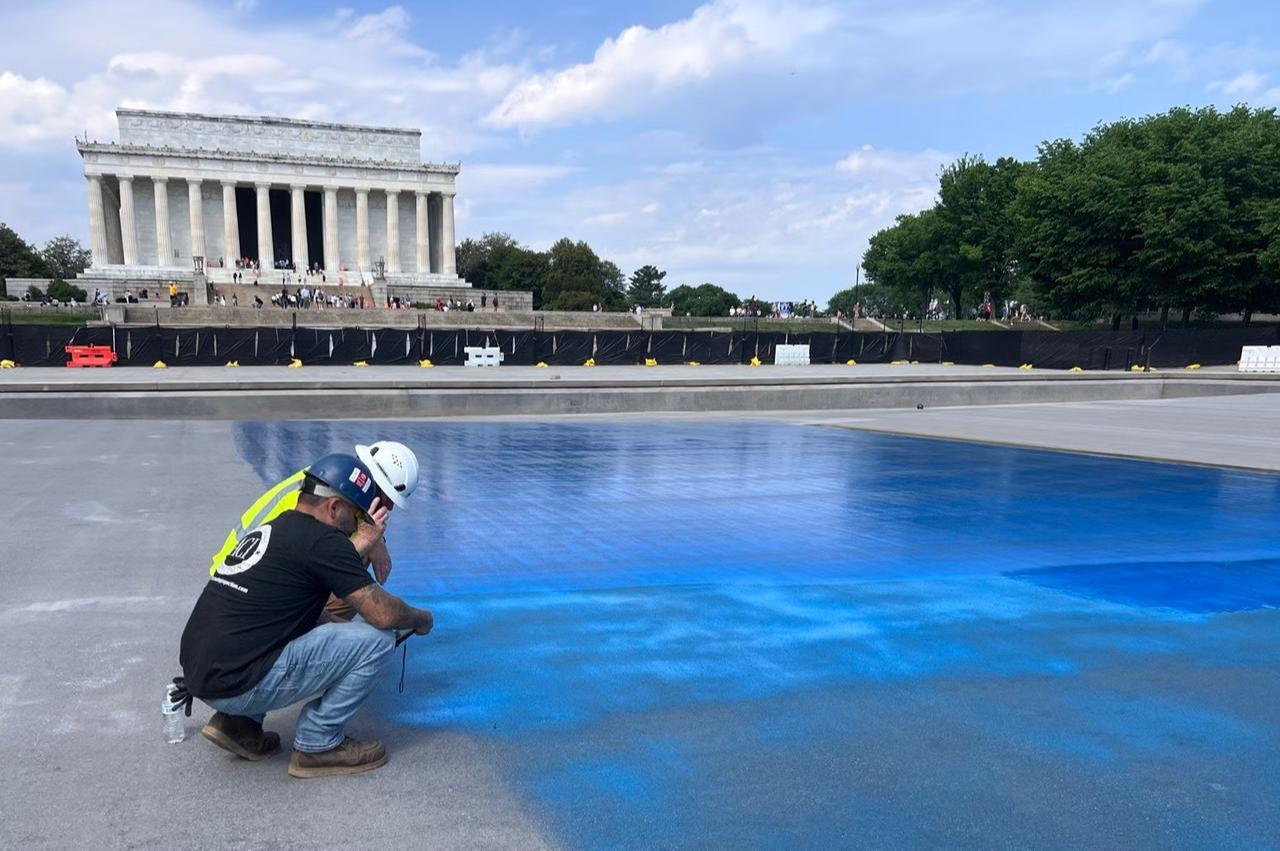
The White House's historic East Wing has been partially demolished to make way for a ballroom styled after Gilded Age opulence, the National Mall's reflecting pool is undergoing a redesign, and a new stadium on federal land near the Anacostia River is being proposed under the name "Trump Stadium" for the incoming Washington Commanders franchise.
Taken together, the projects amount to a sustained attempt to leave a visible mark on the capital's built environment, one that goes well beyond the nameplate.
Political scientists and architects of autocracy will recognize the psychology here, even if the American version arrives wrapped in gold letterhead rather than enforced by secret police.
As archaeologist Lauren Petersen, writing in The Conversation last October, observed of authoritarian monumentalism: "The awe we experience when we encounter something vast diminishes the individual self, making viewers feel respect and attachment to creators of awesome architecture." Napoleon understood this when he built the Arc de Triomphe. Louis XIV understood it when he expanded Versailles.
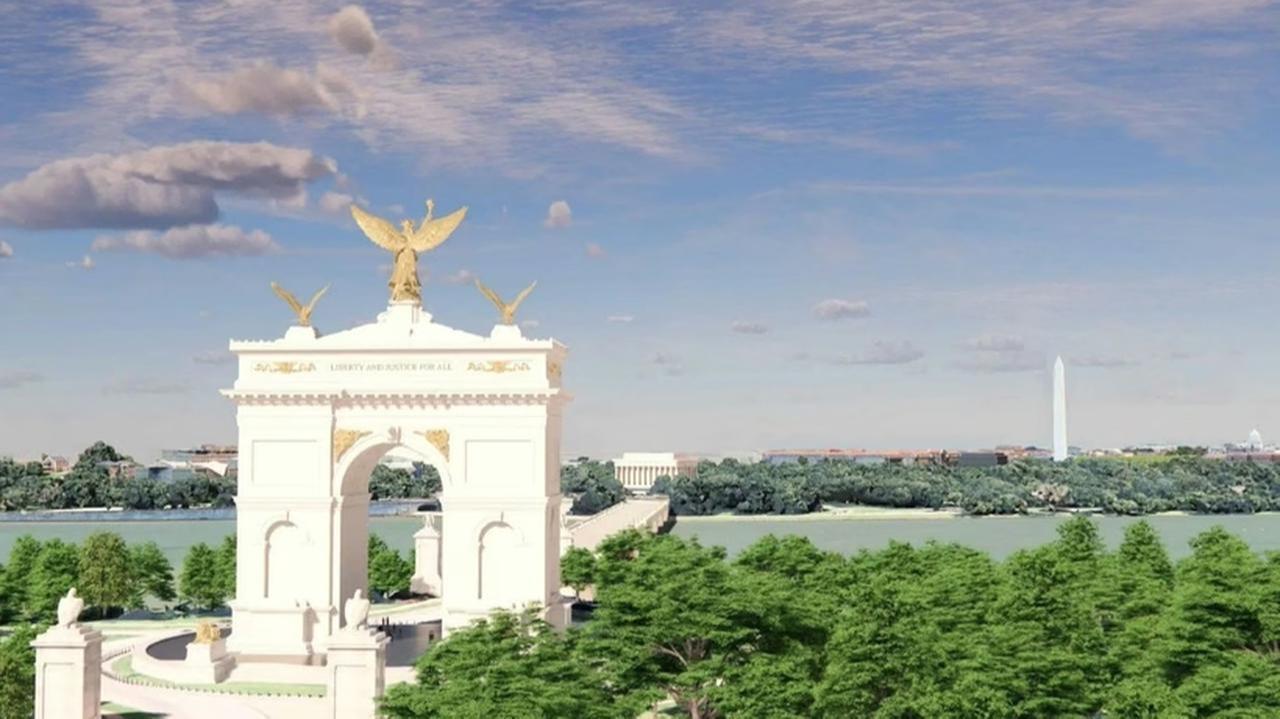
The proposed "Arc de Trump"—a 250-foot triumphal arch to be erected across the Potomac from the Lincoln Memorial—would appear to have been designed with some familiarity with this tradition, even if the White House frames it as infrastructure for the 250th anniversary of the Declaration of Independence.
What distinguishes the American case, for now, is the absence of coercion. Nobody is wearing Trump lapel pins under duress. Cabinet members are reportedly being nudged to wear ill-fitting black shoes in imitation of the president's style—a detail that is either trivial or telling depending on your appetite for symbolism. But Iraqi military commanders once grew matching Saddam Hussein mustaches out of something considerably more pointed than professional courtesy.
The edifice complex described by Jackson Diehl, writing in March, has reasons: autocrats do plaster their names on everything within reach, and they do it for the utilitarian reasons he identifies—psychological dominance, the blurring of the state with the individual, the demand for fealty enforced through imitation. But Trump operates closer to the vanity end of that spectrum than the terror end. The distinction matters, though it is not a reason for complacency.
What matters more, historically, is not the motive but the architecture of consolidation that the branding reflects. In many of the Middle Eastern regimes that have deployed this playbook, the monuments to the leader persist because the institutions that might challenge them have been cleared of dissent. The physical and the political work in parallel.
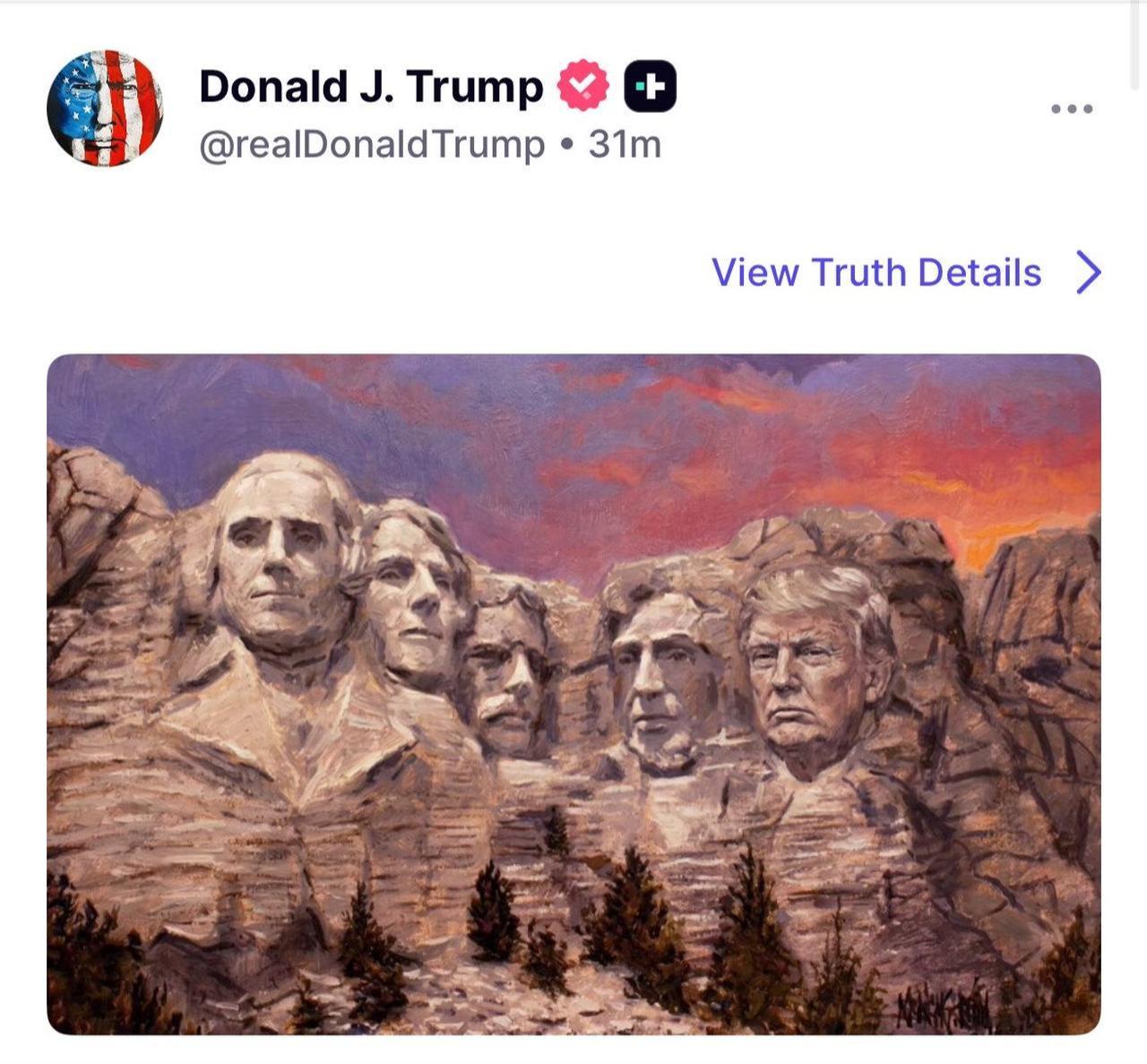
Trump’s tightening grip on the GOP is another face of the same cult of personality. After 24 years in the Senate, John Cornyn of Texas lost his primary runoff to state Attorney General Ken Paxton by twenty-seven points, days after Trump endorsed Paxton. Cornyn had spent years carefully calibrating his proximity to the president, threading every needle available to him, and it wasn't enough.
Louisiana's Bill Cassidy, who voted to convict Trump in the 2020 impeachment trial, came in third in his own primary. Brad Raffensperger, who refused in 2020 to "find" the votes Trump requested, lost his gubernatorial race to a Trump-backed loyalist.
Thomas Massie, a libertarian insurgent who made a career of defying party leadership, including Trump, was beaten by a Trump-endorsed challenger in the most expensive primaries of the party’s history. In total, there were nine high-profile Republican defeats so far in 2026, each of them a legislator who had, at some point, failed the loyalty test.
Leaders who build their names into stone almost always believe the stone will outlast them. The evidence suggests otherwise. In Syria, after December 2024, statues of the Assad family became rubble within days.
In the Philippines, the likeness of Ferdinand Marcos carved into a mountainside was eventually blown up with dynamite. In Baghdad, the image of Saddam Hussein in a traditional kaffiyeh survived the regime's fall only long enough to have its mouth shot out by residents in Basra. Mobutu Sese Seko's face was literally carved out of the currency when he fell in Zaire.
The most instructive case, for present purposes, is perhaps the least dramatic. In the Golan Heights, in a patch of contested territory Israel calls its own, there stands a sign—or what remains of one—announcing the settlement of Ramat Trump, Hebrew for "Trump Heights." The settlement was inaugurated in June 2019 with considerable ceremony. Benjamin Netanyahu stood before an enormous sign in gold letters, Hebrew and English. Within a year, most of the letters had been stripped off by vandals. The weeds were growing high. Construction had not begun. The nearest supermarket was a half-hour drive on unlit roads.
Whether a president's name on a building projects power or eventually becomes a monument to its own overreach is a question that tends to answer itself, but only in retrospect, and only after the cement has had time to settle.
The question worth asking now, while the engravers are still at work, is what kind of institution you want to find when the scaffolding finally comes down.


 Set as preferred source
 Set as preferred source


 1 min read
 1 min read