Newsletters




Some countries introduce themselves to the world with cathedrals, philosophers and centuries of carefully layered civilization.
The United States prefers monster trucks, constitutional brawls, celebrity lawsuits, and political combat so strange it feels less like democracy than a nationwide endurance performance staged in a junkyard at midnight.
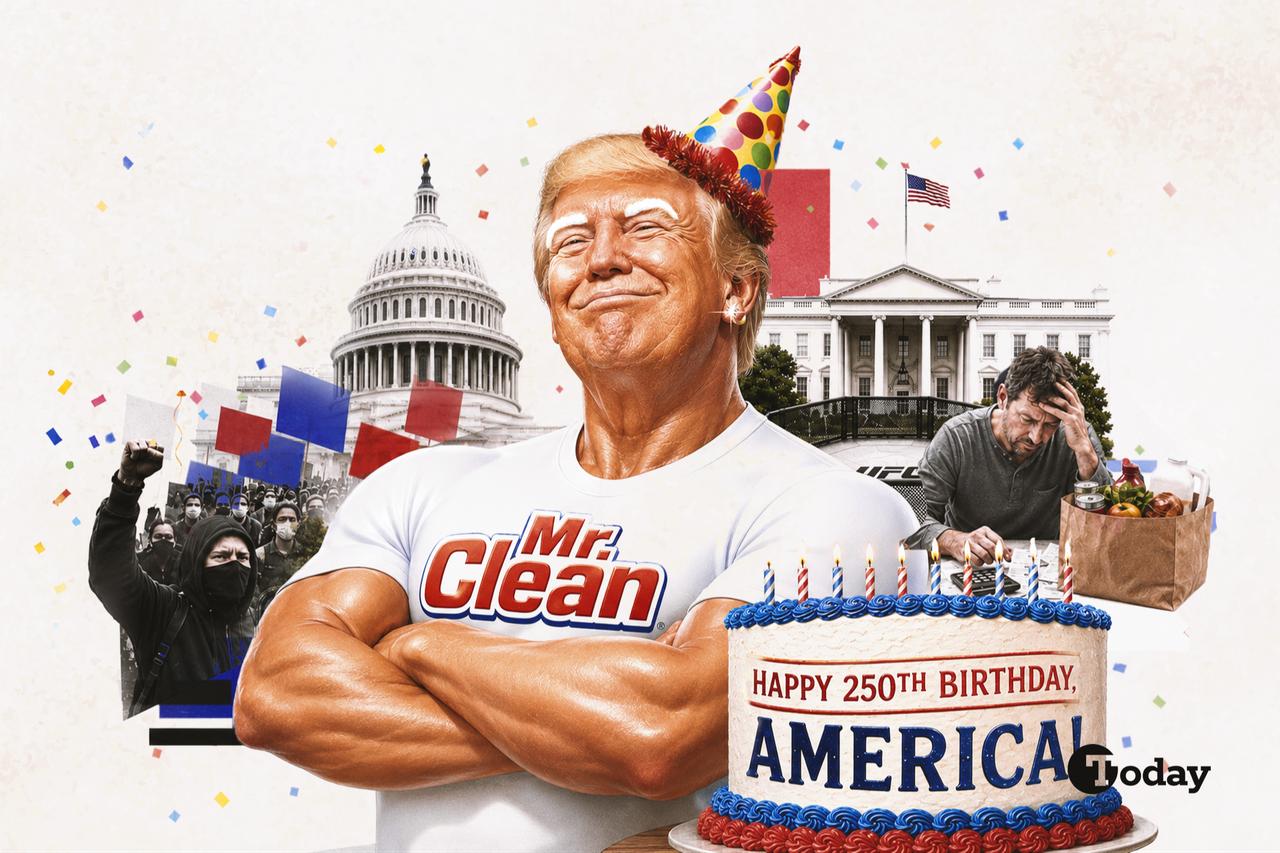
Indeed, that’s precisely why President Donald Trump has scheduled an Ultimate Fighting Championship bout—Freedom Fight 250—to take place on the White House South Lawn on Flag Day, June 14, which also happens to be his 80th birthday.
For non-Americans trying to understand modern America as it creeps toward July 4, 2026—its 250th birthday—begin here:
The loudest people are not the majority. They are merely the ones with microphones, livestreams, podcasts, tactical vests, and an industrial commitment to appearing online.
America contains multitudes. It also contains people who treat politics like a blood sport.
For years, an ecosystem of ideological fringe movements has flourished in the digital age. On one side stand militant left-wing activists operating under banners like antifascism—often shortened to “antifa”—a loose collection of activists rather than a centralized organization.
Some participants focus on protest and counterdemonstration. Others have embraced confrontation, street conflict, and a belief that extraordinary political threats justify extraordinary tactics.
Across from them emerged a volatile constellation of right-wing activist networks, nationalist groups, online agitators, militia enthusiasts, and political entrepreneurs who discovered that MAGA outrage scales beautifully on social media.
America’s political fringe learned a brutal lesson during the smartphone era: attention is currency.
Film conflict. Edit conflict. Upload conflict.
Repeat until monetized and MAGAnetized.
Figures who built reputations documenting street unrest became symbols themselves. Activists filmed activists filming activists. Rival tribes constructed rival realities. One side saw dangerous extremism requiring resistance. The other saw political persecution requiring defiance. Every confrontation generated fresh content. Every upload hardened loyalties.
Polarization became an industry.
Trump did not invent America’s divisions. The country carried old fractures long before he descended an escalator in Manhattan in 2015. Race. Class. Geography. Immigration. Cultural identity. Distrust of institutions. America had been arguing with itself since powdered wigs and muskets.
The country has always been mopping up the mess. Cable TV news networks, for instance, could not pay their pundits without inexhaustible commercials for household cleaners.
But Trump recognized something other household cleaning products missed. He weaponized attention itself.
When violence emerged around protests in cities like Portland, clashes between ideological factions became national theater. Competing narratives hardened into competing realities. Americans increasingly inhabited parallel information systems that interpreted identical events through entirely different moral frameworks.
The result is not merely confusion. It is a profitable carnival of competing charismas.
The American center—large, quieter, exhausted—watches with the haunted expression of airline passengers discovering both pilots are screaming.
Now, Trump carries an assignment unlike any American president before him. Guide an anxious republic into its 250th birthday, a quarter of a millennium old.
And somewhere inside all this noise sits the ordinary American citizen attempting to buy groceries, pay rent, raise children, and survive another election cycle without developing stress-induced heart palpitations.
Foreign observers have a knack for misreading Trump because they mistake spectacle for structure. Faithful Americans counter that the nation’s greatest tradition—and durability—is a messy correction from madness, although a casual stroll through MAGA-controlled Washington shows that faith doesn’t prove anything.
“The primary and overriding duty and responsibility of each Member of the House and the Senate is to get re-elected,” Congressman Adam Clayton Powell Jr. presciently observed in 1963. “Their number one purpose is to get back on the payroll. The only time this is not true is when a Member has accepted a much more lucrative position in private industry or has voluntarily retired.”
As of now, a record 14 senators and 57 House members have chosen not to return to their current seats after the 2026 midterm elections. Another 10 have resigned, and three have been defeated in primaries. Five have died.
America at 250 will not resurrect the triumphant certainties of 1776. It will emerge as the launch platform for a full-throttle epistemological war against the future of democracy at home and abroad.
And that’s more than a problem, because boxcar loads of reliable studies augur that the overwhelming majority of Americans would likely confuse epistemology with a urine test.
To be sure, the most recently cited national adult literacy figure for the U.S. shows that 54% of U.S. adults read below the equivalent of a sixth-grade level.
Think of the cascade effect of this population drifting over America and its allies like cigarette smoke, while television prophets and algorithm mechanics shovel noise into the bloodstream by the metric ton.
Is there a way to win the epistemological war—the dirty business of flooding reality itself with distortion, collapsing trust, and sabotaging shared facts until people fight over the existence of the ground beneath their shoes—against a population in which the vast majority of adults have reading skills below those of an 11-year-old?
I don’t think so. Which is likely why Trump, live on TV said, “I love the poorly educated.”


 Set as preferred source
 Set as preferred source


 7 min read