Newsletters


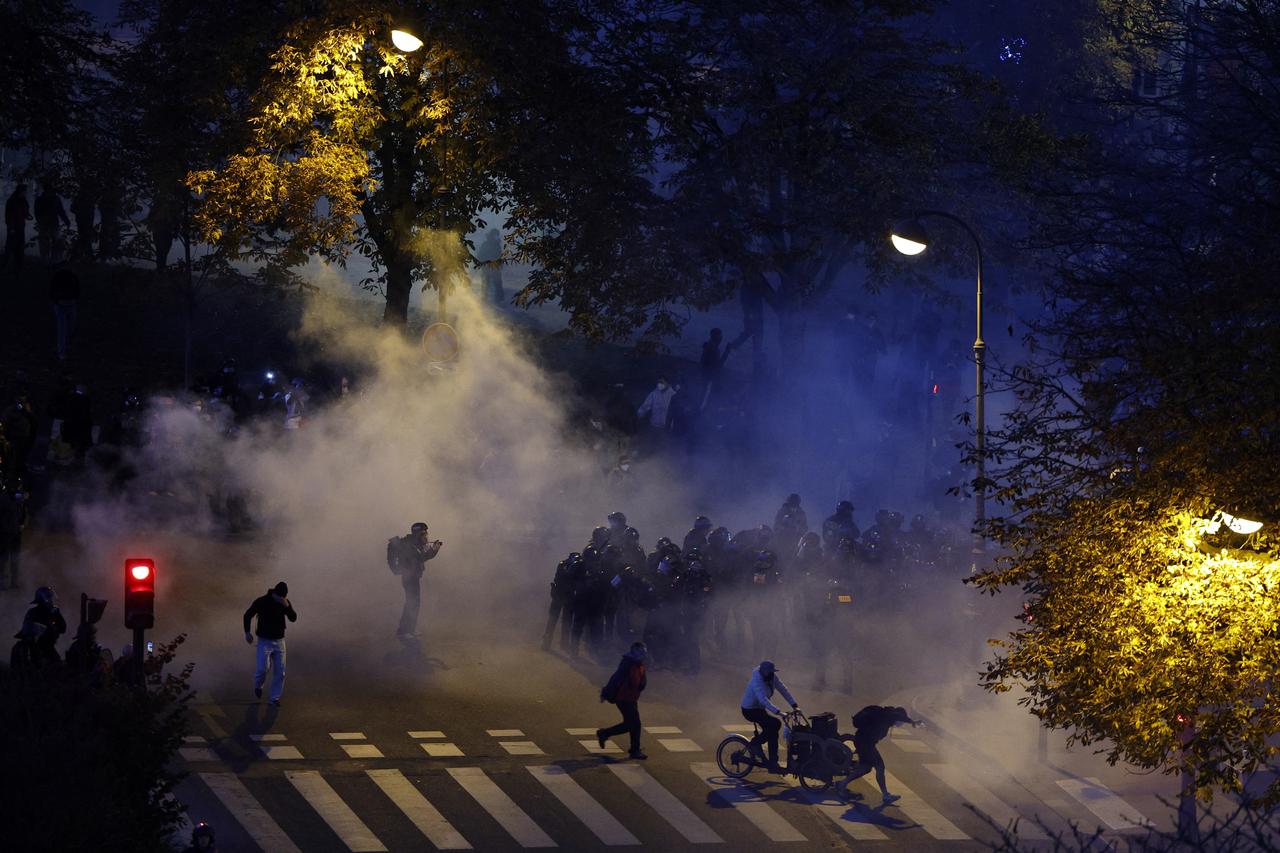


Around 106,000 people joined cost-of-living protests across France on Saturday, including 24,000 in Paris, the interior minister said. That was the lowest turnout estimate for weekend rallies in recent weeks. Student unions gave a far higher count of 200,000 nationwide, with almost 100,000 of them in the capital.
Demonstrators filled streets in cities across the country. Some climbed statues carrying French flags, and their grievances ranged from rising prices to a bill that would give police greater legal protection. The unrest has gripped the European Union’s second-largest economy for more than a month, with high school blockades and mass demonstrations. The far right leads polls to win next year’s presidential election, when Emmanuel Macron’s time in office ends.
Students, unions and Yellow Vest activists marched in Paris, the fifth Saturday in a row that protesters have taken to the streets. The Yellow Vest movement first emerged in 2018 over fuel taxes and living costs.
“No justice, no peace,” one protester shouted into a megaphone. Others demanded that the president resign or chanted “Everybody hates the police.” One group carried a giant puppet wearing a hat that read “Lord Macron.”
Some of the largely peaceful rallies in recent weeks have seen violence at the fringes. There have also been accusations of police brutality, including against young teenagers. Lawyers said last week that police violence at recent protests had caused “mutilations,” including injuries to hands, feet and eyes.
Saturday’s rallies were largely peaceful, but police fired tear gas in Paris, Bordeaux and Nantes. In Lyon, police had to step in to protect a team of television reporters after protesters attacked them, local authorities said.
For many in the Paris crowd, the main issue was a new bill in parliament that would give extra protection to police officers who use their weapons. Backers include the far-right party of presidential hopeful Marine Le Pen. They say a law presuming officers acted in self-defense is needed so that police are not automatically suspected of using disproportionate force.
Activists say the measure would amount to a “license to kill.” They argue it would hamper the opening of investigations and make holding security forces accountable even harder, in a country where alleged police brutality cases rarely reach a criminal court.
Adrien, a 20-year-old cello player in a volunteer orchestra at the Paris rally, said the bill had made protesters more fearful. Tear gas fell on protesting musicians last month. “We’re scared when we come to a protest, and this will only make us even more afraid if their impunity is strengthened,” he said.
Other demonstrators called for better learning conditions, more children’s rights or simply a better France. In Bordeaux, 72-year-old Josette sang a protest song, “I have two passions: brass bands and revolution.” She said her children had not wanted her to attend, but she was grateful to young people for starting the movement. “They’re giving us hope at a time when it feels like we’re heading straight for disaster, with a planet that keeps getting hotter and far-right movements that are increasingly unapologetic,” she said.
In Toulouse, Kenza, a 28-year-old asylum law specialist, condemned the government’s handling of the unrest. “The repression of protesters is unacceptable, even more so when they are children,” she said.
Recent polls show Macron’s popularity at its lowest since he first became president in 2017. The government has little room to meet protesters’ demands as it struggles to reduce its debt. Polls also project hard-left candidate Jean-Luc Melenchon finishing second in next year’s election, while the centre-right has struggled to field a single strong contender.
Unions have called a new day of strikes for Tuesday. They rejected a government promise to raise the minimum wage by 0.6 percent, dismissing it as “crumbs.” The largest turnout in recent weeks came during a union-led strike on Thursday last week, when more than half a million people took to the streets nationwide, according to official figures.


 Set as preferred source
 Set as preferred source


 1 min read

 1 min read