Newsletters


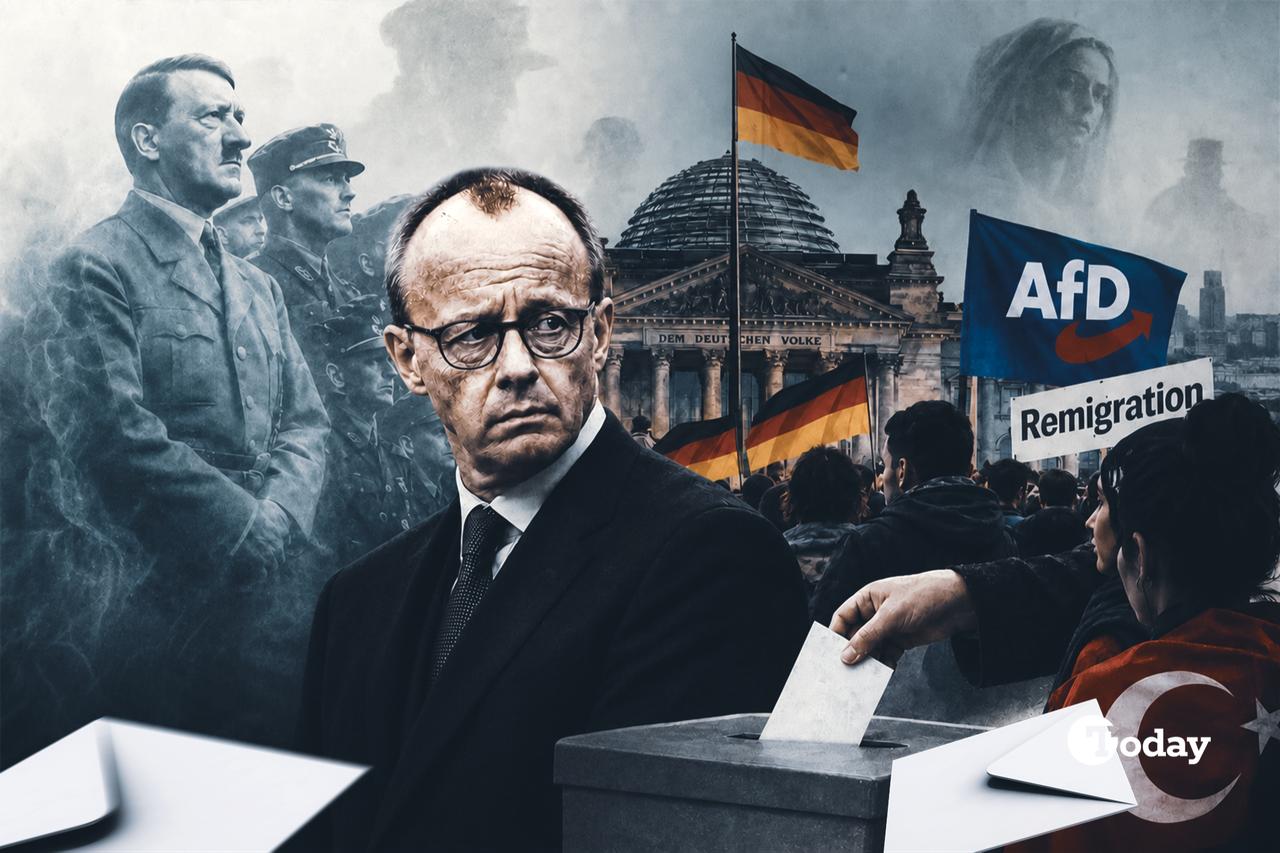


There are few things more unsettling than a German political ghost story in which the skeletons stop haunting the house and start winning elections.
Germany’s roughly three million people of Turkish descent have a particular reason to gasp. About 1 million were eligible to vote in 2025, and the AfD’s campaign for “remigration” has turned the question of who belongs in Germany into something considerably more personal than another Sunday-night shouting match on television.
They are no political tribe, but Turkish-origin voters have generally leaned left; one 2025 study put the SPD at 35%, the CDU/CSU at 12%, and the AfD at just 8%.
Chancellor Fredrick Merz now finds himself squeezed between an AfD he accuses of taking remigration toward ethnic expulsion and immigrant-origin voters his CDU has struggled to capture. It is a miserable piece of political geometry.
And that squeeze is one reason Merz will not be drinking cocktails in Manhattan next week. The chancellor was supposed to attend the U.N. General Assembly but has suddenly discovered that his presence is “required in Berlin.”
Indeed. When smoke starts curling under the cockpit door, the pilot does not fly to New York to discuss multilateralism.
The burn is thick. On Sept. 6, the AfD took 43.8% in Saxony-Anhalt, while Merz’s CDU received 17.2%, with turnout at 77.8%.
Those are not the hallucinations of some plastered pollster barricaded in the back room of a Leipzig nightclub. They are votes, which is considerably worse.
Now comes Sept. 20 and the calculus of confusion. In Mecklenburg-Western Pomerania, recent polling has the AfD around 37–38%, the SPD at 33–34, and the CDU—once the great armored personnel carrier of German conservatism—wheezing along at an almost comic 7%. Berlin offers no aspirin: polling there puts the CDU and Left around the low twenties, with the AfD in the high teens.
So Merz stays home while the machinery rattles and party grandees gather on Sunday to demonstrate unity, which in politics is traditionally what everybody announces shortly before checking the room for knives.
National CDU/CSU support is down around 18–20%, and an INSA survey found 78% of Germans saying Merz is not the right man for the chancellorship.
Merz insists he will serve his four-year term. Markus Soder, the CSU chief, insists he supports him. There is an enormous amount of insisting going on in Berlin these days, never a reassuring symptom in a capital full of ambitious men.
The historical temptation is obvious, but the more useful question is how democracies get themselves into this kind of mess. Germany knows better than most the chemistry by which economic anxiety ferments into grievance, grievance hardens into identity and identity eventually goes looking for somebody to blame.
The Nazi movement crawled out of Munich’s radical nationalist swamp after the First World War. Hitler joined the German Workers’ Party there in 1919; it became the NSDAP, attempted a putsch, failed, reorganized, and increasingly pursued power through elections. In 1928, the Nazis received less than three percent nationally. Then the economy cracked, the political center buckled, and millions of respectable voters went shopping for something harder.
Umberto Eco understood the pathology because he had spent his childhood under Mussolini. In "Ur-Fascism," later collected in English in "How to Spot a Fascist," he identified recurring characteristics, including the “fear of difference,” an appeal to social frustration and an “obsession with a plot.” His coldest formulation required only three words: “disagreement is treason.”
That makes Eco useful now—not as some ideological breathalyzer for stamping FASCIST across the forehead of every nationalist politician, but as a field guide to the habits that appear before democracy begins behaving strangely.
The AfD began in 2013 as a Eurosceptic party and evolved into a nationalist, fiercely anti-immigration force whose politicians have promoted “remigration” and repeatedly generated controversies over Germany’s Nazi past.
The party rejects accusations that it is extremist or anti-Semitic.
Its rise is also feeding on grievances that cannot be laughed away as mass delusion: high energy costs, economic stagnation, anger over migration, the burden of supporting Ukraine and the lingering eastern German conviction that reunification was a banquet at which somebody else got the good table.
Merz’s answer is reform, cheaper fuel and new trade agreements. Perhaps that will work. But there are political fevers that do not respond to cheaper petrol.
The uglier varieties of politics rarely advertise themselves as such. They arrive selling solutions: somebody betrayed you, somebody stole the country, somebody does not belong here, and some magnificently uncomplicated lunatic will finally clean up the mess.
History does not repeat itself with enough precision to be useful. It changes clothes, buys a smartphone, hires consultants, and discovers social media.
Munich is still there. So are the old photographs.
History too often grows malicious when sozzled. It may forget your name, but it remembers the address.


 Set as preferred source
 Set as preferred source


 1 min read