Newsletters


Ukraine claimed extensive drone strikes on Russian vessels in the Sea of Azov overnight into Saturday, prompting Russia to temporarily halt shipping through two key waterways and triggering a jump in global wheat prices, as both countries also exchanged strikes on land targets.
Ukraine's General Staff said in a statement that units of Ukraine's Defense Forces struck vessels in the Sea of Azov overnight into July 11 as part of efforts to reduce Russia's "military-economic potential."
The statement said 21 Russian tankers were hit, along with four tugboats, two dry cargo vessels and a dredger, which it said Russia uses for military logistics, cargo transport and port infrastructure support.
"The tankers are used to transport oil and petroleum products in circumvention of international sanctions, ensuring the flow of funds to finance armed aggression against Ukraine," the General Staff said, adding that the extent of the damage was still being determined.
Separately, Ukraine's Unmanned Systems Forces said on Telegram that at least 25 vessels had been struck in the Sea of Azov.
Ukrainian drone unit commander Robert Brovdi, known as Madyar, said in a Telegram post that Ukraine struck 28 vessels overnight, including tankers and dry cargo ships, and that a total of 76 vessels had been hit since July 6.
These figures could not be independently verified, and the differing vessel counts across Ukrainian military channels are reproduced here as reported by each respective source.
Ports on the Sea of Azov are not commonly used for loading Russian crude oil for export; tankers there mostly transport petroleum products to Russian-annexed Crimea and surrounding areas, where fuel shortages have become common this summer.
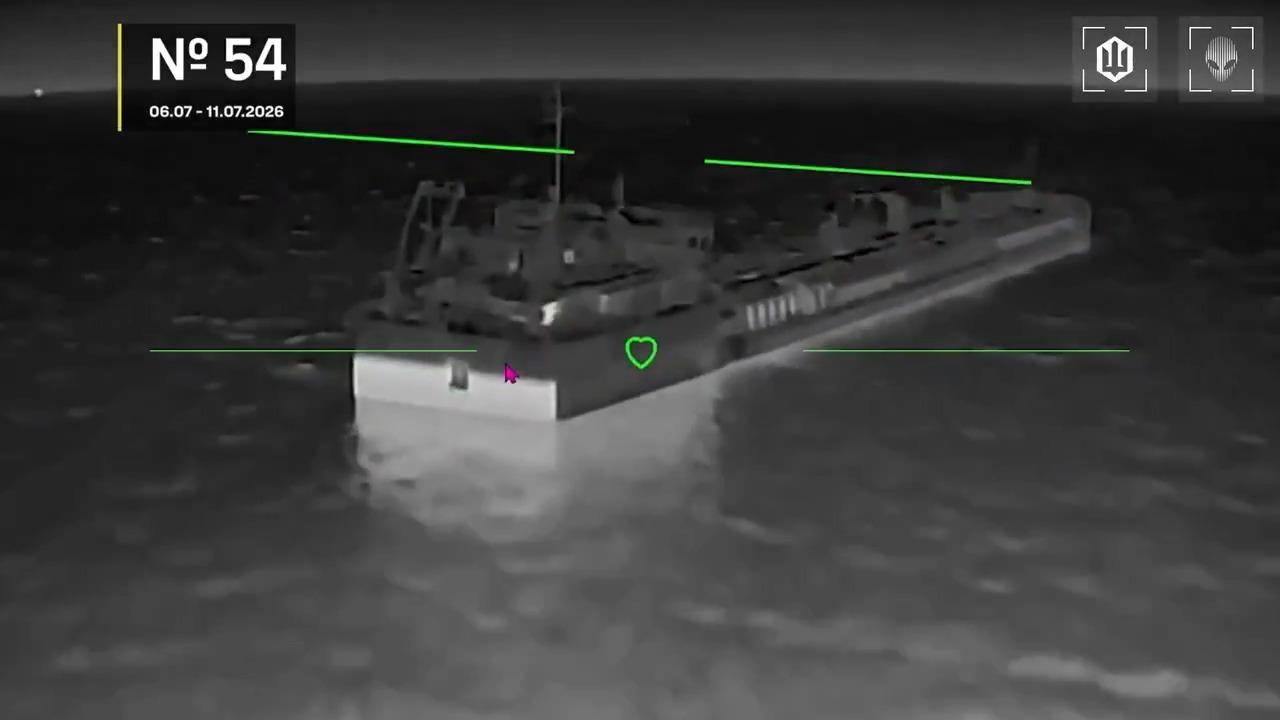

Rostov region Gov. Yuri Slyusar said in a statement that four civilian vessels of various types, including a tanker carrying methanol, came under drone attack in Taganrog Bay.
"Today, vessels in the Taganrog Bay once again came under a drone attack. A tragedy occurred — a sailor aboard a civilian technical vessel was killed," Slyusar said, adding that all vessels sustained minor damage and that there was no threat of a methanol leak or environmental contamination.
Slyusar said more than 15 drones were shot down while repelling the attack, which also targeted the city of Taganrog and the Azov and Nekliniovsky districts, and that a drone threat remained in place across Rostov region at the time of his statement.
He urged residents to avoid open areas, stay indoors and away from windows.
In a separate post, Slyusar said fires that broke out in Taganrog and Azov the previous day had been fully extinguished by Saturday morning, thanking emergency services, and said evacuated residents of Taganrog and Azov could return home, with the drone threat over the region subsequently lifted.

Russia temporarily halted shipping through the Don-Azov Channel, a waterway linking the Don River with the Sea of Azov, three sources in the grain export industry told Reuters.
Reuters reported that Russia's border guards, who report to the FSB security service, notified shipping companies that requests for passage through the Kerch Strait, which connects the Sea of Azov and the Black Sea, would not be accepted starting at 6:10 p.m. local time on Friday, without specifying when the halt would be lifted.
The move followed a Ukrainian attack on 13 Russian vessels in the Sea of Azov on Friday, including 10 tankers, according to Reuters' sourcing.
Market analysts cited by Reuters said up to a quarter of Russia's wheat exports, Russia being the world's largest wheat exporter, pass through the Sea of Azov, with the country's leading grain-producing regions, Rostov and Krasnodar, located along its coast.
Euronext wheat prices rose as much as 4% Friday to a six-week high amid market speculation about a possible closure of Sea of Azov shipping, according to Reuters.


 Set as preferred source
 Set as preferred source



 4 min read