

 Newsletters


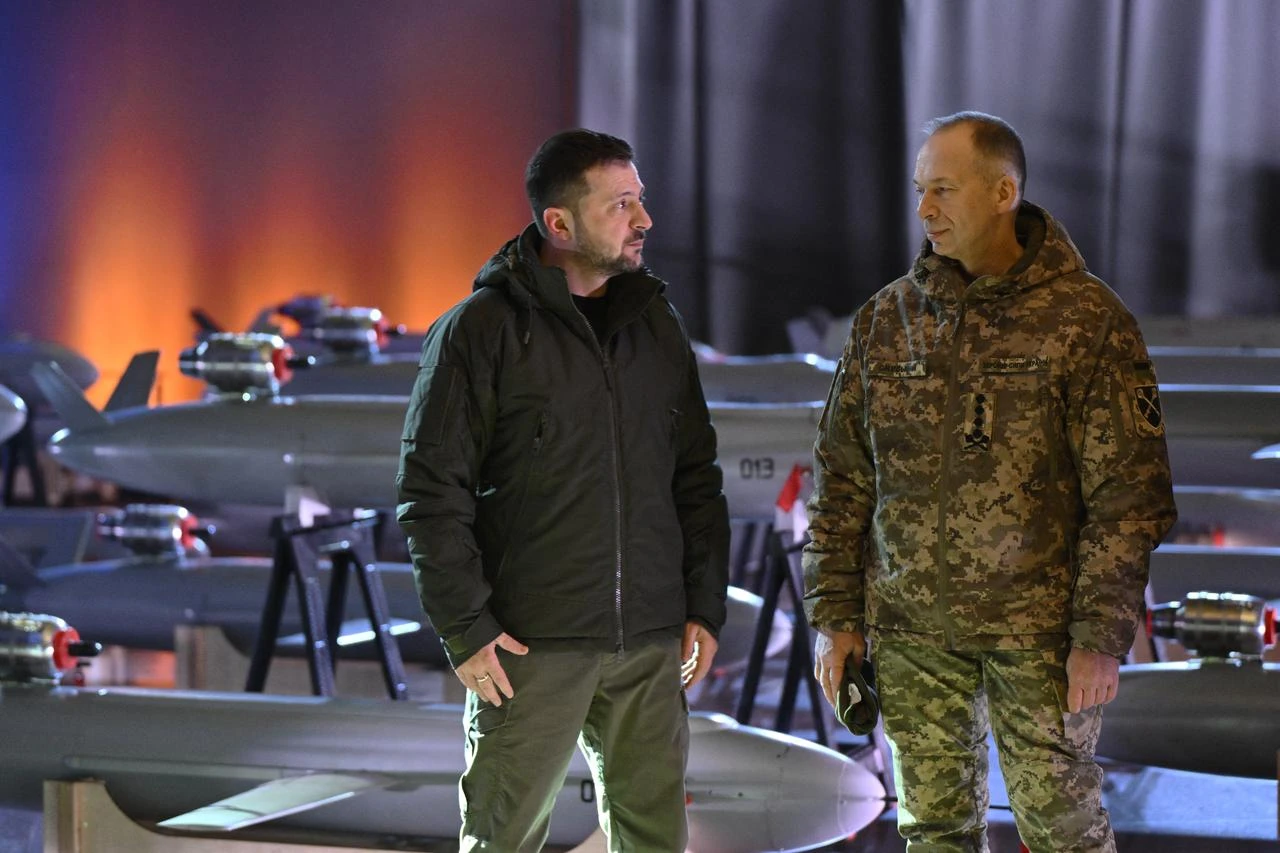


Ukrainian President Volodymyr Zelenskyy dismissed Oleksandr Syrsky as commander-in-chief of the armed forces on Tuesday, bowing to days of street protests and naming 43-year-old joint forces commander Mykhailo Drapaty as his successor in the most dramatic military reshuffle since Russia launched its full-scale invasion in February 2022.
"I have decided that the new Commander-in-Chief of the Armed Forces of Ukraine will be Mykhailo Drapaty," Zelenskyy said in a statement posted to Telegram, adding that he was grateful to Syrsky "and to each of our warriors for Ukraine's strong front-line positions."
The announcement ended a week of acute political turbulence that had shaken the foundations of Ukraine's wartime government. At its root was Zelenskyy's surprise removal of popular Defence Minister Mykhailo Fedorov just six months into the job. F
edorov publicly blamed Syrsky for orchestrating his ouster, a charge Syrsky denied.
Thousands took to the streets in Kyiv and other cities demanding Syrsky's removal instead, in the largest demonstrations Ukraine had seen since Russia's invasion began.
Syrsky, 60, had served as commander-in-chief since early 2024, leading the defence of Kyiv at the outset of Russia's assault and directing two of Ukraine's most celebrated battlefield operations: a lightning counter-offensive in the northeastern Kharkiv region in 2022 and the audacious incursion into Russia's Kursk region in 2024, the first sustained foreign military operation on Russian soil since World War II.
Yet the very qualities that made Syrsky useful to Zelenskyy proved, in the end, to be his undoing.
Born in Soviet Russia and trained at a Red Army academy in Moscow, he never fully dispelled doubts about his cultural ties to the country Ukraine is fighting. His parents and brother still live in Russia.
When asked about Syrsky after the Kursk operation, his brother told state news agency TASS that the two had long since stopped speaking. "I'm not in touch with him ... I don't know anything about him," he was quoted as saying.
Critics had long called Syrsky a "butcher," accusing him of disregarding the human cost of his operations. Analysts described him as a commander whose strength lay in his unconditional loyalty to the president rather than in strategic innovation. "He is not a politician. Just look at him.
He speaks Ukrainian poorly and is not a public communicator," said Anatolii Oktysiuk of Kyiv's KI Research Group. "He always adapts to what Zelenskyy wants."
That very adaptability, Oktysiuk argued, had become corrosive over time. Syrsky "built a system in which initiative and independence are suppressed, while a loyal cadre of generals is promoted instead."
For Zelenskyy, a leader analysts describe as wary of subordinates with political ambitions, Syrsky's lack of popular appeal had long been an asset.
It set him apart from his predecessor, Valery Zaluzhny, who was removed in part because of his broad public standing. As recently as Monday, Syrsky had published a rare article insisting: "My job is war ... I have no political ambitions. I deal with the war 24/7."
It was not enough to save him.
The rupture between Syrsky and Fedorov had long been reported in Ukrainian media, but it burst into the open after Zelenskyy dismissed the defence minister on July 15.
Fedorov, a 35-year-old technology specialist and former minister of digital transformation, had been appointed to the defence portfolio in January 2026 with a mandate to modernise the military's management culture.
He immediately set about tackling what he described as excessive bureaucracy, non-transparent arms distribution and a Soviet-style command mentality. "We cannot fight a war with new technologies but an old organizational structure," he told parliament at the start of his tenure.
Fedorov alleged that Syrsky had systematically blocked his reform agenda on procurement, equipment and mobilisation, and had then pressured Zelenskyy to remove him. "All the initiatives we were proposing started to be blocked," Fedorov said, adding that Syrsky "is not ready to look you in the eye and openly talk about those problems."
Even as protests swelled across Kyiv and other cities, Zelenskyy initially appeared to stand by his military chief, convening days of intensive meetings with senior commanders. After a week of mounting pressure, he relented late Tuesday.
Drapaty has spent two decades moving through some of the conflict's most demanding commands.
He helped stabilise the southern front during the early weeks of the full-scale invasion, played a role in the liberation of right-bank Kherson in 2022, and was later appointed to lead the Ground Forces before moving to the joint forces command.
Those who have worked alongside him describe a general more inclined to consult his subordinates than to simply issue orders, a style that stands in sharp contrast to what observers say defined the Syrsky era.
Fedorov, who had publicly championed Drapaty in the days preceding the announcement, welcomed the change as an opportunity to reinvigorate a military establishment he said had grown rigid.
"The war has completely changed," Fedorov said. "The command-and-control system has changed, and we have to change."
Zelenskyy, in his statement, acknowledged the scale of Syrsky's contributions, citing his record at Kyiv, Kharkiv and Kursk. But with Ukraine under continued pressure along extended front lines and its Western partners watching the internal upheaval closely, the president signalled that past achievements could no longer outweigh the cost of leaving the command structure unreformed.


 Set as preferred source
 Set as preferred source


 1 min read
 1 min read


