Newsletters




The United States has ordered civilian federal agencies to stop using artificial intelligence tools developed by Chinese startup DeepSeek, citing concerns that sensitive data could be transferred to China, as Washington steps up scrutiny of the company that challenged American dominance in the global AI market.
The Department of Homeland Security announced the restrictions on Monday, extending the ban to third-party applications built using DeepSeek technology. China criticized the decision, accusing Washington of "overstretching" the concept of national security.
Founded in 2023, DeepSeek has emerged as a major competitor to American AI developers, attracting international attention with its low-cost technology while facing growing questions over censorship, data security and its access to advanced semiconductor chips.
DeepSeek was founded by Liang Wenfeng in Hangzhou, a major technology center in eastern China, as a side project of his quantitative hedge fund, which used data-driven investment strategies and had access to powerful Nvidia AI processors.
The company gained worldwide attention in January 2025 after rolling out R1, an advanced AI model designed to carry out complex reasoning tasks.
Its performance reportedly approached that of leading American chatbots, including ChatGPT, despite DeepSeek's claims that it had developed the technology at a fraction of the cost.
The announcement triggered a sell-off in U.S. technology stocks and prompted venture capitalist Marc Andreessen to describe the breakthrough as a "Sputnik moment," referring to the Soviet Union's launch of the first artificial satellite in 1957, which caught Western countries by surprise.

DeepSeek's rapid expansion has also raised concerns about how its systems handle politically sensitive information and user data.
Like other Chinese chatbots, its AI tools generally avoid subjects censored in China, including the 1989 Tiananmen Square crackdown.
Such restrictions, combined with concerns over potential data transfers, have led governments, including those of Australia and South Korea, to limit DeepSeek's use on official devices.
The latest U.S. restrictions go further by prohibiting civilian federal agencies from using DeepSeek products and third-party tools developed with its technology.
Despite those measures, DeepSeek remains attractive in developing markets because of its relatively low costs and ease of deployment.
According to web analytics company Similarweb, DeepSeek accounts for approximately 4% of global chatbot web traffic, compared with ChatGPT's 68%.
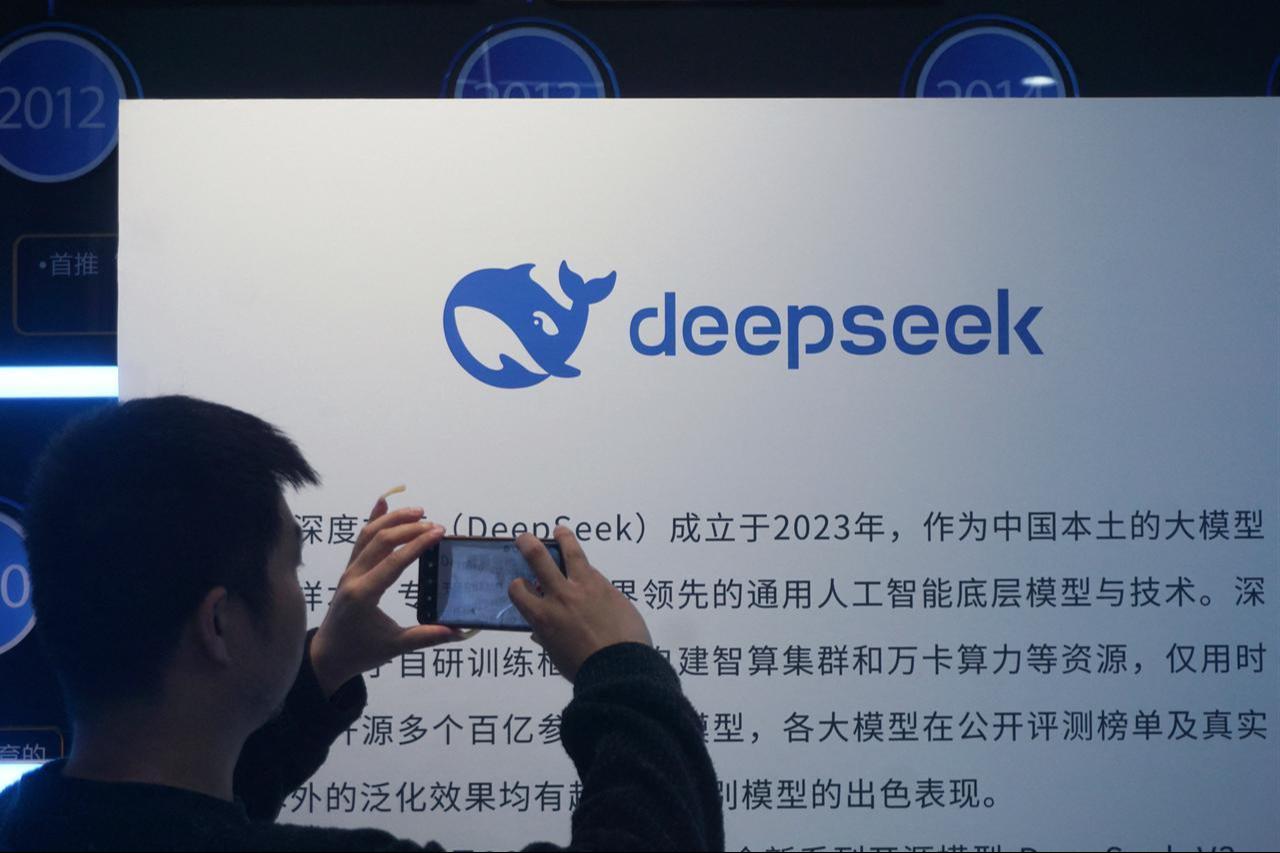
A key factor behind DeepSeek's popularity is its open-source approach, which allows developers to access and modify publicly available model components to meet their own requirements.
Other major Chinese technology companies, including Alibaba, have embraced similar approaches, contrasting with the proprietary models offered by OpenAI and several Western competitors.
Beijing has promoted open-source AI as a way to speed up technological development and encourage broader adoption.
Chinese National People's Congress spokesperson Lou Qinjian highlighted the country's position in April, saying, "Chinese AI models are leading the way in the open-source innovation ecosystem."

DeepSeek's success has helped boost investor interest in China's artificial intelligence sector, despite ongoing technological competition with the United States and concerns about a possible global AI market bubble.
Chinese AI startups Zhipu AI and MiniMax recorded strong stock market debuts in Hong Kong this year, while domestic semiconductor companies, including MetaX, also attracted investor attention.
In June, investors valued DeepSeek at more than $50 billion during its first funding round, according to The Wall Street Journal.
Shi Yaqiong and her team at Beijing-based investment firm Jinqiu Capital told AFP that DeepSeek's breakthrough had brought about a "clear surge" in enthusiasm for Chinese AI companies, alongside increased competition among investors.
DeepSeek has also faced scrutiny over reports that it obtained restricted U.S.-made semiconductors to train its latest AI systems.
Technology publication The Information reported in December, citing six people familiar with the matter, that DeepSeek had developed its V4 model using thousands of advanced chips allegedly dismantled in third countries and smuggled into China.
The allegations concern U.S. export restrictions designed to prevent China from obtaining advanced semiconductors used to train powerful AI models.
DeepSeek did not respond to AFP's request for comment at the time. Nvidia, meanwhile, told The Information that it had seen no evidence supporting the allegations and that "such smuggling seems far-fetched."
In April, DeepSeek said it had used both Nvidia processors and Huawei's domestically produced Ascend chips for its new model.
Huawei subsequently confirmed that its Ascend product range supported DeepSeek's V4 series, underscoring China's efforts to develop alternatives to American semiconductor technology.
Washington, however, maintains that DeepSeek's latest model remains approximately eight months behind the most advanced AI systems developed by U.S. companies.


 Set as preferred source
 Set as preferred source



 2 min read