Newsletters




Imagine walking past a shop window and spotting a watch you have admired for years. Beside it hangs a sign: "60% off."
Your first thought might be that you have found a bargain. Your second: what is the catch?
Is the seller clearing out stock? Has demand collapsed? Or is there something wrong that you cannot see?
Now replace the watch with a stock market and the display with shares in banks, airlines, retailers and industrial companies, some with businesses stretching far beyond their home countries. Their valuations sit well below those of their international peers.
That is the proposition confronting foreign investors looking at Türkiye: a market that appears to offer a substantial discount, but where the debate is as much about the reasons behind the price as the opportunity it presents, particularly after September’s fund rout, when several portfolio managers failed to meet investor withdrawal requests.
According to data from global index provider MSCI as of Sept. 30, 2026, Turkish stocks trade at a forward price-to-earnings (P/E) ratio of 6.66, compared with 9.72 for emerging markets and 16.20 for global equities, putting Türkiye at a 31.5% discount to emerging markets and a 58.9% discount to global peers based on expected earnings.
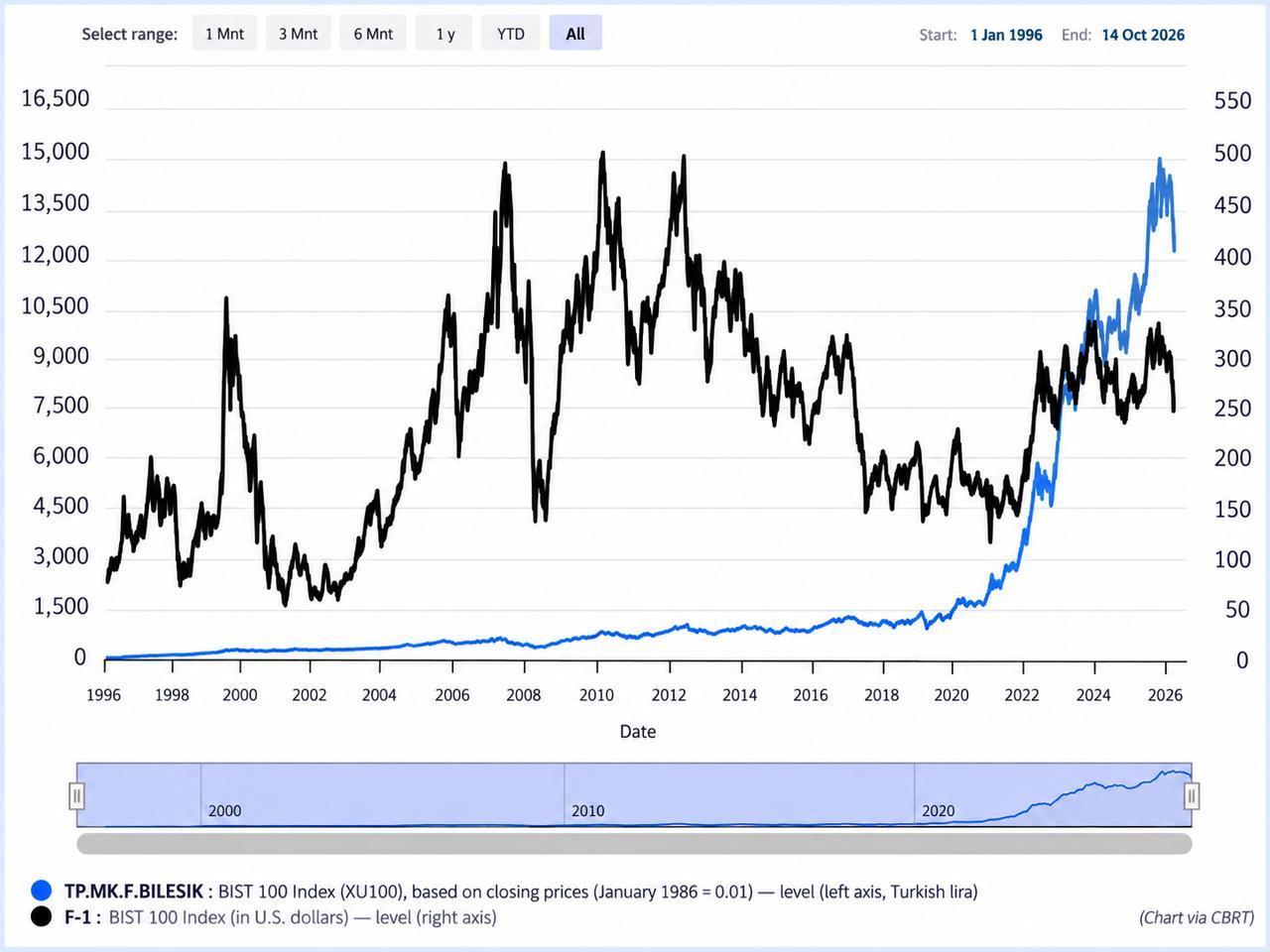
For more than a decade, Türkiye’s stock market has struggled to regain its former highs. Measured in U.S. dollars, the BIST 100 remains well below its May 2013 peak of $500 and has spent much of the past decade fluctuating between $250 and $350.
For some, the gap is already an invitation to buy before confidence returns. For others, it is compensation for risks they are not yet ready to take.
The question is not simply whether Turkish stocks are cheap. It is what would persuade investors that they deserve to be worth more.

Turkish equities kicked off 2026 with a dazzling rally, raising hopes among investors who had waited years for meaningful returns amid high inflation and tight monetary conditions.
Falling inflation and the prospect of further interest-rate cuts helped fuel the advance. But the bigger question was whether the improving outlook could also ease the doubts that had long shaped foreign investors’ perceptions of the market.
The new-year rally sent the benchmark BIST 100 surging around 25% to a record high by mid-February, following an uneven year.
The advance placed it among the period’s strongest-performing major equity benchmarks, behind South Korea’s Kospi, which benefited from a global boom in demand for memory chips.
Foreign investors, who had ended 2025 with net equity purchases of $2.3 billion, their highest level since 2017, continued to increase their exposure.
They poured another $2.3 billion net into Turkish shares from the start of the year through the week ending Feb. 27, extending the buying streak until the outbreak of war involving Iran clouded the outlook.
Following steep capital outflows amid the regional conflict, the market rebounded in April, lifting the BIST 100 to another all-time high above 15,000 as foreign investors returned to buying and supported the recovery.
However, concerns about market access and investor protection returned to the foreground in June, when MSCI’s warning served as a reminder that stronger market performance did not necessarily mean foreign investors’ longstanding criticisms had been resolved.
The global index provider flagged complaints about opaque ownership structures and possible coordinated trading involving funds affiliated with smaller listed companies, making it difficult to determine how many shares were genuinely available to the public and whether prices could be trusted.
Without credible progress by November, MSCI warned, it could open a consultation on the treatment of Türkiye and its eligible securities, putting the country’s emerging-market status under scrutiny and potentially acting as a further deterrent to major global investors.
For years, global institutions have questioned how much of Türkiye’s stock market is genuinely available for public trading and how much remains in the hands of a small group of major shareholders.
An OECD report published in 2025 found that ownership remains highly concentrated in Türkiye.
Based on 2022 data, 82% of listed companies were controlled by three or fewer shareholders holding more than half their shares. Across the market, private corporations owned around 40% of shares, while institutional investors held just 8%, with free float accounting for 26%.
For an overseas fund acquiring a minority stake, this structure raises a practical question: buying an economic interest in a company does not necessarily provide meaningful influence over its direction.
Türkiye’s Capital Markets Board (CMB) moved to introduce new rules in late August aimed at curbing potential market manipulation, limiting risks from uncollateralized lending between related parties and addressing unusual price movements in stocks with low free floats.
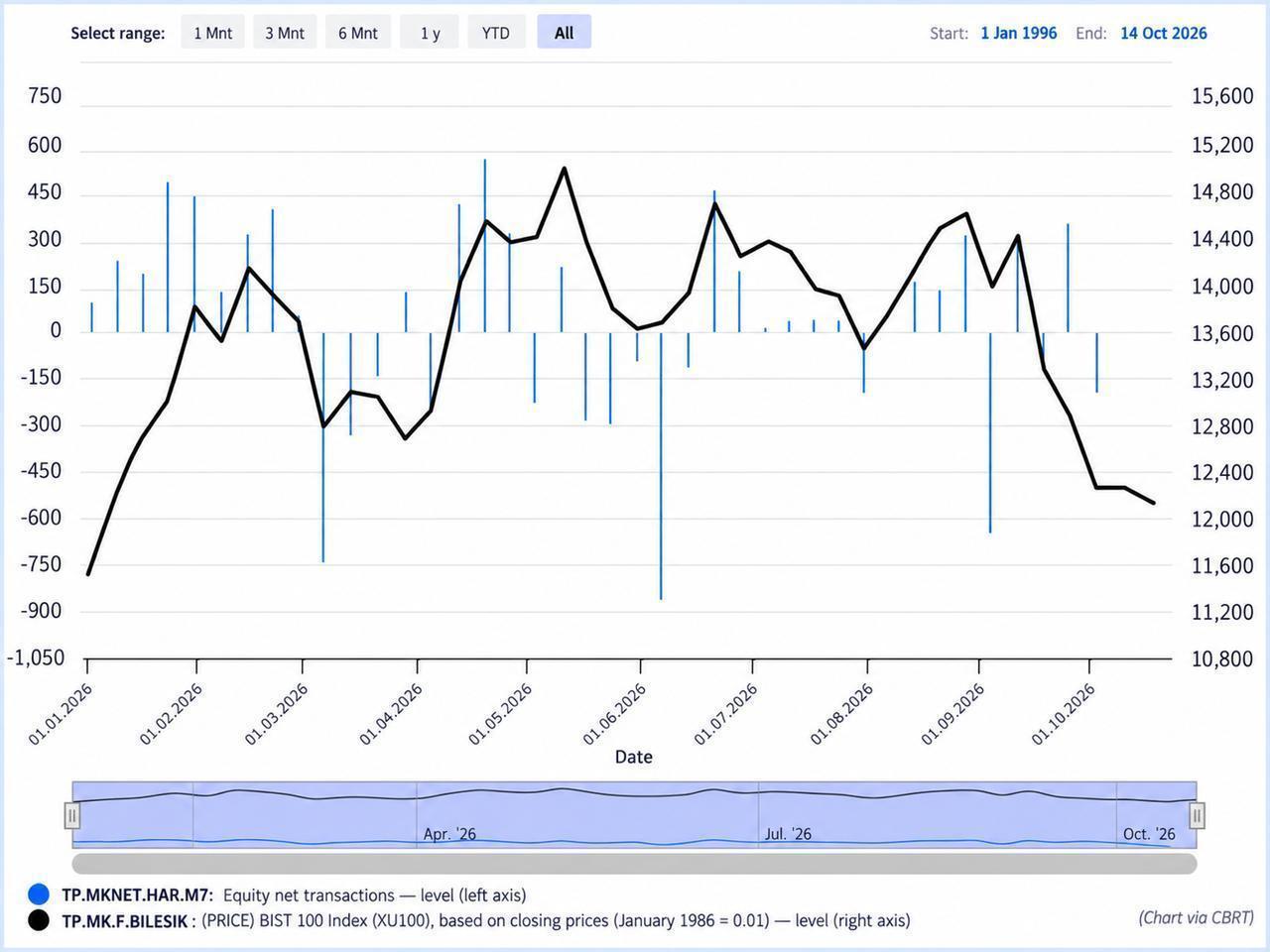
From the first trading day after the decision, investment funds that had offered astronomically high returns over the years through feedback loops based on concentrated holdings came under heavy selling pressure, eventually contributing to a broader market rout by mid-September.
The pressure intensified on Sept. 16-17, when several funds defaulted on investor redemption requests.
The CMB subsequently ordered the liquidation of 131 funds managed by seven portfolio management companies over a six-month period.
The funds held around ₺936.3 billion ($19.1 billion) in assets at the time, leaving more than 455,000 investors caught up in the turmoil.
Foreign investors also cut their exposure as the sell-off unfolded.
They were net sellers of $311 million in equities between Aug. 31 and Oct. 2, while the value of their portfolios fell 12.5%, or ₺387 billion ($7.8 billion), to ₺2.7 trillion in September, accounting for around 37% of total investor portfolios.
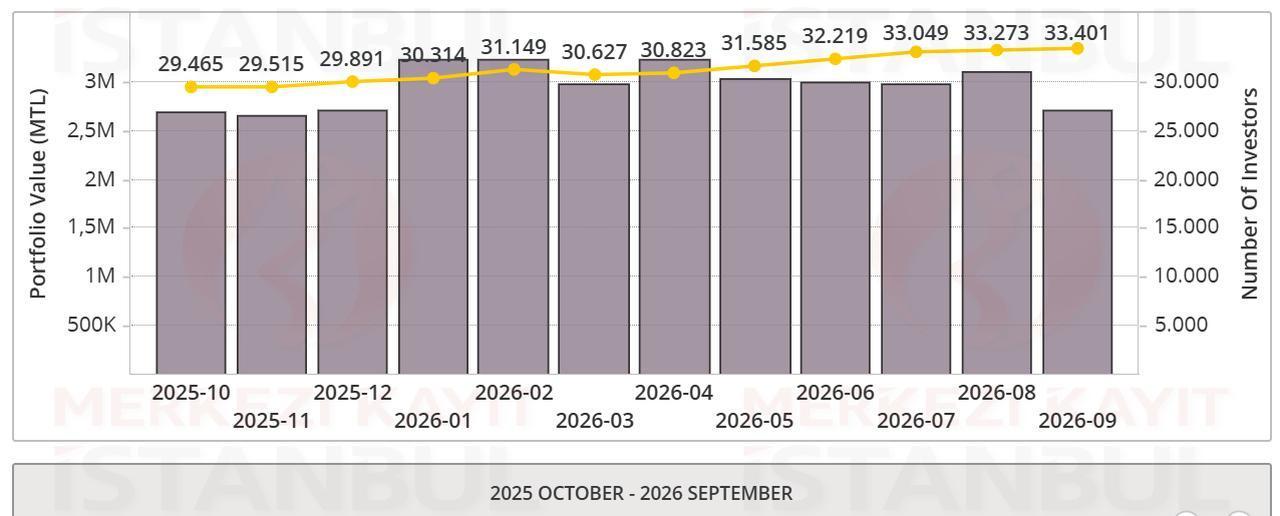
Holdings of individual foreign investors dropped 14.9% to ₺20 billion, while corporate investors’ holdings fell to ₺1.6 trillion from ₺1.8 trillion and other investors’ holdings declined to ₺1.1 trillion from ₺1.3 trillion.
Yet the decline in portfolio values did not translate into a drop in the number of foreign investors.
The number of individual foreign investors rose to 30,657 from 30,524, while corporate investors increased to 1,251 from 1,247 and other investors fell to 1,493 from 1,502. This brought the total number of foreign investors to 33,401, up from 33,273, compared with 6.7 million domestic investors.
While the downturn did not trigger a mass exodus of foreign investors on the scale of previous episodes, they remained net buyers overall, with net equity purchases totaling $1.7 billion since the start of the year.
Nevertheless, MSCI hardened its stance in an Oct. 15 announcement, extending the deadline for assessing Türkiye’s progress from November to June 2027 while immediately freezing certain index changes.
MSCI acknowledged that recent regulatory changes in Türkiye, including the CMB’s framework for excluding certain fund-held stakes from free float, represent initial steps toward improvement. However, it stressed that these measures require consistent enforcement and more transparent ownership disclosures.
The index provider also warned that insufficient progress could trigger a consultation on downgrading Türkiye to frontier-market or standalone-market status.
Earlier in October, another index provider, FTSE Russell, maintained Türkiye’s “Advanced Emerging” status and kept the country off its watch list.
However, FTSE Russell also postponed certain index changes during its September review and said it would continue working with Borsa Istanbul and the CMB to improve the transparency of published free-float calculations.
For Türkiye, the challenge is now to turn regulatory changes into lasting progress in tackling structural weaknesses and, ultimately, strengthening confidence among major global investors.


 Set as preferred source
 Set as preferred source


 3 min read