Sign in
 Newsletters


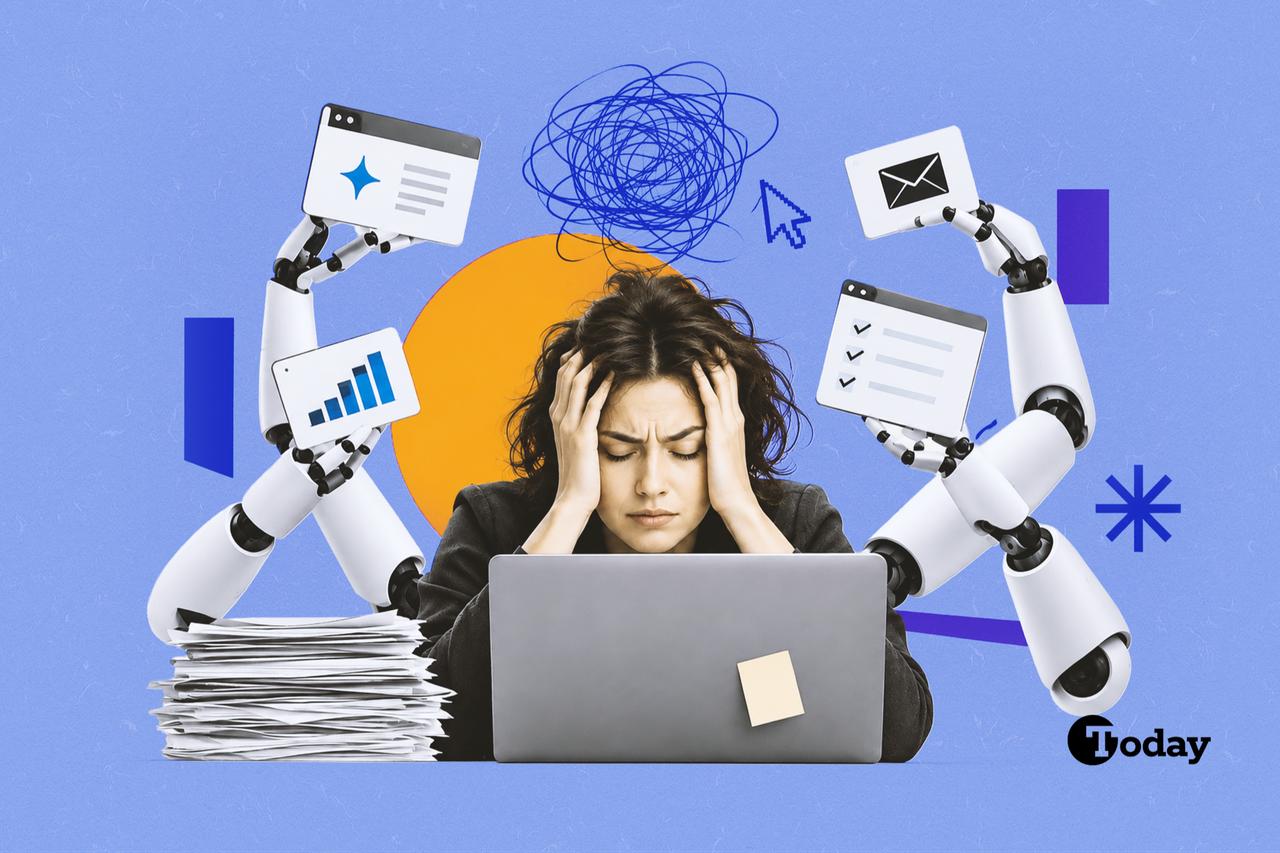


Artificial intelligence (AI) was supposed to make work easier by taking over ordinary tasks like drafting marketing copy or building spreadsheets. Now, that promise has evolved into autonomous AI agents: bots designed not just to assist, but to execute tasks and make decisions independently.
But overseeing too many of these tools is leaving some workers mentally exhausted, according to a study by Boston Consulting Group researchers published in Harvard Business Review on March 5, 2026.
Some companies measure and reward token consumption as an indicator of performance: the more you use AI, the harder you seem to work. This pushes employees to build and oversee more AI agents. As a result, there are too many agents to control, and an ordinary worker becomes a manager.
Engineer Francesco Bonacci, founder of Cua AI, shared his feelings in a post on X: “I end each day exhausted—not from the work itself, but from the managing of the work. Six worktrees open, four half-written features, two ‘quick fixes’ that spawned rabbit holes, and a growing sense that I’m losing the plot entirely.”
In the study, the researchers surveyed 1,488 full-time U.S.-based workers at large companies across industries, roles and levels. They asked participants how much and in what ways they use AI, and about their work experiences, cognition and emotions.
The researchers call this cognitive exhaustion “AI brain fry,” defined as “mental fatigue from excessive use or oversight of AI tools beyond one’s cognitive capacity.” Many participants described it as a “buzzing” feeling or a mental fog.
After long stretches of going back and forth with AI tools, participants said they struggled to think clearly, a feeling some compared to a hangover. They reported difficulty focusing, slower decision-making and headaches, and some had to physically step away from their computers to “reset.”
This may sound like burnout, a condition the researchers describe as chronic work stress that brings exhaustion, negativity toward work and lower effectiveness. But the two are different: burnout is mainly emotional, while brain fry is an acute cognitive strain. In fact, AI use predicted mental fatigue but not burnout, and “when AI is used to replace routine or repetitive tasks, burnout scores—but not mental fatigue scores—are lower.”

The first factor is whether workers have to oversee AI tools. Those whose AI work required a high degree of oversight reported 14% more mental effort on the job, 12% more mental fatigue and 19% more information overload.
If you cook too many meals at the same time, you have to work harder to keep track of them all. The same goes for workers. The second factor the study identified is that AI increases employees’ workload. Combined with oversight, this means paying attention to more outcomes from more tools in the same amount of time, so cognitive load and mental fatigue rise.
Workers’ self-reported productivity increased as they used up to three AI tools at the same time, but with four or more, their scores dipped.
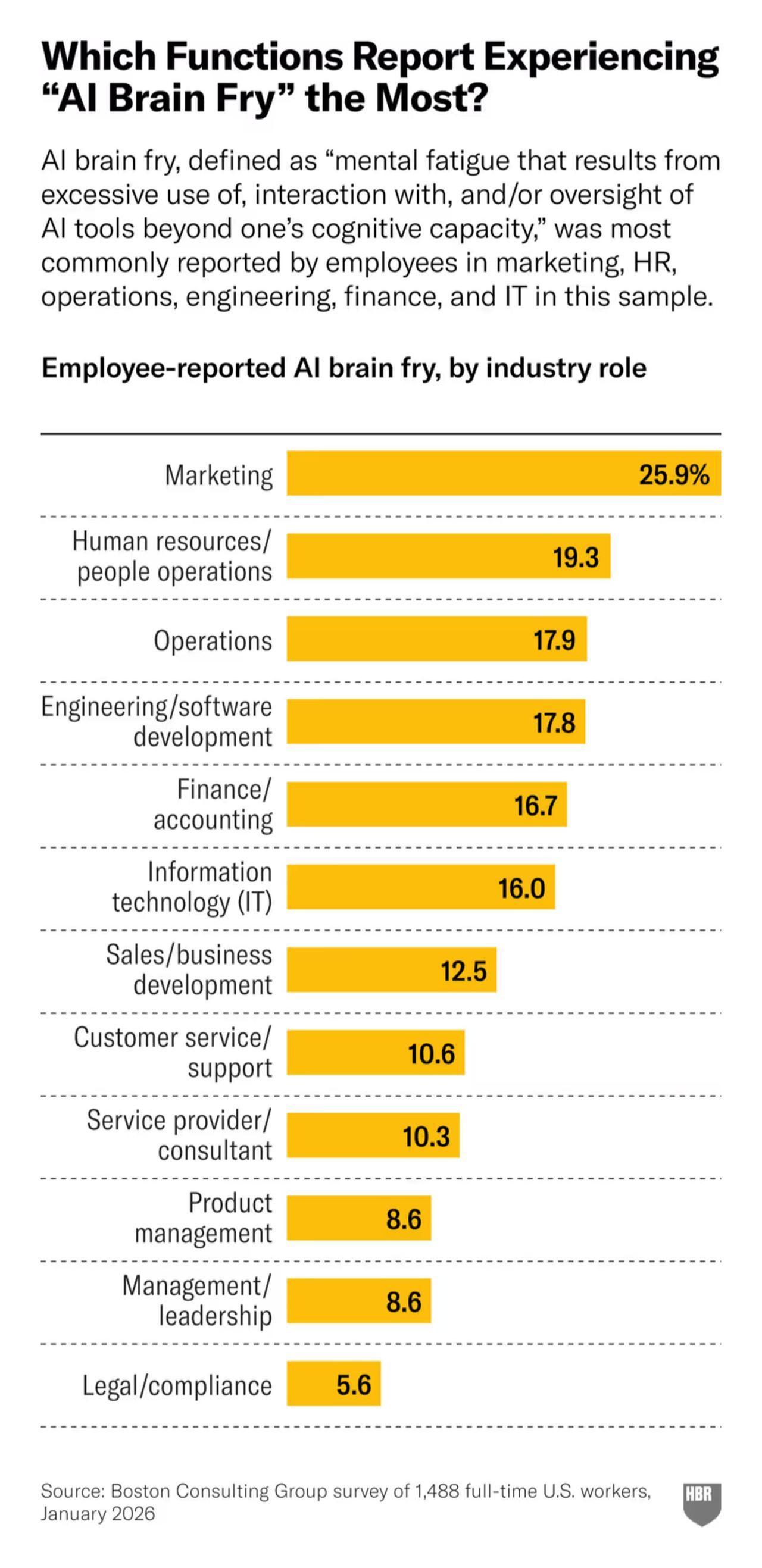
Fourteen percent of participants who use AI at work said they had experienced brain fry, and the share varies by role. Marketing has the highest rate at 25.9%, followed by human resources/people operations (19.3%), operations (17.9%) and engineering/software development (17.8%). Legal/compliance ranks lowest at 5.6%.
 2 min read
This cognitive strain also comes with heavy business costs. Workers experiencing AI brain fry reported 33% more decision fatigue, made major errors 39% more frequently and were 39% more likely to express an active intent to quit (34%, compared with 25% among those without brain fry).
On the other hand, using AI isn’t harmful in every situation. The report shows that when participants used AI to reduce time spent on repetitive tasks, they reported lower burnout scores: 15% lower than those who didn’t use AI in this way.
Those who saved time felt more engaged and motivated at work, had more positive feelings about AI and felt closer to their colleagues.
The takeaway is clear: AI works best when it eliminates routine work, not when it turns workers into an overworked supervisors of bots. To prevent brain fry, companies should measure real impact rather than usage intensity and set clear limits on AI oversight.


 Set as preferred source
 Set as preferred source



 1 min read