Newsletters




The bus is packed, and almost no one is talking. Thumbs glide over glass. A student murmurs a question into her phone, and it answers back in an easy, unhurried voice, like a friend who always picks up.
Artificial intelligence has slipped into nearly every corner of daily life, one tap or one spoken sentence away on any phone or computer.
A few years ago, it felt like science fiction. Today, it’s just a Tuesday. But how many of us are really doing this?
The numbers answer that question, and they are striking. In its latest report on AI use among individuals, age groups and sectors, published this October, the Turkish Statistical Institute (TurkStat) found that adoption has nearly doubled in a single year.
The share of people who say they use generative AI jumped from 19.2% to 37.6%. Among companies, it rose from 7.5% in 2025 to 14% in 2026.
Young people lead the way. Almost 65% of those aged 16-24 use generative AI, followed by 55.7% of 25-34-year-olds. The share drops sharply after that, to around 38% among 35-44-year-olds.
Higher education graduates lead, at around 63%, which is hardly a shock. The surprise is who comes next: people with a middle school education (35.5%), well ahead of those with a primary school education (8.5%).
Business adoption has climbed just as steeply over a longer stretch. In 2021, only 2.7% of companies used AI in their work. By 2026, that share had grown more than fivefold, to 14%.
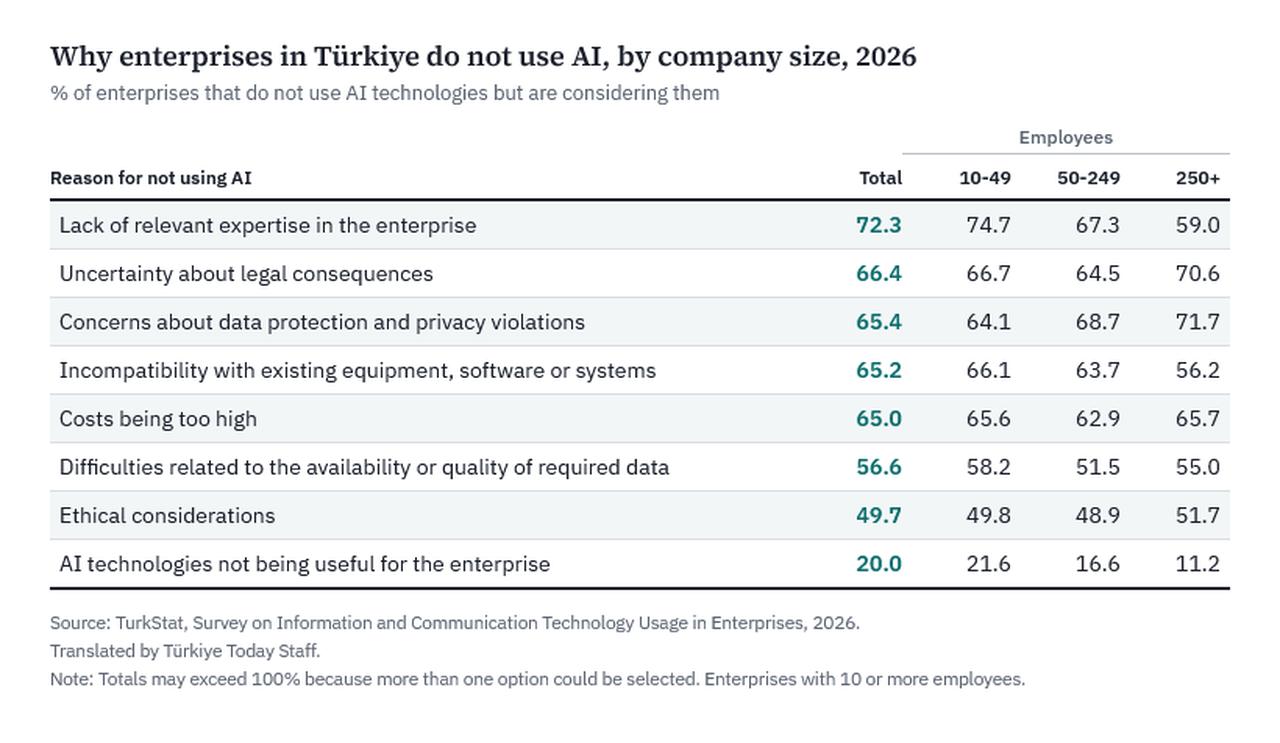
Yet for firms that aren’t using AI but are considering it, the biggest barrier is people: 72% cite a lack of experts. Legal uncertainty, including who is liable when AI causes harm, follows at 66.4%, and data privacy concerns at 65.4%.

How does that stack up globally? The United States offers a useful yardstick.
Pew Research Center’s June 2026 survey found that almost half of U.S. adults now use AI chatbots, up from 33% in 2024. For a quarter of Americans, the habit is daily: 24% of all adults use them every day, and 4% use them almost constantly.
Searching for information is the top use, at 42%. But chatbots are also stepping into more personal territory: one in five U.S. adults turns to them for medical advice, another one in five for diet and fitness, and one in 10 for emotional support or advice.
Yet people don’t fully trust the tools they confide in. Even as they share health worries and private feelings, 71% of Americans believe AI will make their personal information less secure.
Furthermore, younger people are more wary than older people about AI’s potential impact on society and on themselves.
Wariness about AI is highest among the young. Among 18-29-year-olds, 48% are concerned about its impact on society and 37% about its effect on them personally. For those aged 30-49, the figures fall to 39% and 30%, and people 50 and older are less wary still.
Europe paints a similar picture. According to Eurostat research extracted in March 2026, 33% of people aged 16-74 living in the EU had used generative AI in the previous three months. Denmark, Estonia and Malta lead, at 48%, 47% and 47% respectively.
People aged 16-24 are the biggest users, at almost 64%, followed by ages 25-34 at around 51%. Education also has an impact on AI use: almost half of people with a high level of formal education used it, while the figure is 22% for those with little or no formal education. The most common purpose is private use, at almost 77%.
When people who don’t use AI were asked why, they mainly said that they didn’t feel the need to (64%). Those who said they didn’t know how to use it made up 14%.
AI is spreading fast, but enthusiasm is running ahead of readiness. For individuals, the main obstacles are simple: many don’t feel they need it, and some don’t know how to use it. For businesses, the barriers are heavier: a shortage of experts and worries about data privacy.
Younger generations use it the most, but they are also aware of the consequences and wary of it, at least in the U.S. Among all U.S. adults, 71% think AI will make their personal information less secure, a concern that also appears among companies in Türkiye considering AI. Older generations and companies are trying to follow the trend, but they might not know how to adapt.
Set side by side, the figures show Türkiye, the U.S. and Europe on the same road, at different speeds.
AI is no longer a futuristic idea. It is following the path phones and the internet took: first a novelty, then a habit, then something we barely notice.


 Set as preferred source
 Set as preferred source


 1 min read


 1 min read