Newsletters




Autonomous delivery robots are becoming a familiar sight across U.S. cities, where companies are rolling out thousands of small sidewalk vehicles as a cheaper and more energy-efficient way to deliver food. Yet as their presence grows, so does public pushback, with complaints over blocked sidewalks, rising vandalism, and calls for bans.
Across many American cities, these robots now move quietly along sidewalks, crosswalks, and curb edges without human guidance. Roughly the size of a small cooler, they are fitted with cameras and sensors that allow them to make their way through urban streets on their own. What once looked experimental is now turning into one of the most visible everyday uses of artificial intelligence.
Serve Robotics stands out as one of the fastest-growing companies in the sector. The company, which spun off from Uber, had a fleet of about 100 robots only a year ago, but has now rolled out around 2,000 autonomous vehicles operating across different cities.
Other companies, including Starship Technologies and Coco, have also built fleets that have reached into the thousands. Together, they point to how AI-powered delivery is quickly moving out of pilot programs and into daily life.
Each robot relies on a layered perception system to get around. Cameras and lidar sensors, which use laser-based mapping to read surroundings in three dimensions, are built into the vehicle's body. The onboard software then processes that information through AI models trained on large street-image datasets, allowing the robot to interpret its environment in real time.
That system enables the robot to decide whether to cross the street, yield to a pedestrian, or find its way around a construction zone. On uneven ground, it can tilt its body to keep its balance. These actions are continuously recalculated in milliseconds by a route-planning engine designed to support full autonomy at the pedestrian scale.
According to the companies behind the technology, the case for delivery robots is both economic and environmental. They argue that moving a single meal with vehicles weighing more than a ton does not make sense in terms of either energy use or cost.
Calculations cited from consultancy Thunder Said Energy Inc. suggest that a delivery robot uses only about 1% of the energy consumed by a motorcycle carrying out the same task. That, in turn, is presented as making robots a far more efficient and lower-cost alternative.
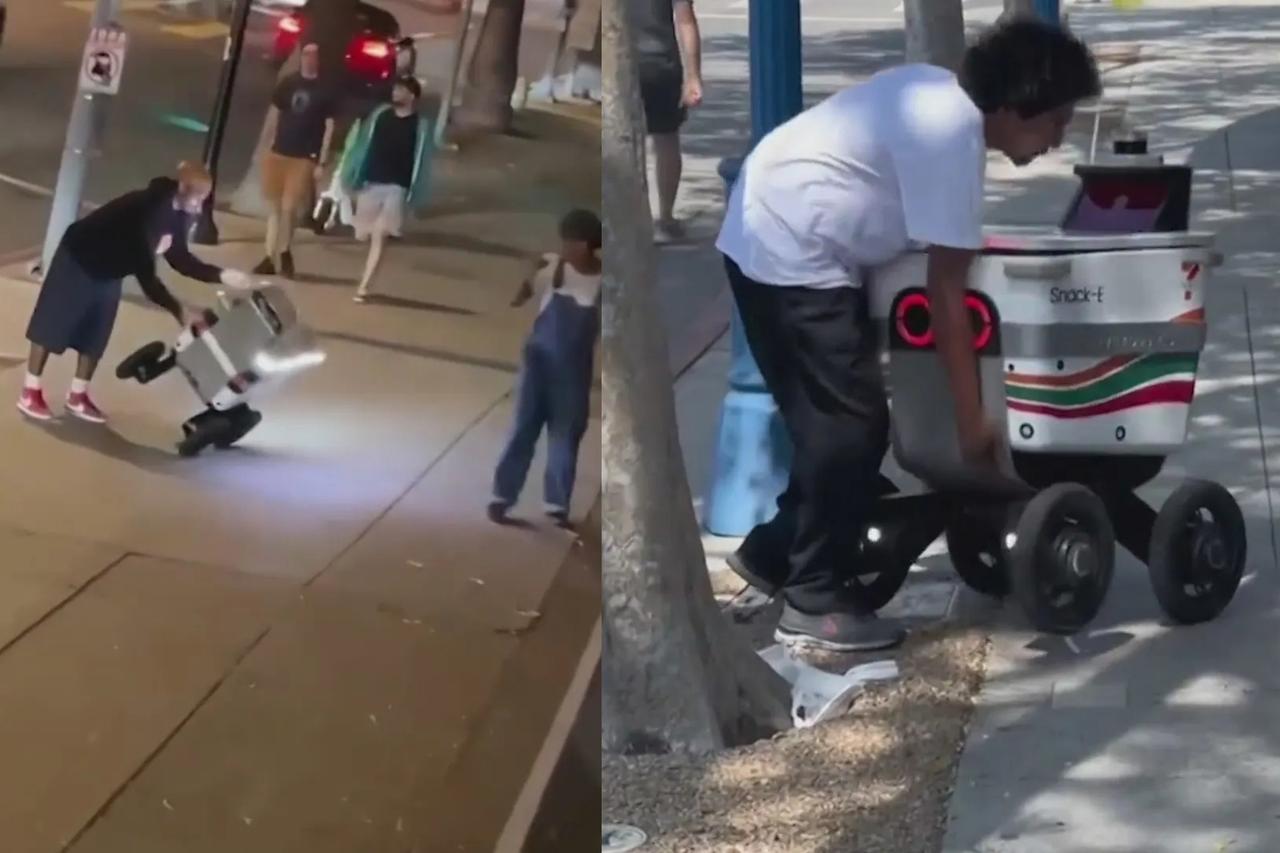
The rapid spread of the technology has also brought out growing social tension. Videos shared on social media show delivery robots being kicked and even smashed apart. Some incidents are seen as attempted theft, while others appear to reflect direct public hostility toward the machines.
In some cities, thousands of people have called for delivery robots to be banned, arguing that they take over sidewalks and create risks for pedestrians.
As that resistance builds, companies are leaning into design choices aimed at making the robots feel less intrusive. Serve Robotics has given its sidewalk robots digital eyes, blinking animations, and human-style names such as Deja and Niska. On the software side, the robots slow down as they approach pedestrians and slightly turn to show where they are heading, in effect signaling their next move.
Chief Executive Ali Kashani said this was not a marketing trick but a psychological adaptation strategy. Company data, meanwhile, shows that 99.8% of planned deliveries are completed without problems.


 Set as preferred source
 Set as preferred source


 2 min read