Newsletters




Türkiye’s economic confidence index climbed to 101.3 in September from 100.6 in August, marking its strongest reading in 39 months, the Turkish Statistical Institute (TurkStat) reported on Tuesday.
The latest reading shows sentiment moving further into positive territory after the index crossed the 100-point threshold in August. The improvement is also reflected in consumer and business surveys, although the gains are uneven across sectors.
Consumer confidence rose 1.3% to 91.9 in September, its highest level since July 2018. The increase was driven largely by stronger expectations, rather than a broad improvement in households’ assessment of their current financial position.
The index tracking households’ financial situation over the next 12 months increased 0.6% to 93.7, while expectations for the general economic situation over the same period advanced 0.5% to 89.8. By contrast, the current household financial situation index fell 0.1% to 75.3, and the measure of the current general economic situation dropped 3.6% to 62.3.
The improvement extended beyond households, although businesses showed a mixed picture.
The real sector confidence index edged up 0.1% to 102.5, keeping it above the 100-point threshold. Retail trade confidence rose 1.1% to 111.3, while services confidence remained unchanged at 111.9. The construction sector moved in the opposite direction, with confidence falling 0.2% to 83.
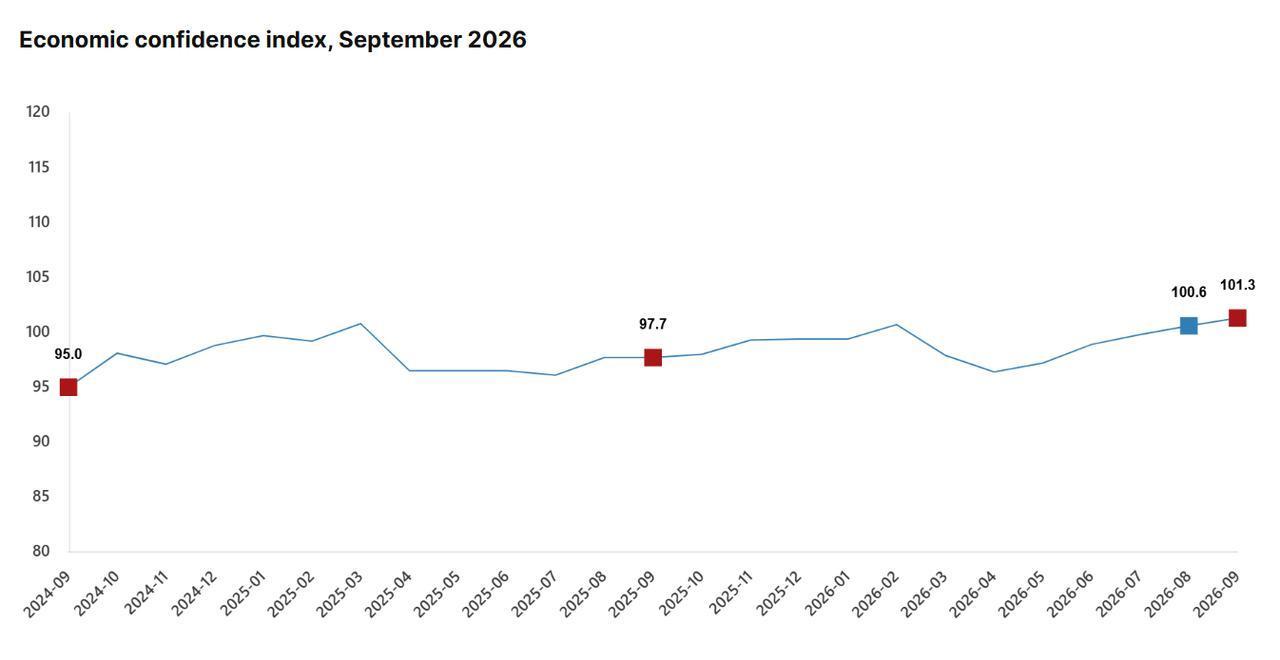

The economic confidence index is designed to provide a broad snapshot of how consumers and businesses view the economy and where they expect it to head. The measure ranges from 0 to 200, with 100 as the key threshold. Readings above 100 indicate an optimistic outlook for the general economic situation, while readings below 100 point to a pessimistic outlook.
Because it incorporates forward-looking questions on issues such as household finances, spending, production, employment, orders, sales and demand, the index is considered a leading indicator. TurkStat says it can provide earlier information on economic developments than broader measures such as GDP, employment and industrial production.
However, the index can also reflect sentiment about economic conditions before those expectations translate into actual activity, while some of the underlying data may capture conditions from an earlier period.


 Set as preferred source
 Set as preferred source


 2 min read

 1 min read