Newsletters




Fitch Ratings put Türkiye’s inflation at 30.5% at the end of 2026 and GDP growth at 2.8% for the year, while warning that high inflation and external shocks from the Iran war continue to pressure the country’s credit profile, which stands at ‘BB-’ with a Stable outlook.
In a statement published Friday, Fitch also projected inflation at 23.5% at the end of 2027. The agency attributed its higher inflation outlook to "stubbornly high inflation expectations and energy prices."
The forecast exceeds the government’s latest projection, as Türkiye’s new Medium Term Program raised its end-2026 inflation forecast to 28.4%, up from 16% in the previous program, while its end-2027 projection rose to 21% from 9%.
While Fitch’s 2026 growth forecast is lower than the government’s 3.3% projection, it sees growth rising to 4.3% in 2027, slightly above the government’s 4.2% forecast, as policy easing boosts credit and real rates fall.
Fitch projected that the impact of the Iran war would push Türkiye’s current account deficit to close to 3% of GDP in 2026, compared with 1.9% in 2025. It estimated that a roughly $20-a-barrel increase in average annual oil prices would add more than 1 percentage point to the deficit.
The agency put average oil prices at $87 a barrel in 2026 and $70 a barrel in 2027, while expecting the current account deficit to remain broadly flat next year as higher import demand offsets lower oil prices.
Tighter monetary conditions, a consistent policy mix and recovering foreign exchange reserves were helping limit near-term risks from higher energy prices, Fitch said.
Gross FX reserves had risen by $25 billion from the end of March to $176 billion as of Sept. 23, equivalent to 4.5 months of current external payments.
The level remained below the $210 billion recorded before the Iran war and the ‘BB’ median of 5.2 months, while net reserves excluding swaps had climbed to $45 billion from $16 billion.
"The partial recovery in Türkiye’s FX reserves since April, easing of depreciation pressures and maintenance of a tight policy mix mitigate risks posed by high energy prices," Fitch said.
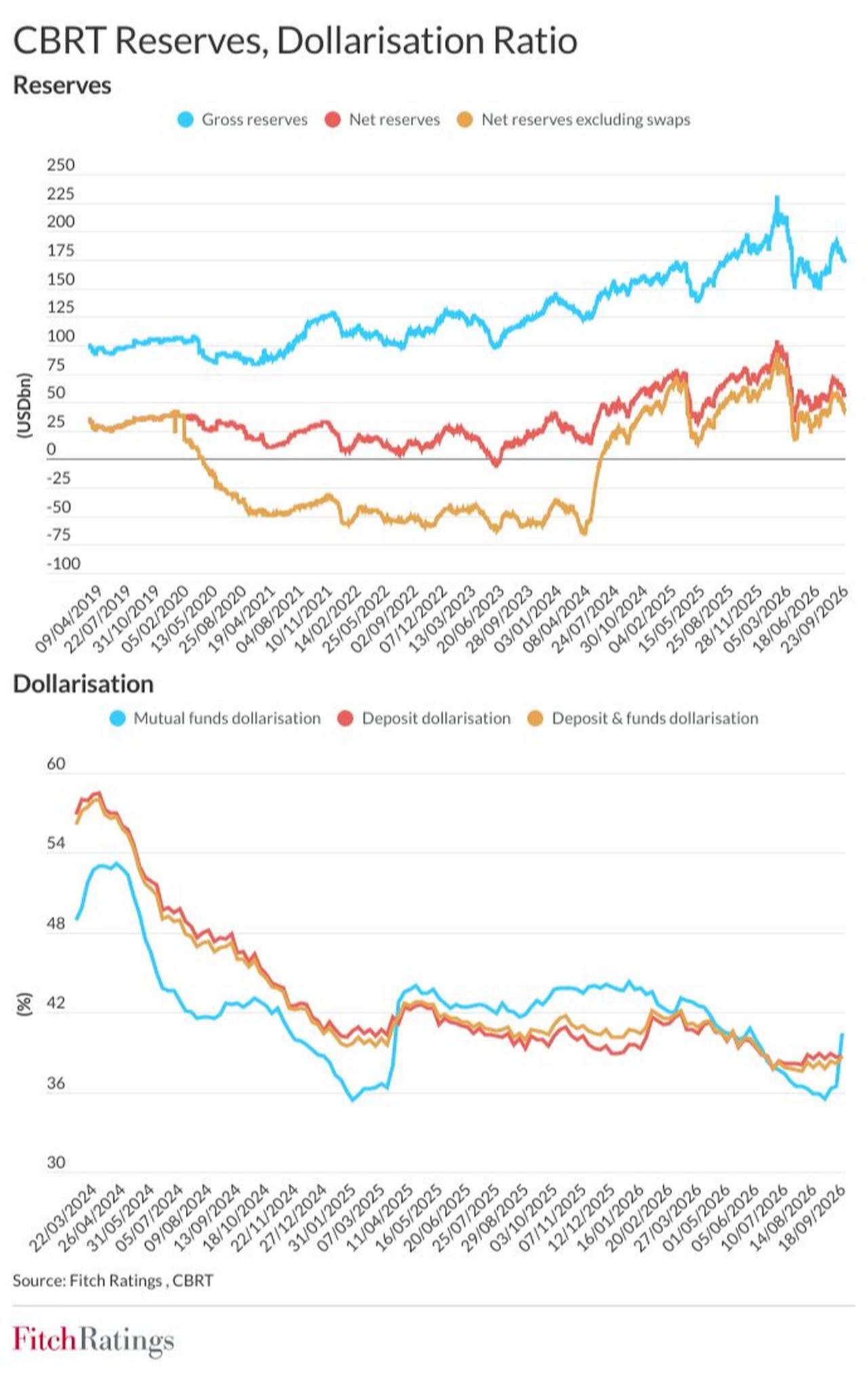

Fitch said Türkiye’s reserves remain vulnerable to domestic and external shocks, partly due to short-term carry trades and a policy mix favoring gradual lira depreciation. The agency noted that these vulnerabilities could leave reserves exposed to sudden shifts in investor sentiment and capital flows.
Central Bank of the Republic of Türkiye (CBRT) interventions during last year’s political turmoil and at the start of the Iran conflict each depleted reserves by around $50 billion.
The liquidation of investment funds worth an estimated $18 billion also exposed regulatory shortcomings, although Fitch said the authorities’ timely response, including CBRT liquidity support and eased collateral requirements, helped stabilize the stock market.
Deposit dollarization remained broadly stable at 39%, but Fitch cautioned that the risk of an increase was greater ahead of presidential elections, which it expected to be brought forward to late 2027 or early 2028.
The agency also projected the lira at ₺51 per dollar at end-2026 and ₺60 at end-2027, pointing to a slightly faster pace of nominal depreciation than previously expected.
Fitch expected general government debt to remain broadly stable at around 24% of GDP, well below the median for countries with a ‘BB’ rating. It projected the central government deficit to widen by 0.4 percentage points to 3.5% of GDP in 2027 before returning to 3.1% in 2028.


 Set as preferred source
 Set as preferred source


 1 min read

 1 min read