Newsletters




This article was originally written for Türkiye Today’s weekly economy newsletter, Turkish Economy in Brief, in its Sept. 21 issue. Please make sure you are subscribed to the newsletter by clicking here.
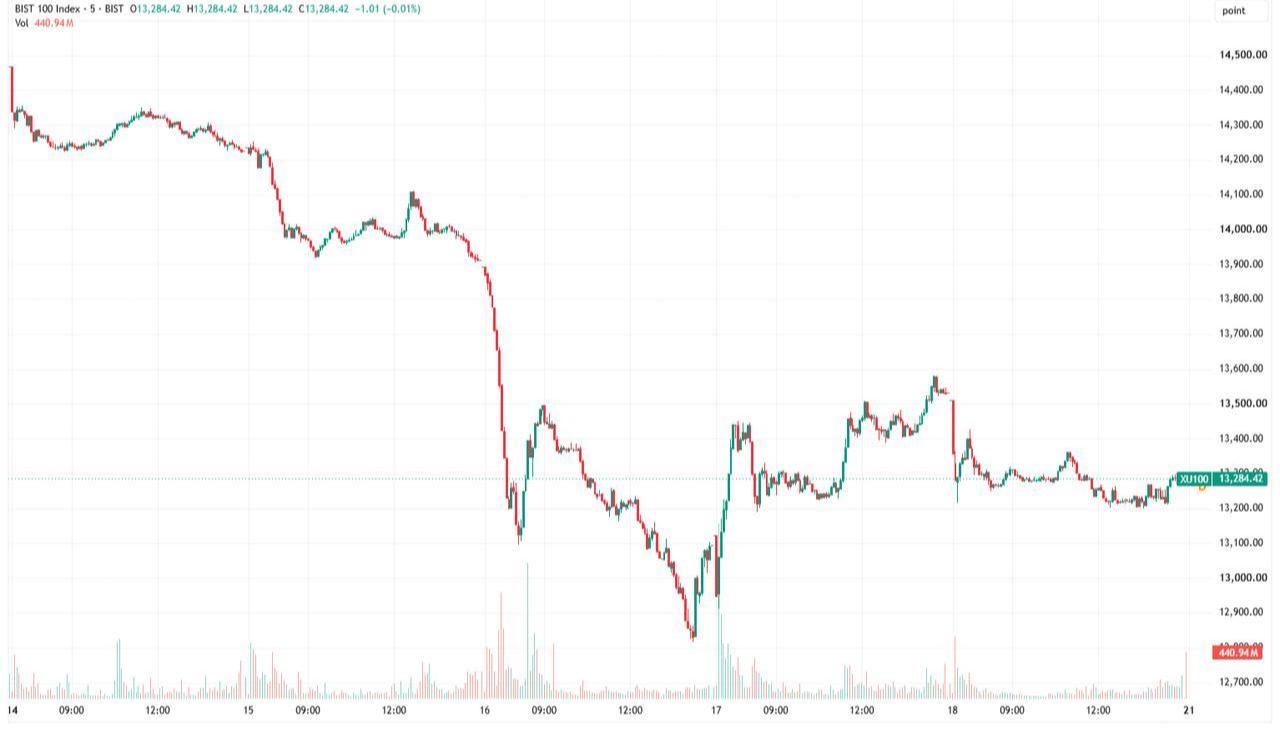
The Turkish stock market fell 8.2% last week, closing at 13,284 points. The benchmark BIST 100 index fell as low as 12,817 points during the week, reaching its lowest level in six months.
It also broke below the 13,630 level, which represents its 200-day moving average, for the first time in months.
Alongside recent developments in investment funds, the market is going through a major test. Following new rules announced on Aug. 28, losses in some stocks and funds accelerated investor withdrawals.
Last week, the situation escalated to defaults, with some funds declaring default.
A liquidation process was also launched for 131 funds with a combined portfolio value of more than ₺800 billion ($16.4 billion).
So how did we get here, and what happens next?
An investment fund can be thought of as a large investment basket. Thousands of investors put their money into a fund, and the fund manager uses those resources to invest in stocks, bonds, gold, and other financial instruments.
Investors do not directly own these assets, but they hold shares in the fund, which owns the underlying assets. When the value of the assets in the basket rises, the value of the fund increases; when they fall, the value of the fund's shares declines.
So the first important point is this: Problems at a portfolio management company do not mean that the financial assets held by the fund have disappeared.
The root of the problem is described as some funds holding highly concentrated positions in stocks with low free float, leading to "unusual price movements" in those shares.
In a statement, Türkiye's Capital Markets Board (CMB) said it had observed that "some funds were causing price movements in shares with low free float that could not be explained by economic realities or the companies' fundamental financial figures."
While the existing structure could provide funds with high returns during periods of rising prices, the risks also increased when prices reversed. As investors began withdrawing their money from the funds, the funds were required to convert their holdings into cash.
When an investor sells their fund shares, the fund must pay the investor within a specified period. If the fund does not have enough cash on hand, it must raise the necessary funds by selling assets in its portfolio.
However, when a portfolio contains stocks with low trading volumes, selling those assets quickly can be difficult. When large amounts are put up for sale at the same time, there may not be enough buyers. As selling pressure increases, the stock price can also fall.
This is what is known in financial markets as a "liquidity problem." The asset exists, but it cannot be converted into cash in the required amount and at the required time.
Following the regulation introduced on Aug. 28, new requirements were established regarding the proportion of certain financial assets that funds could hold. Some funds were required to adjust their portfolios and raise cash to comply with the new rules.
Meanwhile, selling pressure became more pronounced in low-liquidity stocks. Falling stock prices reduced the value of the funds, while investors who saw those losses became increasingly inclined to withdraw their money. This created a cycle in which selling pressure and investor withdrawals reinforced each other.
One of the most critical stages of the process came when some funds were unable to make payments to investors on time. Payment problems emerged on Sept. 15 and 16, and some of the portfolio management companies in question declared "default."
In financial markets, the failure to pay an amount owed to an investor when it is due is referred to as "default."
The key point here is that a payment problem does not mean the fund's assets have disappeared. The problem stems from the fund's inability to obtain the necessary cash in time.
The funds needed to raise cash to make payments to investors. When they could not find enough buyers for low-volume stocks, more liquid and easily tradable stocks in their portfolios also became subject to selling.
As a result, selling pressure that initially centered on certain funds and low-liquidity stocks spread across the Borsa Istanbul. On Wednesday, Sept. 16, the BIST 100 index fell more than 5%.

Following these developments, the CMB on Sept. 17 ordered the liquidation of 131 funds traded on TEFAS and established by Tera, Pusula, Hedef, Atlas, A1 Capital, Pardus and Bulls Portfolio Management companies.
Liquidation refers to the process of ending a fund's operations, converting the assets in its portfolio into cash, and distributing the proceeds to investors.
The stocks and other financial assets held by the funds will be sold as part of the liquidation process. After the fund's expenses and liabilities are covered, the remaining amount will be transferred to investors' accounts according to the proportion of shares they hold.
According to the CMB's decision, Is Bank will handle the liquidation of funds established by Tera Portfolio, while Ziraat Bank will handle the funds of the other six portfolio management companies.
The financial assets in the funds' portfolios will be gradually converted into cash, taking into account investors' interests, market depth, and liquidity conditions. The aim will be to convert the assets into cash under the most orderly conditions possible.
Amounts arising from sell orders placed through TEFAS but not yet executed will also be recorded as liabilities in the funds' accounts. Cash generated through the liquidation process will first be used to pay these liabilities.
The announcement indicates that orders submitted before 1:30 p.m. on Sept. 17 and accepted through TEFAS are covered by this provision.
The liquidation process is expected to be completed within a maximum of six months from the date the liquidation announcement is published.
However, the period may be extended with the CMB's approval.
The developments should not be viewed as a problem affecting all investment funds. Trading in other funds continues under their own rules and normal operating procedures.
Treasury and Finance Minister Mehmet Simsek also commented on the issue, saying that "what is happening in the markets is a credit and liquidity problem limited to a small number of funds, there is no systemic risk spread across the market, and there is no structural problem in the stock market or financial markets."
Simsek said there had been "market-distorting actions in a limited number of funds" and that the necessary steps had been taken. He said 90% of the fund market continued to operate in a healthy manner, while the funds affected by the latest interventions accounted for around 10% of total fund assets.
He also stressed that this did not mean the affected funds had no assets. The liquidation process would be carried out in line with the CMB's appointments and principles, he said, adding that the process was proceeding healthily and that the problematic area had been "quarantined." He said the measures taken at this stage were sufficient.
All these developments have once again highlighted the importance of financial literacy.
Financial literacy means understanding where and why you are investing your money and being able to assess investment instruments and their risks at a basic level.
Another lesson is the importance of "building a basket" when investing—in other words, distributing your money across different assets rather than investing it all in a single instrument.
The main aim is to reduce the impact of an adverse movement in a single investment on the overall portfolio. This spreads risk, meaning that when one investment loses value, the performance of other investments can limit the overall loss.
At this point, the liquidation process affecting the funds and investor sentiment afterward is likely to be important. Establishing a more institutionalized and healthier market structure could also be viewed as positive, particularly from the perspective of foreign investors.


 Set as preferred source
 Set as preferred source



 6 min read