Sign in
 Newsletters





The value of foreign investment in Türkiye fell by $41.6 billion in the third quarter of 2026, dropping to $748.9 billion from $790.5 billion at the end of June, as September's investment fund scandal rattled the Turkish market.
Central Bank of the Republic of Türkiye (CBRT) data show that the contraction was led by a $37.8 billion drop in direct investment liabilities, largely reflecting lower valuations, while portfolio investment liabilities fell by $5.1 billion and financial derivative liabilities declined by $2.9 billion.
The contraction marks the steepest quarterly decline in Türkiye's external investment liabilities since the first quarter of 2023, when the figure fell by $64.2 billion.
Several investment funds, later accused of investing heavily in low free-float stocks that could be easily manipulated upward or downward, failed to meet investor redemption requests in mid-September as they faced a liquidity crunch due to these holdings.
The Capital Markets Board (SPK) ordered the liquidation of 131 investment funds managed by seven portfolio management companies over a six-month period, affecting over 455,000 investors with a combined asset base estimated at ₺936.3 billion ($19.1 billion) at the time.
The turmoil weighed heavily on Turkish capital markets, with the benchmark BIST 100 index falling over 20% in a month and entering a bear market. Capital outflows also accelerated, as portfolio investments recorded a net outflow of $7.7 billion in September, the highest monthly figure since March 2026, after the Iran war began.
According to Friday's International Investment Position, foreign investors' combined holdings of Turkish equities and investment fund units fell from $49.7 billion in June to $41.4 billion in September, representing an $8.3 billion contraction in three months.
Investment fund holdings accounted for $3.8 billion of the decline, falling from $8.8 billion to $5 billion, while the market value of foreign-owned Turkish shares dropped by $4.5 billion to $36.4 billion.
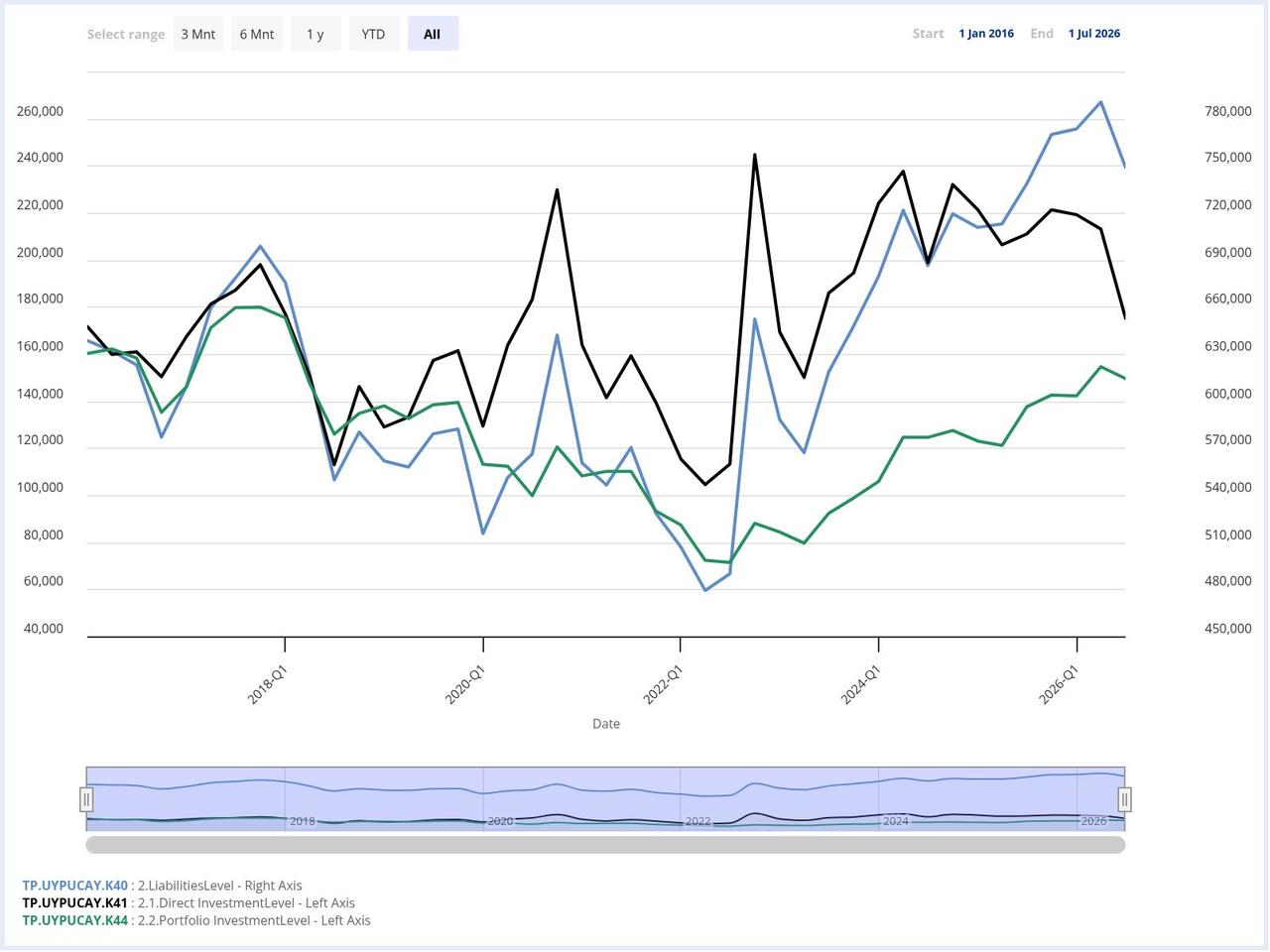

The largest decline in foreign investors' positions came from direct investment, which fell from $213 billion in June to $175.2 billion in September.
This category covers foreign ownership stakes in Turkish companies, including investments that give overseas investors a lasting interest or influence in a business. Its equity capital component, representing the value of those ownership stakes, accounted for almost the entire decline, dropping by $38.3 billion to $154.2 billion.
The sharp drop does not necessarily indicate an equivalent withdrawal of foreign capital, as changes in the reported value of direct investment stakes also reflect valuation and exchange-rate effects. In fact, CBRT balance-of-payments data show that Türkiye recorded a net direct investment inflow of $859 million in September.
Other direct investment capital, which mainly consists of loans and other financial claims between foreign parent companies and their Turkish affiliates, increased slightly to $21 billion.
Portfolio investment liabilities, which cover foreign holdings of publicly traded shares, government and corporate bonds, and investment fund units that do not give investors significant influence over a company, also declined, falling from $154.5 billion to $149.5 billion.
The decline was not uniform across asset classes, as foreign holdings of Turkish debt securities increased by $3.2 billion to $108.1 billion, partly offsetting the drop in equities and investment fund units.
Other investment liabilities, which include deposits held by non-residents in Turkish banks, loans from foreign lenders and trade credit extended to Turkish businesses, moved in the opposite direction, rising by $4.2 billion to $420.2 billion.
While the sharp decline in foreign liabilities drove much of the improvement, Türkiye's net external investment deficit narrowed by $69.4 billion to $320.4 billion in September, as external assets rose 6.9% to $428.5 billion and liabilities to non-residents fell 5.3% to $748.9 billion.
The increase in assets was driven partly by reserve accumulation, with reserve assets climbing to $166.1 billion from $147.4 billion and monetary gold holdings rising to $107.1 billion from $94.3 billion.


 Set as preferred source
 Set as preferred source


 1 min read
 1 min read