Newsletters




International Netherlands Group (ING) expects Türkiye's central bank to move cautiously on interest rates, forecasting limited room for monetary easing as inflation remains stubborn and geopolitical tensions continue to cloud the outlook.
In a note published Wednesday, the bank projected consumer inflation at 29% by the end of 2026 and 21% by the end of 2027, while expecting the policy rate to stand at around 35% by year-end.
Analysts also see risks skewed toward a tighter policy stance ahead of the Central Bank of the Republic of Türkiye's (CBRT) Monetary Policy Committee (MPC) meeting on Thursday.
According to the bank, recent macroprudential measures aimed at slowing credit growth have reduced the likelihood of additional action at the June MPC meeting.
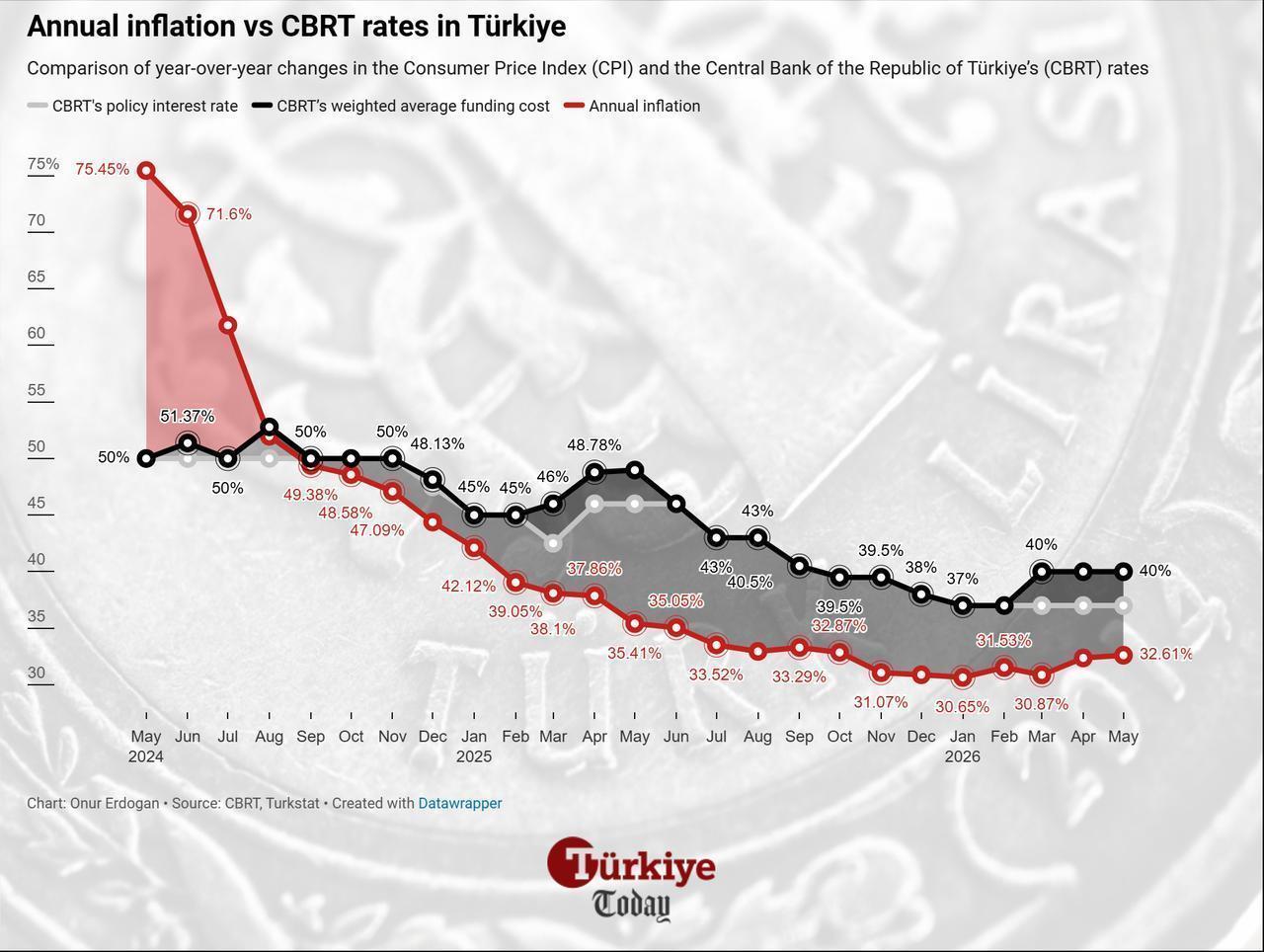
Still, ongoing geopolitical uncertainty and domestic political developments could prompt a more cautious approach. ING noted that policymakers could raise the policy rate from 37% toward the current effective funding rate of around 40% if conditions warrant.
"We anticipate that the scope for easing will be quite limited in the second half of the year," analysts wrote.
ING argued that May inflation data, which showed monthly price growth cooled to 1.7% while the annual rate climbed for the second consecutive month to 32.6%, failed to indicate a clear return to the disinflation trend. The bank pointed to uncertainty surrounding oil prices, broader commodity markets, and food costs as key risks to the inflation outlook.
While stronger agricultural production could help ease food-price pressures, fertilizer costs may push inflation higher, adding to pressures that would likely leave the annual rate slightly below 30% this year.

ING also pointed to signs that pressure on the Turkish lira has eased, while foreign exchange reserves have remained at relatively strong levels.
"With the difficult disinflation story of the last few months and the CBRT's visible efforts to keep FX stable, it is clear that the current FX regime is here to stay," the bank wrote, indicating that the U.S. dollar to Turkish lira rate would reach 53 by the end of the year.
Looking ahead, the bank expects tighter financial conditions to increasingly weigh on economic activity. Net exports, which fell 12.7%, became a bigger drag on first-quarter growth, helping slow the economy to 2.5%, while domestic demand continued to support activity despite losing momentum.
Higher borrowing costs, expectations that interest rates will stay elevated for longer, and tighter limits on loan growth could lead to a more noticeable slowdown in the second half of the year, ING noted. Under that scenario, GDP growth could hover around 3%.
The bank also highlighted external balances, noting that the current account deficit widened to $9.7 billion in March, pushing the 12-month rolling deficit to $39.7 billion, or about 2.6% of GDP. Preliminary trade data, however, point to an improvement in April, with stronger exports helping narrow the foreign trade deficit by nearly 30% from a year earlier.


 Set as preferred source
 Set as preferred source


 2 min read
 1 min read