Newsletters





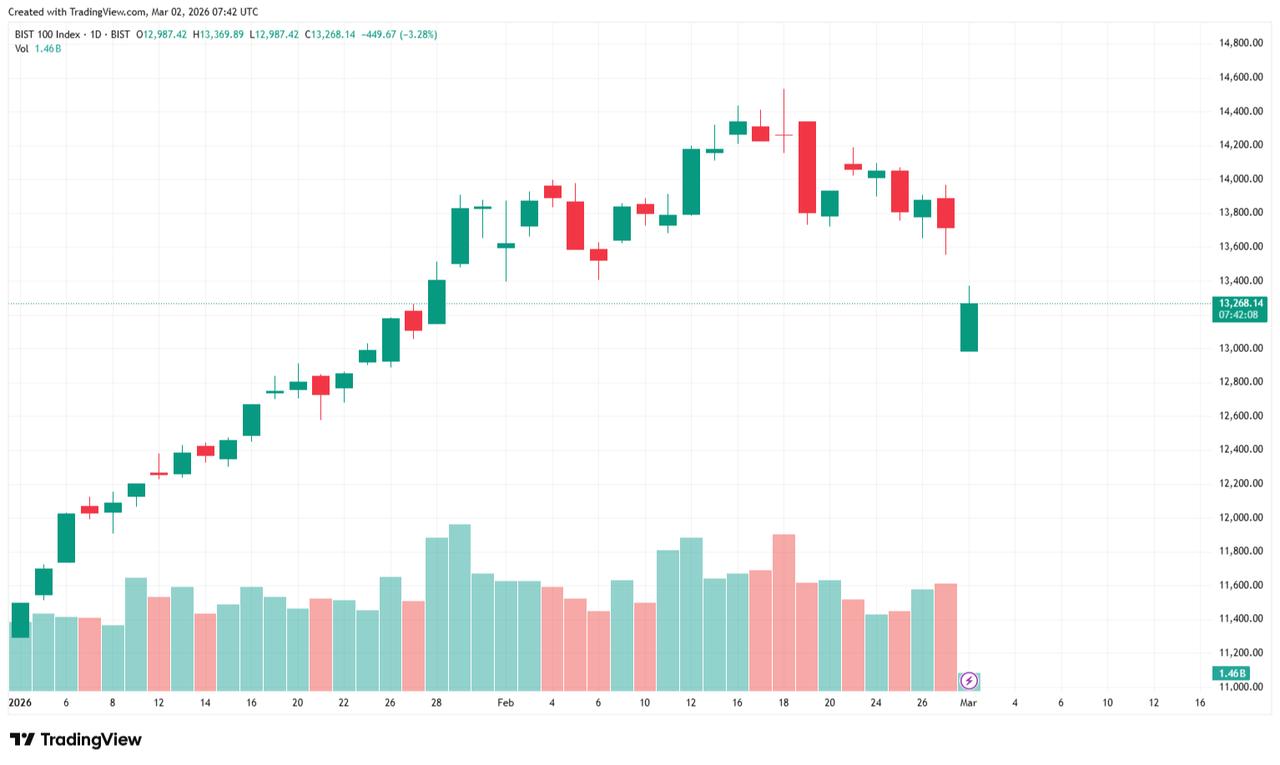
Türkiye’s benchmark BIST 100 index opened Monday down 5.3% at 12,987.42 points as investors reacted to rising regional tensions tied to the Iran conflict.
Selling hit all major sectors at the opening bell, with the banking index falling 5.8% and the holding index dropping 7%, as surging oil prices added to global inflation worries.
Within five minutes, however, the index trimmed part of its losses, climbing back to around 13,348 and cutting the decline to 2.7%.
The index had closed at 13,717.81 points last Friday.
Global markets opened the week under pressure after the U.S. and Israel carried out strikes on Iran over the weekend, increasing the risk of a prolonged conflict in the Middle East. Major Asian shares tumbled, while European and U.S. stock futures also moved lower.
Treasury and Finance Minister Mehmet Simsek said that officials were closely monitoring geopolitical developments and reviewing their possible impact on the economy.
"We are evaluating the possible effects on our economy in all dimensions. Our economy has strong macroeconomic fundamentals and is resilient to shocks," Simsek said.

As part of precautionary steps, Türkiye’s Capital Markets Board banned short selling on Borsa Istanbul’s equity market until the end of Friday’s session. Borsa Istanbul also lowered the order-to-trade ratio in the equity market from 5:1 to 3:1 until further notice.
The Central Bank of the Republic of Türkiye (CBRT), meanwhile, said it had decided to pause one-week repo auctions for a period, citing recent volatility in financial markets.
In a separate move, the bank said it would begin Turkish lira-settled forward foreign exchange sales transactions, allowing it to support foreign exchange liquidity and limit potential volatility in currency markets.
Meanwhile, U.S.-based investment bank JPMorgan said in a client note that it does not expect an interest rate cut in Türkiye on March 12 and raised its end-2026 policy rate forecast to 31% from 30%. The bank added that the surge in oil prices is likely to require revisions to short-term inflation forecasts.


 Set as preferred source
 Set as preferred source


 1 min read

 1 min read