Newsletters




Türkiye’s benchmark stock index, Borsa Istanbul’s BIST 100, delivered the second-highest return among major global equity benchmarks in January 2026, gaining 22.9% in local currency terms. It trailed only South Korea’s Kospi, which posted a 24% rise over the same period.
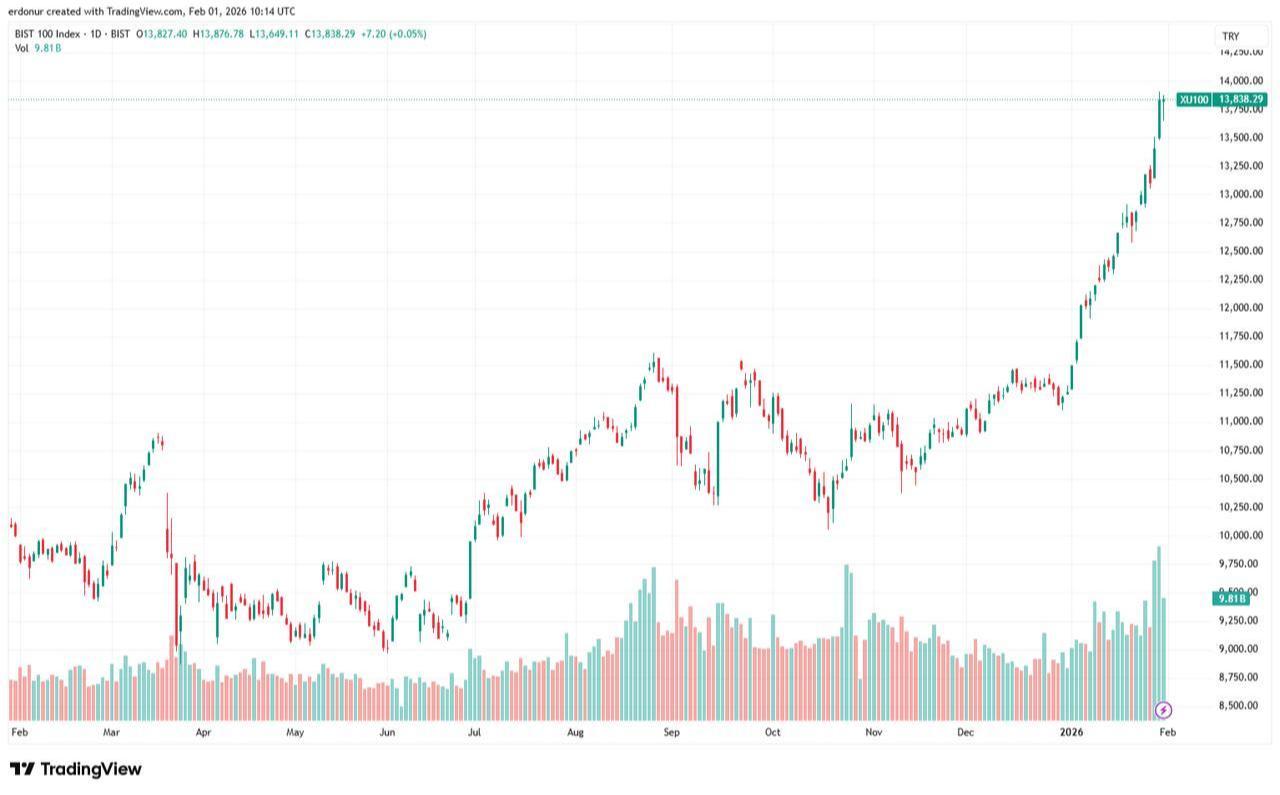
Starting the year at 11,296.52 points, the BIST 100 climbed steadily throughout January. The first record of the year was set on Jan. 5, when the index reached 11,726.18. Momentum continued through the month, culminating in a closing high of 13,906.51 on Jan. 29.
The performance marked the best January performance for the index since 1997, when it had posted a 64% monthly gain.
The index also reached 320.38 in U.S. dollar terms, its highest level since August 2024.
Trading volume mirrored the surge, with daily turnover averaging ₺178.2 billion ($4.1 billion). The highest daily turnover was recorded on Jan. 29 at ₺302.5 billion.
Among BIST 100 shares, real estate financing firm Katilimevim rose 95.7%, Kiler Holding, a diversified Turkish conglomerate with interests in retail and construction, gained 81.5%, and Batisoke Cimento, a cement producer, climbed 66.4%.
Large-cap names also performed well: defense electronics company Aselsan rose 30.7%, Garanti BBVA, one of Türkiye’s largest private banks, advanced 11.8%, and Enka, a major engineering and construction group, increased 24.1%.

The outstanding performance in Turkish equities reflects an improving outlook for the country’s economy, supported by declining inflation, lower borrowing costs, and reduced sovereign risk.
Türkiye’s 5-year credit default swap (CDS), a key gauge of sovereign risk, fell to 202.7 basis points in January, reflecting rising investor confidence in the country’s macroeconomic policy framework.
At the same time, two-year government bond yields declined from 37.22% to 34.61%, as easing inflation created a more favorable backdrop for further loosening of tight monetary policy.
Foreign portfolio inflows remained strong throughout the month. Excluding the final week of January, international investors purchased $3.51 billion in government domestic debt securities (GDSs) and $1.03 billion in equities.
As of the week ending Jan. 23, foreign holdings in Turkish equities stood at $39.87 billion, with government bond holdings at $21.51 billion.
Echoing the improved sentiment, credit rating agency Fitch Ratings reaffirmed Türkiye’s long-term credit rating at "BB-" and revised the outlook from "stable" to "positive," citing stronger policy coordination and improved macroeconomic indicators.
To gauge the sustainability of the current optimism, investors will cautiously watch Türkiye’s January inflation data, due Tuesday, Feb. 3.
Notable volatility is expected in the monthly CPI, which is forecast at 3.76%, largely driven by seasonal movements in food prices.


 Set as preferred source
 Set as preferred source


 1 min read

 1 min read