Sign in
 Newsletters





Türkiye’s central bank will eventually need to move away from its managed depreciation strategy for the Turkish lira, Moody’s senior sovereign risk executive Alexander Perjessy said, pointing to the currency’s real appreciation and its impact on the economy’s competitiveness.
The Central Bank of the Republic of Türkiye (TCMB) currently relies on exchange rate management as one of its main tools to contain inflation and keep inflation expectations in check, Perjessy stressed during an online Moody’s event covering economic developments across the Middle East, North Africa and Türkiye.
However, he said the approach would not remain sustainable indefinitely, as Türkiye’s current account deficit, although still relatively low by historical standards, is also widening, he added.
He noted that the central bank has sufficient foreign exchange reserves to manage a shift in its currency policy and reasonable grounds to make the adjustment.
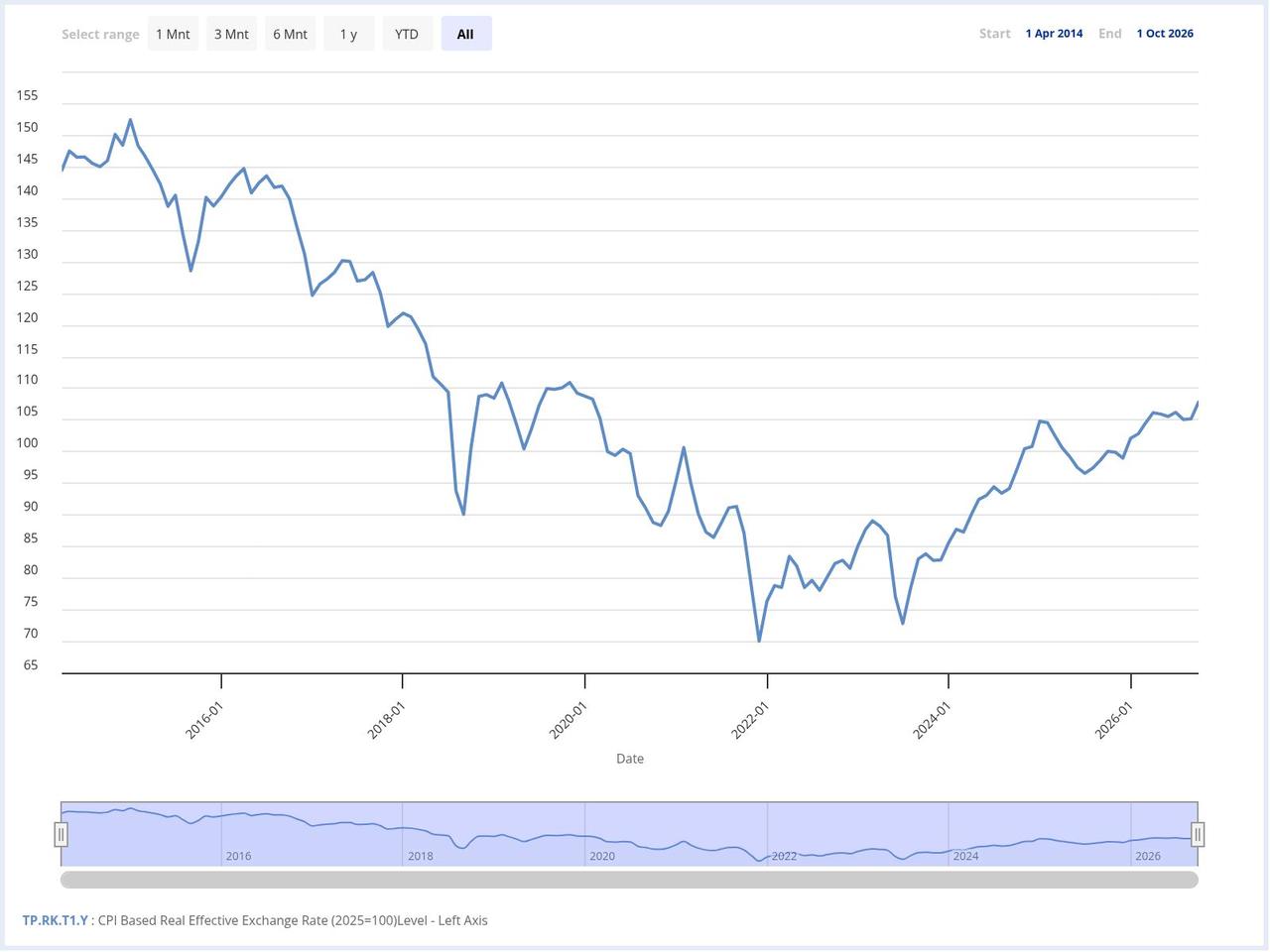
Türkiye’s consumer price index-based real effective exchange rate (REER) rose to 107.76 in October, up 2.66 points from 105.10 in September and 7.79% year over year. The producer price index-based REER also increased 1.67 points to 102.90.
A rising REER indicates that the lira is appreciating against Türkiye’s trading partners after adjusting for inflation differences, potentially eroding the competitiveness of Turkish exports.
Türkiye recorded a $2.72 billion current account surplus in September, while its 12-month rolling deficit reached $39.15 billion, up from $20.1 billion in the same month a year earlier.
The TCMB's gross international reserves stood at $158.95 billion as of Nov. 13, comprising $99.7 billion in gold and $59.25 billion in foreign currency assets. Reserves declined by $2.11 billion in the week, remaining well below the $188.2 billion recorded on Aug. 28.
Net reserves, which measure the central bank's foreign currency assets after accounting for its liabilities, stood at $26.1 billion on Nov. 20, according to calculations based on the TCMB's daily analytical balance sheet.
Meanwhile, the dollar traded at around ₺50.52 on Nov. 20, compared with approximately ₺43 at the start of 2026, marking a 17.49% rise in USD/TRY. The exchange rate also climbed from around ₺49.94 at the beginning of November.
The lira's depreciation picked up slightly in October, with USD/TRY rising 1.82%, compared with 1.54% in September. The pace eased in November, however, with the rate gaining around 1.1% through Nov. 20, despite a further increase in the second half of the month.
The TCMB maintains that it does not target a specific nominal or real exchange rate, although it can step in against excessive currency movements to safeguard financial stability.

Separately, Perjessy played down the potential impact of Türkiye’s September investment fund scandal, saying Moody’s does not expect the fallout to create systemic risks or affect the country’s sovereign credit rating.
The crisis erupted after several investment funds defaulted in mid-September, prompting authorities to place 131 troubled funds into a six-month liquidation process.
The decision affected more than 455,000 investors, with the funds holding combined assets estimated at ₺936.3 billion ($19.1 billion). The ensuing investigation led to the arrest of 136 suspects over alleged market manipulation and irregular transactions, including senior figures from the financial sector.
Moody’s has already published research on the investigation. Its stress scenario points to risks concentrated in specific funds rather than a broader systemic threat, Perjessy noted.
He also dismissed the likelihood of the fallout affecting Türkiye’s credit rating through economic channels or contingent liabilities.
Nevertheless, the investigation exposed gaps in capital market oversight and investor protection, even though authorities moved relatively quickly once the issue became serious, he added.
Perjessy also warned that rising energy costs linked to regional conflicts were making disinflation more difficult and delaying a decline in government borrowing costs.


 Set as preferred source
 Set as preferred source


 2 min read

 1 min read