Newsletters





Türkiye’s central bank reserves rose to an all-time high of $218.16 billion in the week ending Jan. 30, while foreign portfolio inflows into equities and government bonds extended into a ninth consecutive week.
Data from the Central Bank of the Republic of Türkiye (CBRT) showed that total gross reserves climbed despite a $1.8 billion drop in foreign exchange holdings, which stood at $84.41 billion. The increase was driven by a sharp $4.34 billion rise in gold reserves to $133.75 billion over the week.
Net international reserves, however, declined by $4 billion to $93.4 billion. Adjusted for central bank swap agreements, net reserves stood at $82.6 billion, reflecting a weekly drop of $2.9 billion.
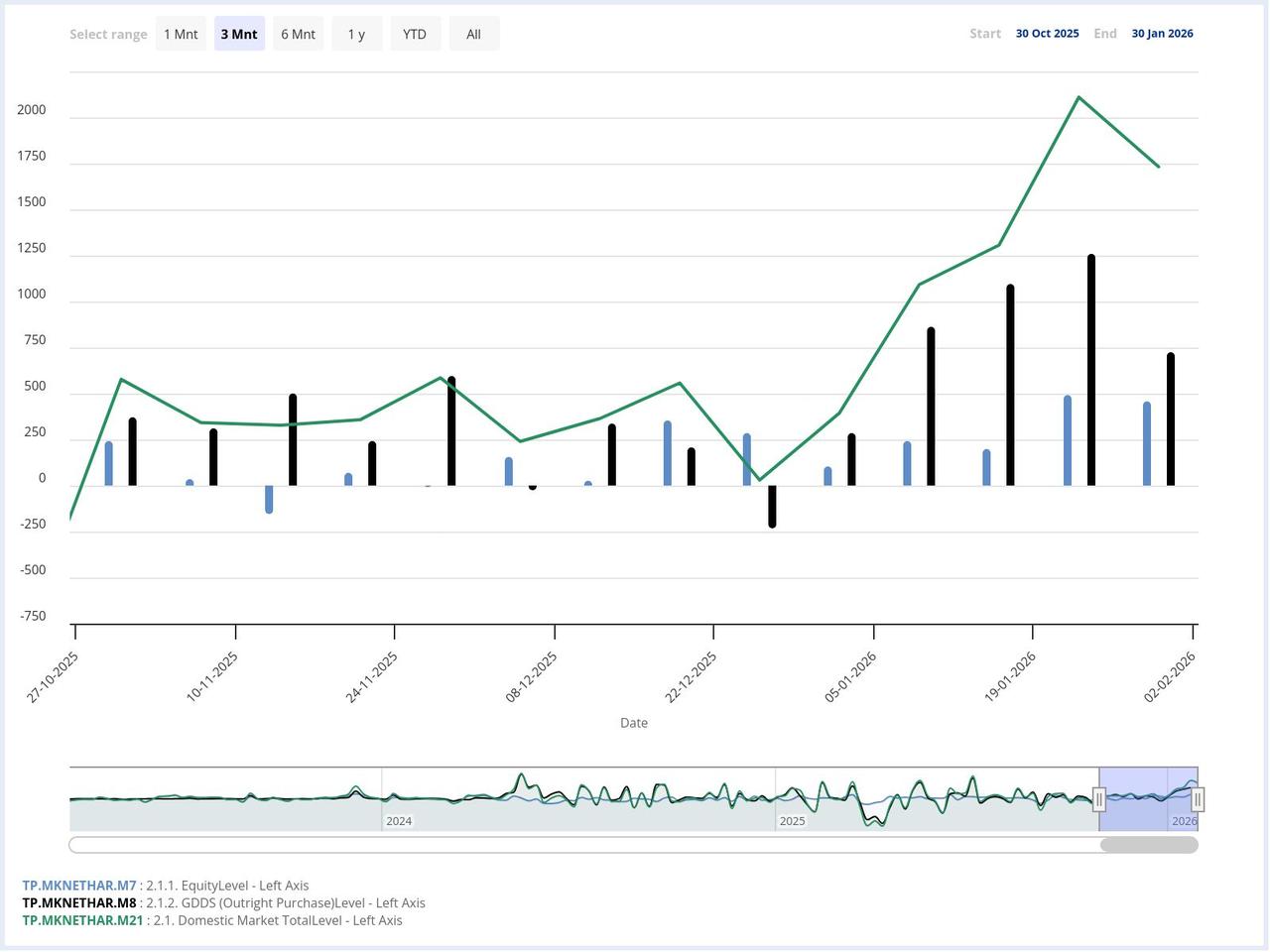
Foreign investors maintained their appetite for Turkish assets. Equity purchases totaled $455 million during the week, following $490 million in inflows the previous week. In the bond market, non-residents bought $839 million worth of domestic government securities (GDSs), compared to $1.3 billion in the prior week.
The total amount of government bonds held by overseas investors exceeded $4 billion in January.
Stockholdings of non-resident investors rose to $42.37 billion from $39.87 billion in a week, marking the highest level on record. Their holdings of government bonds increased from $21.51 billion to $22.41 billion over the same period.

The banking sector’s total deposits fell by ₺29.88 billion ($686.28 million) to ₺29.18 trillion ($1.27 trillion) in the reported week. Foreign-currency deposits held at domestic banks totaled $277.48 billion, of which $238.25 billion belonged to residents. Meanwhile, consumer credit extended to residents rose 2.6% to ₺5.83 trillion.
Assessing the overall performance, Douglas Winslow, Senior Director for Türkiye Sovereign Ratings at Fitch Ratings, said the agency’s decision to revise the country’s outlook from "stable" to "positive" on Jan. 24 was largely driven by the expected improvement in foreign reserves and a decline in external vulnerabilities.
"Since we upgraded Türkiye’s rating in September 2024, we’ve observed a notable enhancement in the quality of the country’s reserves and a reduction in FX-linked liabilities," Winslow said during a Fitch webinar.
"Türkiye’s large and diversified economy, lack of public external debt, strong track record of maintaining access to external financing during periods of stress, and resilient banking sector continue to support its credit rating," he added.


 Set as preferred source
 Set as preferred source


 1 min read

 1 min read