Newsletters





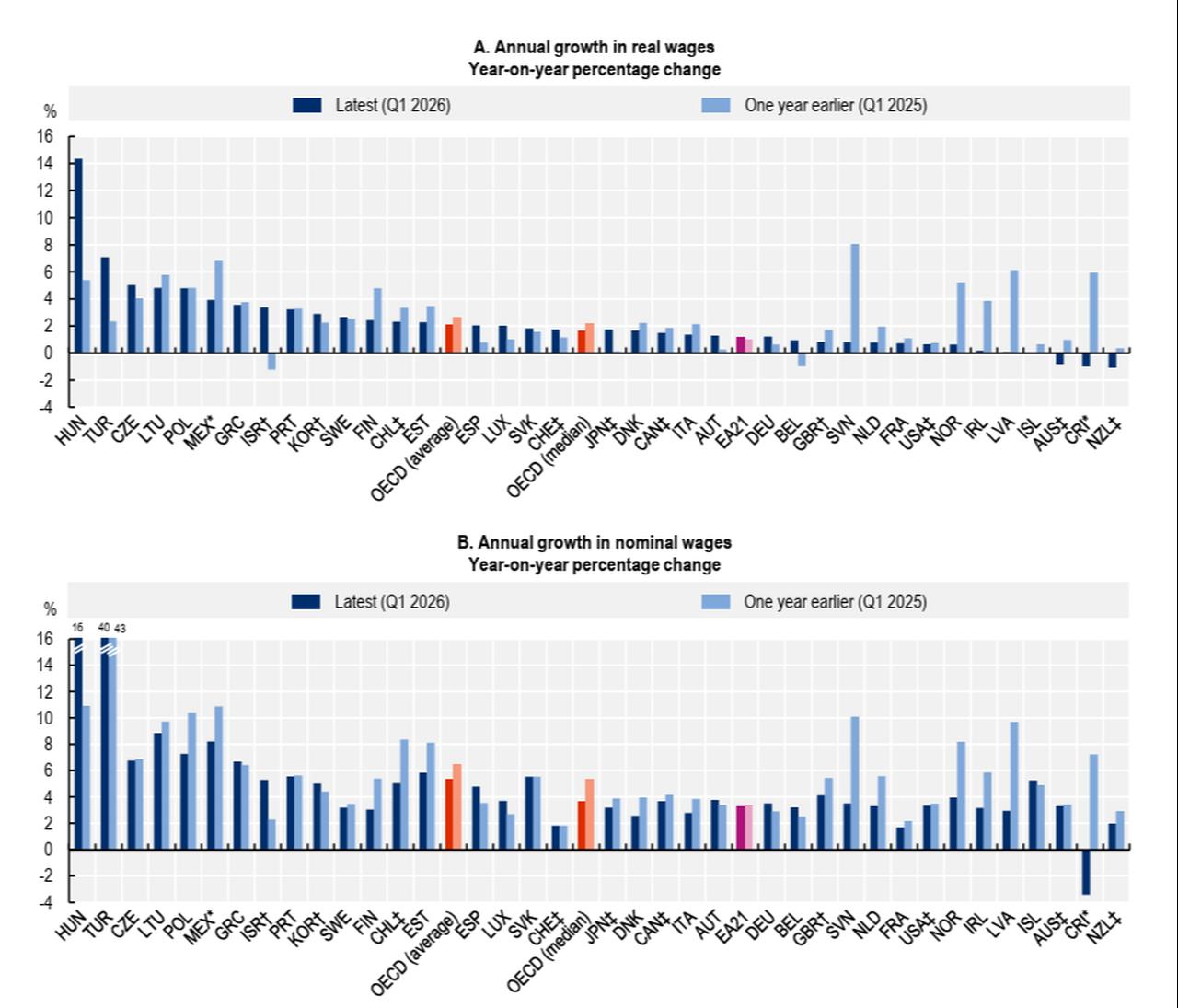
Real wages in Türkiye rose 7.1% year over year in the first quarter of 2026, the second-fastest increase among OECD countries after Hungary's 14.2% and well above the OECD average of 2.2%, according to the OECD's Employment Outlook 2026.
Türkiye also posted the strongest nominal wage growth among OECD members during the January-March period, with wages rising 40.3% year over year, while annual consumer inflation stood at 31%, the highest in the bloc.
The gap becomes even more pronounced over a longer period. Between the first quarter of 2021 and the first quarter of 2026, cumulative real wage growth in Türkiye reached 78.6%, compared with an OECD average of 4.9%.
That made Türkiye the top-performing OECD economy over the five years, with cumulative real wage growth nearly 16 times the organization-wide average.
Hungary ranked a distant second with cumulative real wage growth of 30.5% between the first quarter of 2021 and the first quarter of 2026. Poland followed at 18.0%, ahead of Mexico at 15.3%. Greece (13.1%), Israel (12.7%), Spain (11.8%), and Korea (10.9%) also recorded double-digit gains, though all remained well behind Türkiye's 78.6% increase.
At the other end of the ranking, Australia, Czechia, New Zealand, Finland, Ireland, Italy and Chile had yet to recover the purchasing power workers held before the post-pandemic inflation surge.

The OECD said labor markets across member countries remained resilient despite mounting global uncertainty. Average employment reached a record 72.1% in the first quarter of 2026, while labor force participation climbed to 76.7% and the unemployment rate stood at 4.9% in May.
At the same time, the organization warned that cracks are beginning to emerge.
"Labour markets have continued to show resilience, but new signs of weakening emerged over the past year," the report said, citing rising unemployment, slower employment and labor force participation growth, easing labor shortages, and weaker real wage growth.
Annual real wage growth across the OECD slowed to 2.2% in the first quarter from 2.7% a year earlier, and about two-thirds of member countries posted weaker gains than in the same period of 2025.
Despite the recovery, workers in roughly one-third of OECD economies still had inflation-adjusted wages below early-2021 levels, meaning they have yet to fully recover the purchasing power lost during the post-pandemic inflation shock.
The report also highlighted growing challenges for young people entering the labor market. While labor shortages continued to ease, structural shortages persist in many sectors, labor productivity growth has slowed, and unemployment among young entrants has risen relative to the broader working-age population.
Looking ahead, the OECD warned that geopolitical uncertainty, elevated tariff rates and higher energy costs are expected to fuel inflation and further slow labor market and wage recovery.


 Set as preferred source
 Set as preferred source


 1 min read

 1 min read