Newsletters





Türkiye's inflation slowed in June to around 1% on a monthly basis, official figures showed on Friday, while annual inflation declined to 32.1% as retreating oil prices and a stabilizing food supply curbed cost pressures.
The figures largely align with market expectations, adding further relief to the disinflation outlook following May's data amid optimism surrounding the deal between the U.S. and Iran aimed at ending the regional conflict and normalizing traffic through the Strait of Hormuz, a vital energy corridor.
According to the Turkish Statistical Institute (TurkStat), energy prices eased by 0.9% during the month, helping overall consumer price growth slow further. Food and non-alcoholic beverages prices rose just 0.2%, as transportation prices edged down 0.05%.
Housing costs, which include water, electricity, gas and other fuels, increased 2.3%, making the largest contribution to monthly inflation.
Alcoholic beverages and tobacco recorded the sharpest increase among the main expenditure categories, rising 3.5%. Elsewhere, inflation remained concentrated in services, with prices at hotels, cafes and restaurants climbing 2.1% and education costs rising 1.7%.
Core inflation, which excludes energy, food and non-alcoholic beverages, alcoholic beverages, tobacco and gold, came in at 1.5%, with the annual rate falling to 29.8%.
Domestic producer inflation, meanwhile, eased further in June, with producer prices rising 1.8% from the previous month and the annual rate declining to 28.1%.
Among industrial sectors, crude petroleum and natural gas recorded the sharpest monthly increase at 26.2%. In contrast, coke and refined petroleum products posted the steepest decline, falling 12.6%.
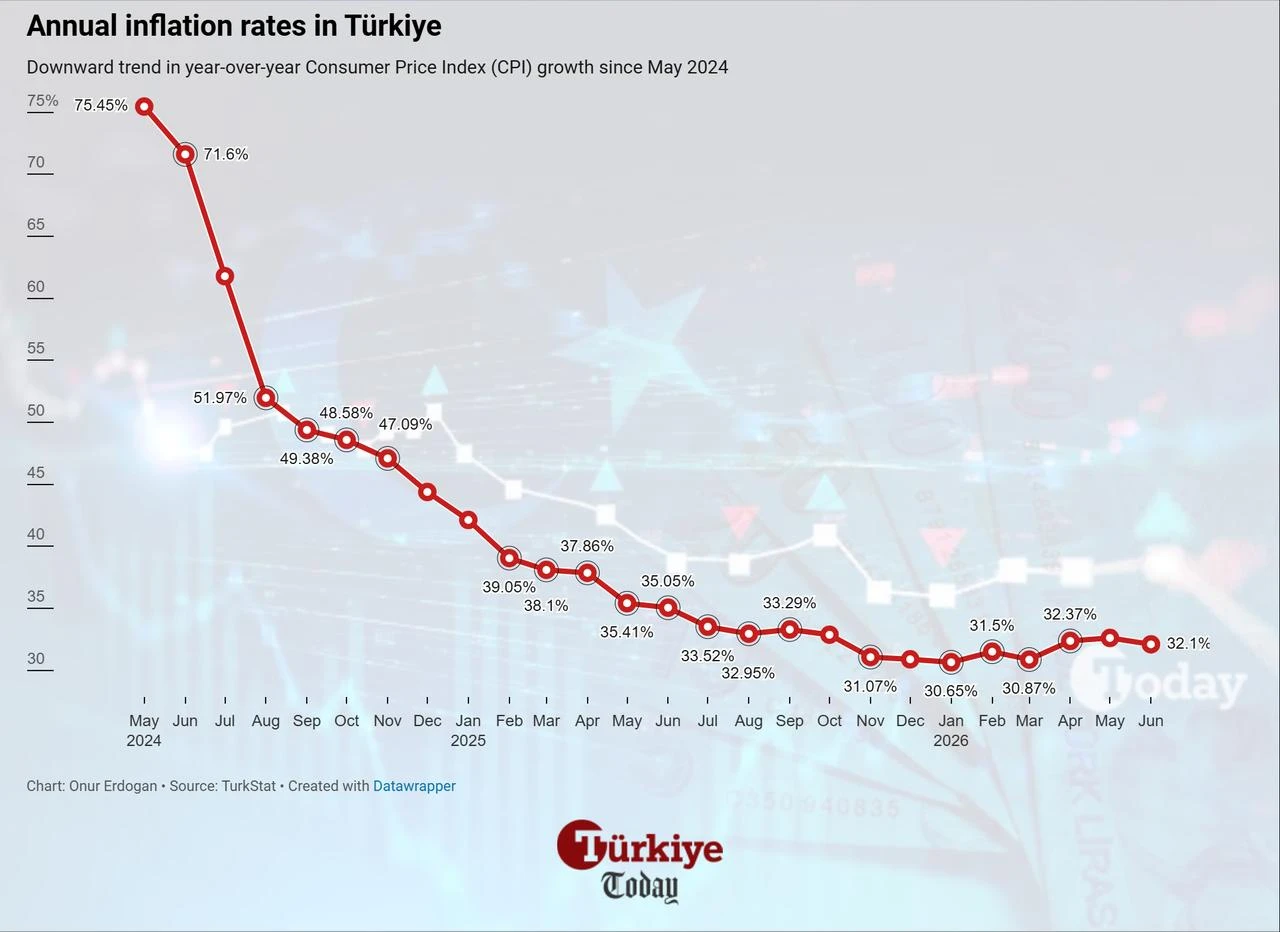

Softer consumer price growth recorded in June extends the moderation following the price pressures seen earlier this year, which were mainly driven by weather-related food supply constraints and elevated energy prices following the Iran war.
The annual inflation rate reached 32.6% in May despite the monthly cooldown, the highest level so far in 2026, up from 30.9% at the end of 2025.
In January and February, consecutive food price shocks, with food inflation rising above 6%, pushed monthly inflation to around 4.8% and 3%, respectively.
During the war period, energy prices rose 4.8% in March, followed by a 14.4% increase in April, pushing monthly inflation to 1.9% and 4.2%, respectively.
The data also boosts hopes that the Central Bank of the Republic of Türkiye (CBRT) may normalize its effective funding rate toward the policy rate of 37% from the current, costlier overnight rate of 40%, as part of unwinding the measures introduced in early March after the Iran war erupted.
The central bank revised its year-end inflation projection to 26% from 18%, while raising its interim target to 24% from 16% in the second Inflation Report of the year, presented in May, citing inflationary pressures stemming from the Iran war.
During the presentation, Governor Fatih Karahan said a prolonged divergence between the policy rate and the effective funding rate would not be appropriate from either a communication or implementation perspective, adding that all options remained on the table for future policy decisions.


 Set as preferred source
 Set as preferred source


 1 min read

 1 min read