Newsletters





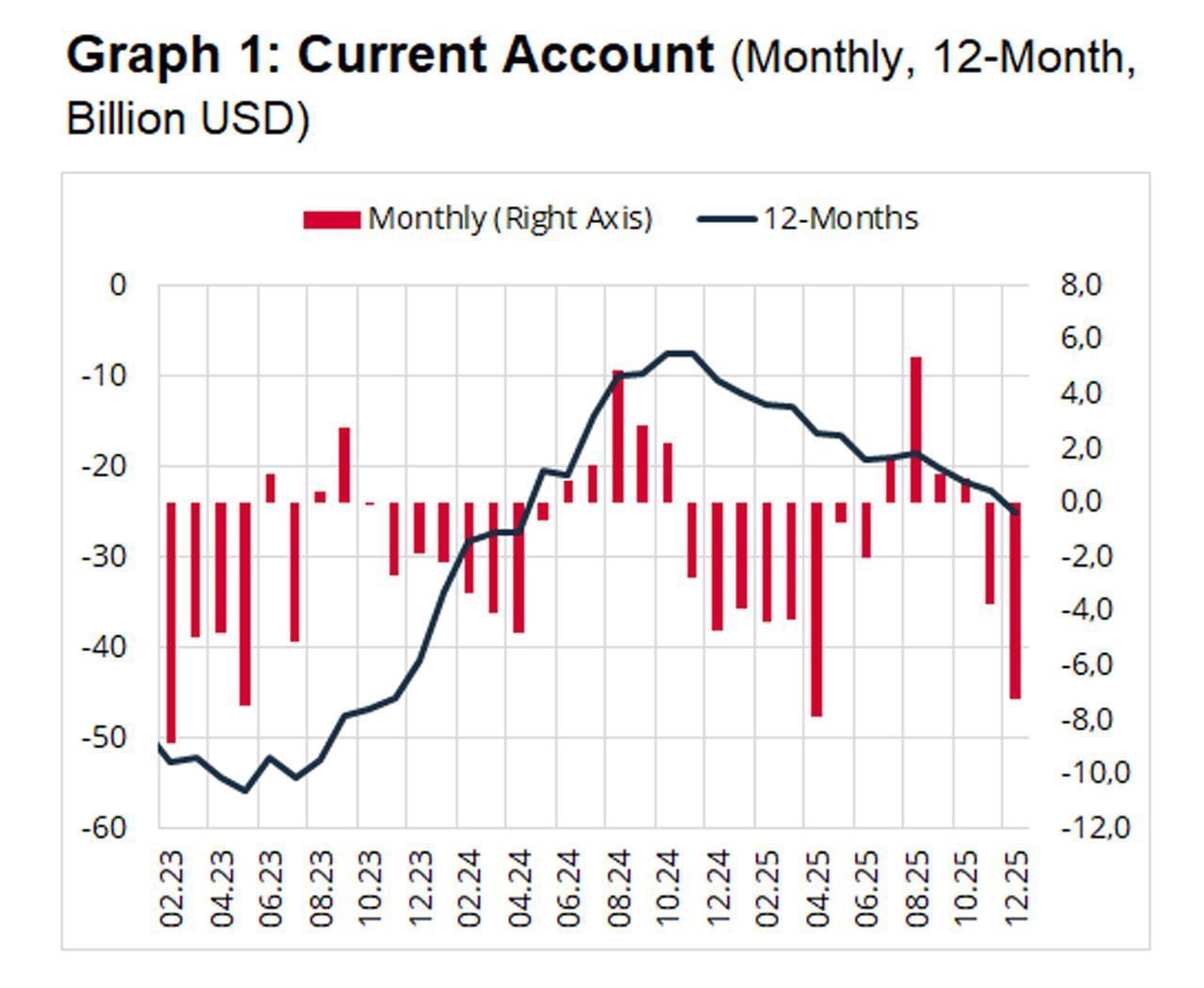
Türkiye’s current account posted a $7.25 billion deficit in December, bringing the year-end current account gap to about $25.20 billion, according to official balance of payments data.
The annual deficit widened by more than 141% from the previous year’s $10.45 billion, driven mainly by a larger foreign trade gap that lifted imports, as a limited easing cycle supported economic activity and firm household consumption, alongside the Turkish lira’s continued real appreciation.
The balance of payments–defined foreign trade deficit came in at $7.44 billion in December, while the full-year trade gap reached $69.70 billion.
Stripping out gold and energy, the current account ran a $0.69 billion monthly deficit, but on a yearly basis the adjusted balance still showed a $42.08 billion surplus.
Services generated a $63.50 billion surplus over the year, mainly from $51.02 billion in travel income and $22.87 billion from transport services. In December, services posted $2.65 billion in net inflows, with $1.67 billion coming from transport and $2.53 billion from travel.

Total foreign direct investment into Türkiye reached $13.08 billion, while outbound direct investment by Turkish residents stood at $9.83 billion in 2025.
Property purchases by Turkish residents abroad climbed to a record $2.68 billion in 2025, while nonresidents’ real estate investments in Türkiye plunged by 17.02% to $2.34 billion.
The government’s medium-term program projects the current account deficit at 1.40% of GDP for 2025, while the ratio stood at around 1.32% in the third quarter.


 Set as preferred source
 Set as preferred source


 1 min read

 1 min read