Newsletters





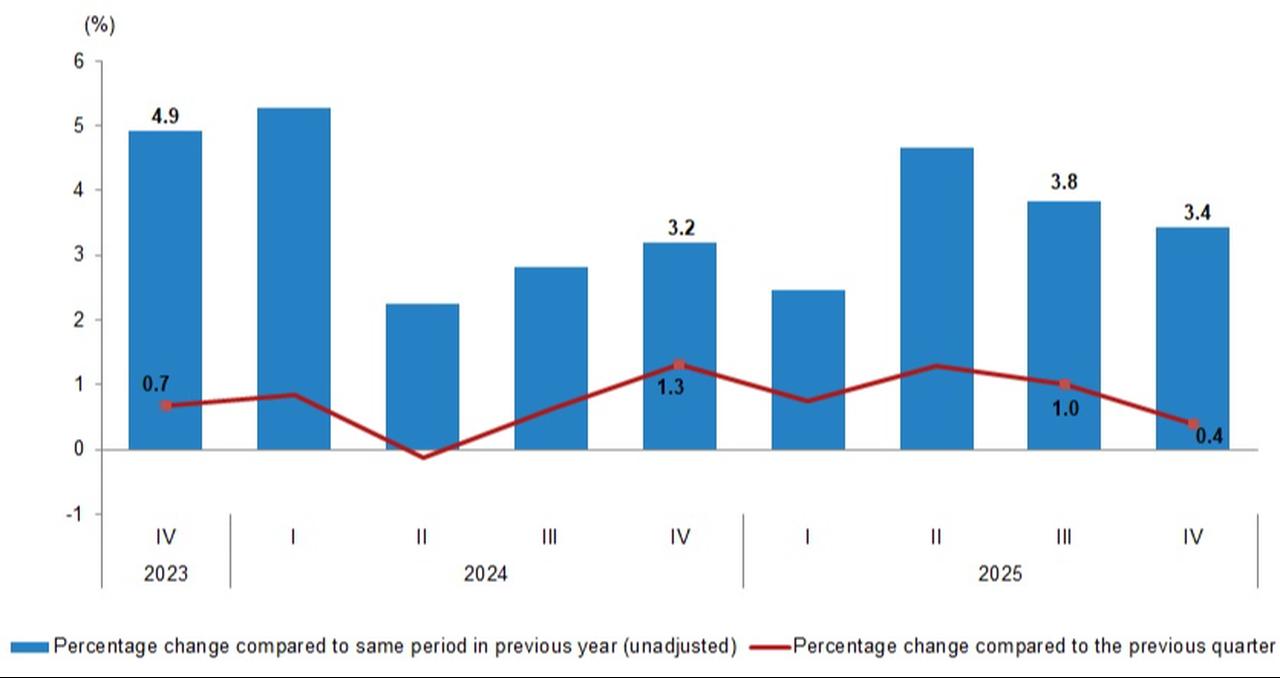
Türkiye’s economy expanded by 3.6% in 2025 compared with the previous year, lifting gross domestic product to ₺63 trillion ($1.59 trillion) from ₺44.6 trillion ($1.36 trillion) a year earlier, according to data released by the Turkish Statistical Institute.
GDP per capita reached $18,040 in 2025, reflecting the average income per person based on the country’s total output. In the final quarter alone, the economy grew by 3.4% year-on-year and 0.4% quarter-on-quarter, the data showed.
Gross fixed capital formation posted the strongest annual increase, rising by 7.0%. Imports of goods and services climbed 4.9%, while household final consumption expenditure rose 4.1% over the year. Government final consumption expenditure increased by 0.8%.
Exports of goods and services edged down 0.3%, marking the weakest performance among the main components despite reaching a record volume of $273.4 billion.
Sectoral data showed construction led the way, expanding 10.8%, while information and communication grew 8% and taxes on products minus subsidies rose 6.9%. Agriculture, however, shrank by 8.8%.

Commenting on the figures, Treasury and Finance Minister Mehmet Simsek said the annual figures placed Türkiye among high-income countries in 2025.
"We anticipate that we joined the high-income countries group in 2025, which is a critical threshold for our goal of permanent welfare gains," Simsek said in a written statement.
He noted that frost and drought continued to weigh on agriculture in the final quarter, while production growth persisted in other sectors.
The minister said net external demand weighed on growth in 2025 amid global trade uncertainty, but the current account deficit held at 1.6% of GDP. The budget deficit stood at 2.9%, below the Medium-Term Program forecast, while the primary surplus reached 1.2% excluding earthquake spending.
He added that easing geopolitical risks and stronger external demand could support growth in 2026, with structural and supply-side policies set to continue.


 Set as preferred source
 Set as preferred source


 2 min read

 1 min read