Newsletters




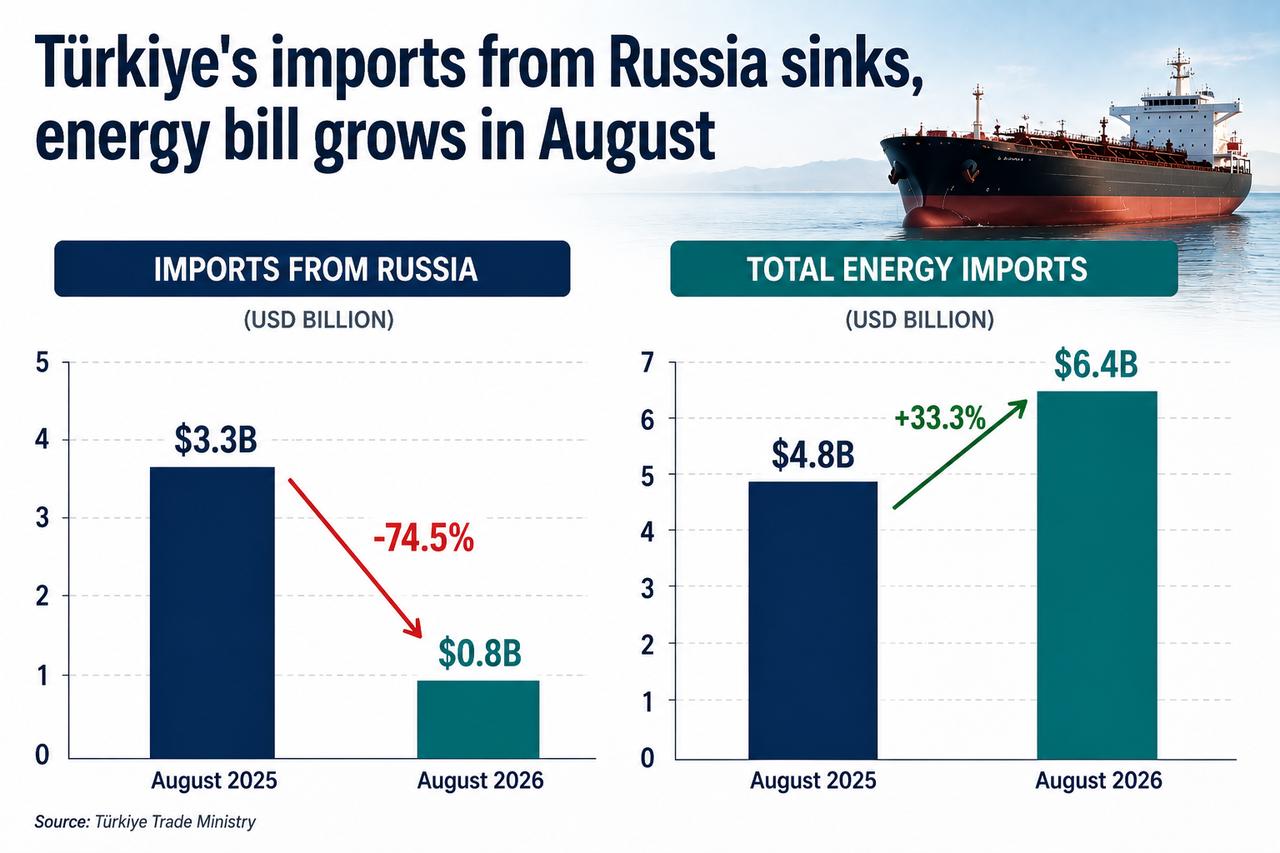
Türkiye’s energy import bill rose 33.3% year on year in August to $6.4 billion as Russian shipments, normally the top and cheapest source of oil and gas for the country, nearly halted amid intensified Ukrainian drone attacks in the Black Sea, pushing refineries toward costlier suppliers.
For the first eight months of the year, Türkiye’s energy imports rose 10.2% to $46.5 billion, from $42.2 billion a year earlier, an increase of $4.3 billion, official data showed on Thursday.
Türkiye’s total imports from Russia, of which energy shipments usually account for about 90%, fell 74.5% year on year to $836.5 million in August, from $3.3 billion a year earlier. The decline amounted to $2.5 billion, leaving Russia’s share of Türkiye’s total imports at 2.9%, compared with 10% in the January-August period and 11.6% for all of 2025.
In the first eight months of 2026, Türkiye’s goods imports from Russia declined 12.4% to $25 billion, from $28.6 billion a year earlier.
The reading follows July, when Türkiye’s imports from Russia fell 40.5% year-on-year to $2.1 billion, their lowest monthly level since May 2021. The sharp drop in bilateral trade came as fighting between Russia and Ukraine increasingly spilled over into commercial shipping.
On Aug. 3, two Turkish-owned civilian vessels, Yasar and Nadezhda, were attacked by drones after leaving Russia’s Black Sea port of Novorossiysk. Türkiye’s Foreign Ministry said crew members, including Turkish citizens, were injured and warned that the war was increasingly affecting civilian vessels.
Another Turkish-operated vessel, Lider Bordo Mavi, was struck off the Russian port of Tuapse on Aug. 26, while Lider Kocatepe, sent the following day to tow the damaged ship, was also targeted.
Türkiye responded by summoning Ukraine’s ambassador to Ankara and conveying its reaction to the attacks.
Türkiye had already cut imports of Russian oil through Black Sea ports in July after Ukrainian drone strikes disrupted Russian export terminals, including Novorossiysk and infrastructure linked to the Caspian Pipeline Consortium.
By August, Türkiye was also turning more heavily to alternative fuel suppliers. Russian diesel exports to Türkiye fell to about 80,000 barrels per day, or 20% of the country’s diesel imports, from 281,000 barrels per day in 2025, while supplies from the United States and India climbed to record levels, Reuters reported.

Despite Türkiye’s exports continuing their record-breaking streak in August, rising 8.1% year-on-year to $23.5 billion, higher energy and chemical imports pushed overall imports up 10.5% to $28.7 billion, weighing on the country’s trade balance as the deficit rose 22.3% to $5.2 billion.
For the first eight months of 2026, exports climbed 4% to $185 billion, while imports rose 5.3% to $250.8 billion. The trade deficit widened 9.3% to $65.8 billion, with the export-to-import coverage ratio at 73.8%.
Trade Minister Omer Bolat said Türkiye is now just $1.7 billion short of its $282 billion goods export target for the year, with the value of exports rising by $11.2 billion over the past 12 months. Annualized services exports also climbed to an estimated $125 billion, up from $122.5 billion in January, leaving Türkiye $3 billion short of its $128 billion year-end target.
Türkiye Exporters Assembly Chairperson Mustafa Gultepe offered a more cautious assessment, noting that the increase in Türkiye’s exports remained limited compared with the growth in global merchandise trade. He said high costs continued to erode Türkiye’s share of global goods exports.
Gultepe also pointed to signs of a recovery in Europe, Türkiye’s largest export market, saying Turkish exporters could turn that improvement into an opportunity but first needed measures to strengthen their competitiveness.


 Set as preferred source
 Set as preferred source


 1 min read
 1 min read