Newsletters





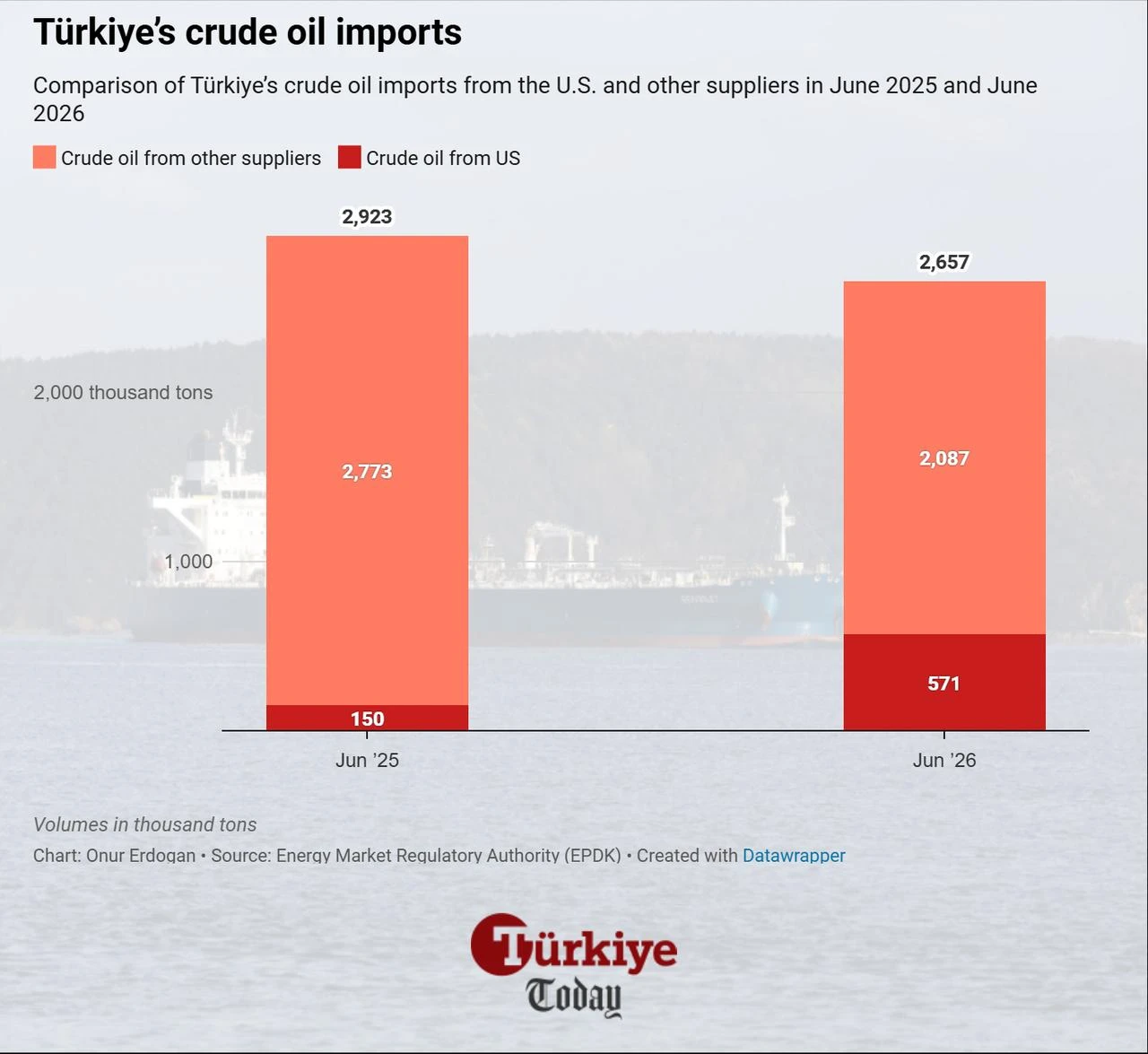
The United States became Türkiye’s second-largest supplier of crude oil and petroleum products in June, as U.S. shipments nearly quadrupled from a year earlier while Russian deliveries nearly halved but remained the largest source, according to official data.
U.S. supplies reached 570,676.7 tons or roughly 139,400 barrels per day, up 280% from June 2025, raising their share of Türkiye’s petroleum imports to 14.2% from 0.6%.
The change likely reflects emergency crude shipments from Washington’s Strategic Petroleum Reserve (SPR), which began reaching Türkiye in May as the U.S. released oil to offset global supply disruptions caused by the Iran war.
Russia, meanwhile, supplied 1.5 million tons, down 48.6%, with its share falling to 37.8% from 64.1%.
The sharp shift in supplier shares came as Türkiye’s total petroleum imports fell 12.9% year-on-year to 4 million tons in June, while crude oil imports declined 9.1% to 2.7 million tons.
The U.S. shipments consisted entirely of crude oil, while Russian supplies covered a broader mix. Russian crude imports fell 76.7% year-on-year to 425,167.2 tons, while diesel declined 24.4% to 772,388.2 tons. Jet fuel moved in the opposite direction, rising 29.6% to 68,768 tons, while marine fuel fell 85.1% to 5,000 tons and other petroleum products increased 17.5% to 247,792.9 tons.
Kazakhstan ranked third among Türkiye’s petroleum suppliers, providing 464,022.8 tons, up 12.7%, with its share rising to 11.6% from 8.9%. Libya recorded a sharper increase, with shipments reaching 320,145.4 tons, up 230.1%, raising its share to 8% from 2.1%.
Iraq supplied 295,575.8 tons, down 19.1%, leaving it with a 7.4% share, compared with 7.9% a year earlier. Saudi Arabia’s shipments fell 61.9% to 113,033.3 tons, cutting its share to 2.8% from 6.4%.
The decline in imports came despite stronger domestic demand. Türkiye’s petroleum product sales rose 9.1% year-on-year to 3.3 million tons, with diesel sales increasing 9.7% to 2.6 million tons and gasoline sales climbing 9.3% to 574,791.9 tons.
Petroleum exports fell 17.2% to 1.2 million tons, while aviation fuel exports increased 3.2% to 594,748.5 tons, accounting for 49.2% of total petroleum exports.
Natural gas imports followed a different pattern in June, with Iran gaining ground as U.S. and Turkmen gas supplies fell to zero.
Türkiye imported 3.1 billion cubic meters of natural gas in June, down 6.2% from 3.3 billion cubic meters a year earlier. Domestic production fell 7.6% to 248.1 million cubic meters, while consumption rose 4.6% to 2.8 billion cubic meters.
Azerbaijan remained the largest supplier, providing 1.0 billion cubic meters, down 0.7% from a year earlier. Iran recorded the strongest increase among the main suppliers, with deliveries rising 26.7% to 882.9 million cubic meters. Russia supplied 882.2 million cubic meters, down 9.1%.
U.S. natural gas imports fell 100%, from 193.0 million cubic meters in June 2025 to zero in June 2026. Turkmenistan also recorded no imports, compared with 103.3 million cubic meters a year earlier. Algeria supplied 282.2 million cubic meters, up 1.5%.
For the first half of 2026, Türkiye’s natural gas imports reached 30.7 billion cubic meters, up 2.6% from the same period of 2025. Pipeline gas accounted for 20.5 billion cubic meters, while LNG made up 10.2 billion cubic meters.
Natural gas stocks also rose 39.8% year-on-year to 5.3 billion cubic meters at the end of June as Türkiye built up reserves amid heightened supply risks linked to the Iran war.


 Set as preferred source
 Set as preferred source


 1 min read

 1 min read