Newsletters




A Roman mosaic discovered beneath a farm field in central England is reshaping how scholars see the reach of Greek literature in the late Roman world. Excavations in the county of Rutland have uncovered a large mosaic floor that tells the story of Achilles and the Trojan prince Hector, yet researchers say it follows a version of the myth associated with the playwright Aeschylus rather than with Homer’s "Iliad."


The story began in the summer of 2020, when a landowner’s son, Jim Irvine, noticed an unusual scatter of pottery, tile and oyster shells while walking across his family’s farmland during COVID-19 lockdown restrictions.
After checking freely available satellite images, he recognized cropmarks that appeared to show a rectangular building with curved, apsidal ends and an adjoining structure, and he reported the find to the Historic and Natural Environment Team at Leicestershire County Council.
A small investigation near the northern apse did not reveal walls as expected but exposed part of a mosaic floor lying only a short distance below the surface. County archaeologists confirmed that the floor was well preserved and decorated with framed panels. Because of the apparent importance of the site, the landowner, local authorities and Historic England agreed on emergency work to assess how extensive and fragile the remains were.

Specialists from University of Leicester Archaeological Services then carried out excavation, cleaning and recording of the exposed mosaic, along with sampling of deposits above it. Two stages of geophysical survey followed, using magnetometer readings and ground-penetrating radar, non-invasive methods that map buried structures by measuring changes in the soil. The results revealed a sizeable villa complex with aisled halls, possible bath buildings and other structures grouped around an open courtyard inside a ditched enclosure, on south-facing ground above a loop in the River Chater.
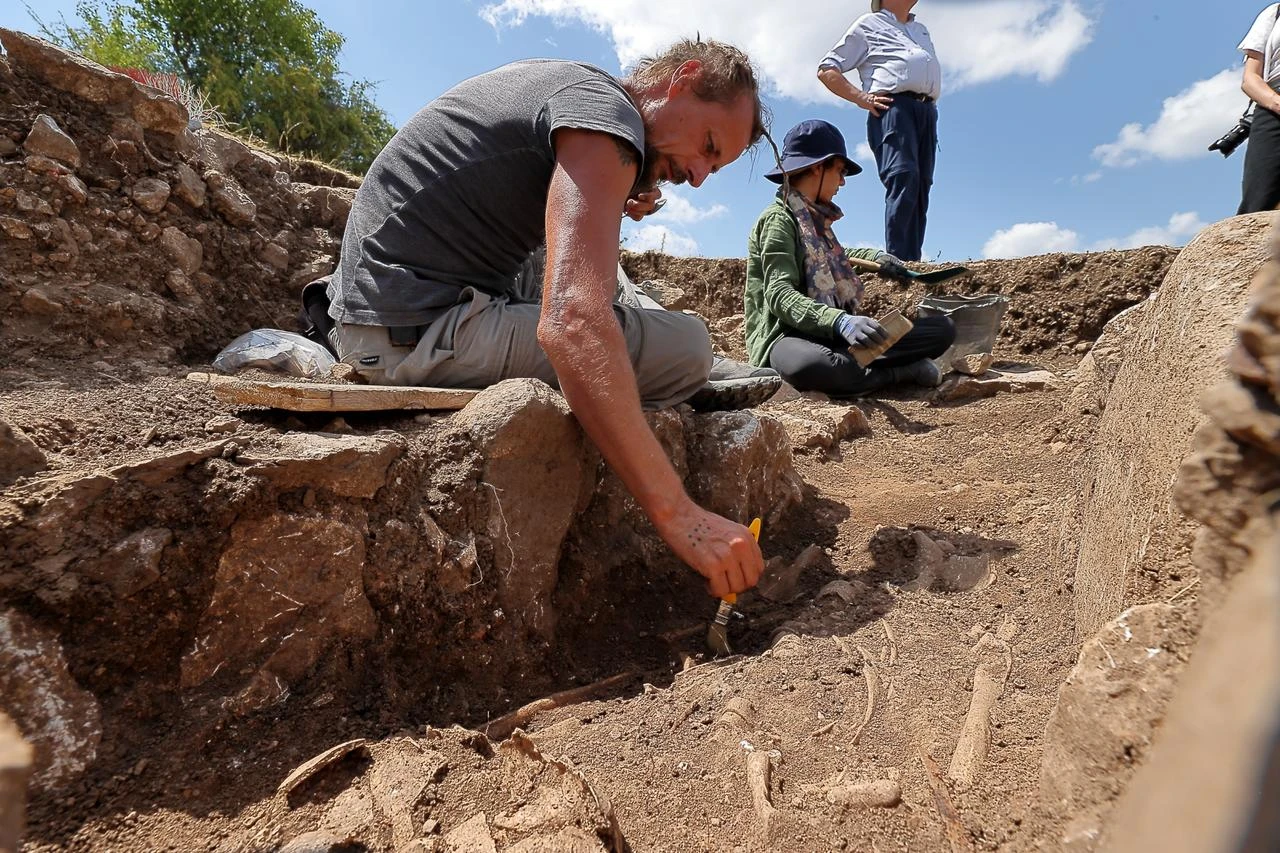
Trial trenches and test pits helped archaeologists understand how deeply the archaeology lay and how best to protect it. In September 2021, the team returned to uncover the mosaic room fully as part of a training project with university students and local volunteers. They exposed a pavement about 10 metres by 5.3 metres in size, thought to belong to a triclinium, a Roman dining room used for formal meals, or to an audience chamber at the northern end of the villa. The design was arranged so that viewers in the apse could follow the scenes in sequence. Pottery and coins indicate that the floor was in use in the later fourth century A.D., although activity at the villa began earlier and continued in the room even after the mosaic went out of use.
Because of its importance, the mosaic and villa complex have now been placed on the national list of Scheduled Monuments on the advice of Historic England, giving them legal protection against unauthorized work. The project has moved into its post-excavation phase, and the team hopes that images of the mosaic and objects from the digs will one day form a permanent display at Rutland County Museum in Oakham.

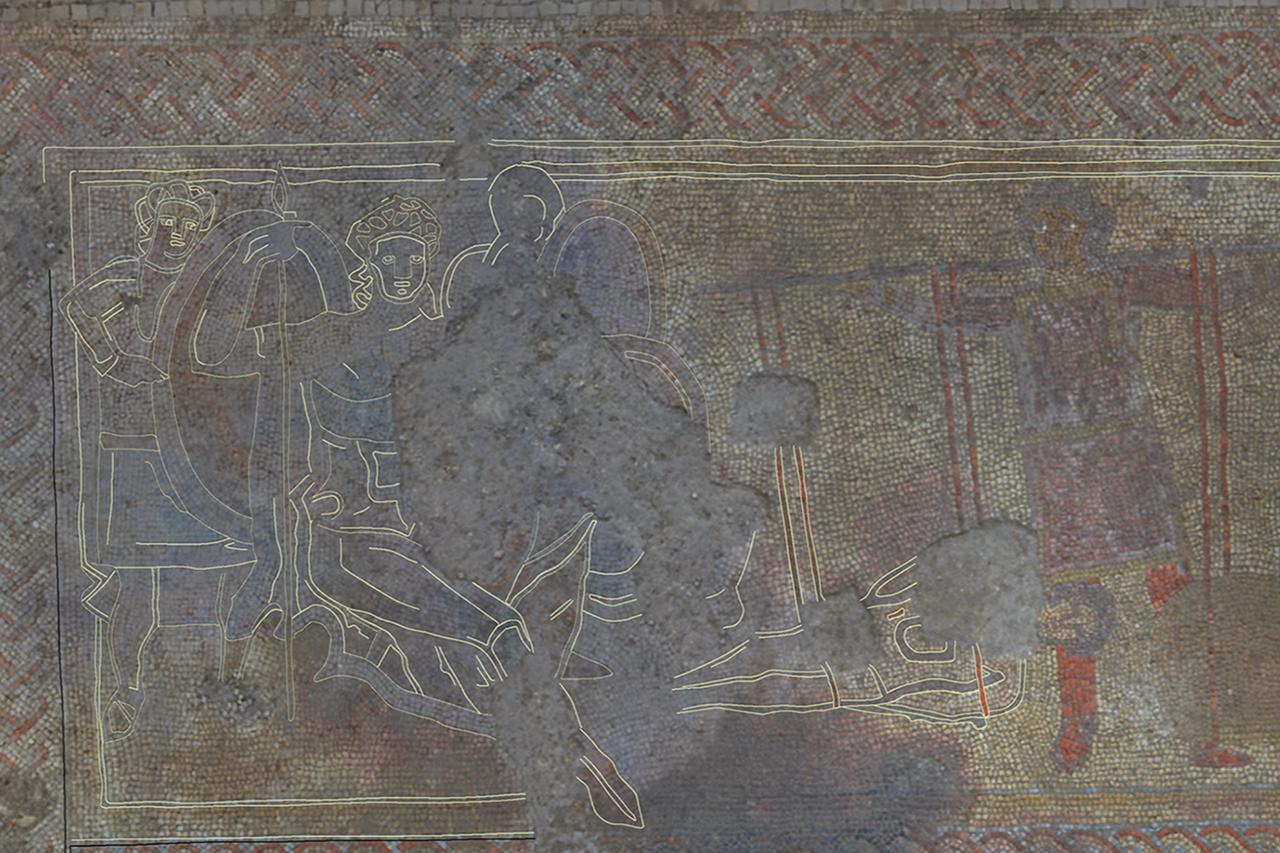
The mosaic is built up from colored tesserae, the small cubes of stone or tile used in Roman floors, and is organized into four horizontal registers framed by guilloche patterns, a plaited, rope-like border motif. The lowest zone, closest to the apse, contains decorative square panels. Above it, three narrative panels unfold key moments from the death and ransom of Hector at the hands of Achilles, in a dynamic sequence that observers have likened to a comic strip.
In the first scene, Achilles and Hector meet in single combat. Both stand in two-horse chariots, known as bigae, and aim their spears as if jousting, a choice that echoes the popular chariot-racing scenes of other fourth-century mosaics. Achilles, shown almost nude except for a flowing red cloak, drives his famous horses Xanthos and Balaios. He is slightly larger than his opponent, faces the viewer more directly and carries a more carefully rendered chariot, details that mark him out as the principal hero. Hector, by contrast, is fully clothed, turned away and accompanied by a smaller team.

The second panel shows the dragging of Hector’s corpse behind Achilles’ chariot, a ritualized display of anger for the killing of the younger warrior Patroclus. Achilles again dominates the scene, while Hector’s body hangs by the feet from the rear of the vehicle and shows red marks that represent abrasions. To one side, a bearded figure in a striped tunic and pointed Phrygian cap runs with raised arms; scholars interpret him as Priam, the king of Troy, rushing forward to plead for his son’s body. A celebratory Greek figure stands on the other side, and beneath the horses, a rearing serpent-like creature emerges, a motif that later analysis has linked to earlier Greek images in which a snake marks the tomb of Patroclus.
The top panel portrays the ransom of Hector. Fire damage has destroyed much of the left half, but the orientation of the tesserae allows a reconstruction of an enthroned Achilles, likened by researchers to depictions of Alexander the Great holding a spear, flanked by two bodyguards. On the right, Priam approaches again, this time carrying two gold vessels, while a guard follows behind him. At the centre stands a man holding a large balance beam across his shoulders. One pan of the scales holds a gold platter to receive Priam’s offerings, and the other contains the stiff body of Hector. The scene shows, quite literally, the exchange of Hector’s corpse for its weight in gold.

When news of the discovery first appeared, many reports naturally linked the mosaic to Homer’s "Iliad," the best-known account of the Trojan War. Detailed study of the imagery and of ancient texts, however, has led researchers to rule out the "Iliad" as the direct source.
In Homer’s poem, Achilles and Hector do not fight from chariots but chase each other on foot around Troy, and the poet dwells on their running and the speed of their feet. The Iliad also describes the dragging of Hector’s body, yet the god Apollo protects the corpse so that its skin does not suffer the damage shown in the mosaic. Most strikingly, the ransom in "Iliad Book 24" consists mainly of luxurious textiles, along with measured amounts of gold and fine vessels, and there is no weighing scene. Instead, during the earlier chase Achilles imagines that even if Priam tried to redeem his son by gold, he would refuse to show mercy. One ancient commentator quoted the line in which Achilles says no one will keep the dogs away from Hector’s head, “not even if Priam, son of Dardanos, orders that your self be redeemed in gold.”
A scholion, or marginal note, in a famous medieval manuscript of the Iliad then links this imagined ransom directly to the fifth-century B.C. tragedian Aeschylus. The note explains that Homer’s hero is speaking rhetorically, but that in Aeschylus’ play Phrygians, also known as The Ransom of Hector, the body really is weighed against gold. Ancient writers from different centuries mention this drama by name and associate it with the weighing scene, and later artworks from the Greek-speaking world and from Roman provinces depict the same motif of Hector lying in one scale pan while treasures fill the other.
The Rutland mosaic therefore appears to illustrate a long-lived alternative version of the Trojan story, rooted in Greek tragedy and transmitted through centuries of literature and art, rather than the more familiar Homeric storyline.

The serpent under Achilles’ horses deepens this connection with Greek visual traditions. On fifth-century B.C. vases from Athens, artists showed Achilles dragging Hector’s body past the burial mound of Patroclus, with a heroic snake coiled at the base of the tomb to mark the sacred spot. Scholars argue that the Ketton mosaicist, by inserting a similar supernatural snake, signalled the same location even though later texts and Roman artworks had mostly shifted the dragging scene to the walls of Troy.
Other details reveal how the craftsman drew on a shared repertoire of patterns and scenes circulating around the Mediterranean. The red bands beneath the hooves of the horses resemble shadow effects in mosaics from Trier in Germany and from the famous Villa Romana del Casale in Sicily, while the weighing motif echoes a floor mosaic from the Villa del Tellaro and appears again on silverware and relief sculpture. The combination of these elements in a late Roman villa in rural Britain suggests that its owners were familiar with the cultural fashions of the wider empire and chose a sophisticated Trojan War cycle to decorate a dining space where guests would recline, talk and show off their learning.


 Set as preferred source
 Set as preferred source


 3 min read