

 Newsletters


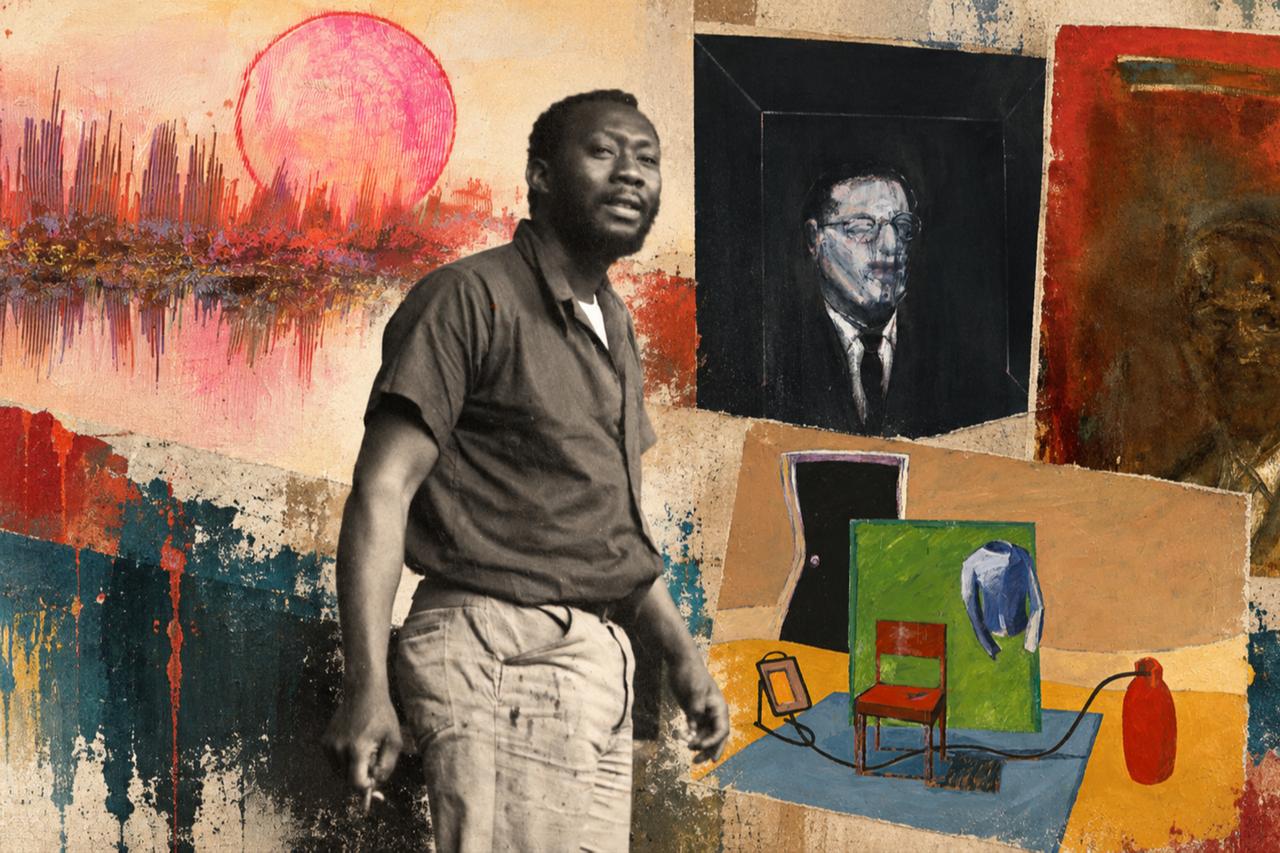


Pera Museum will bring together more than six decades of Frank Bowling's work in Istanbul for the first time, placing the renowned abstract painter's evolving practice in dialogue with works by Francis Bacon and Victor Willing.
Opening Sept. 29, Frank Bowling: Creation and Destruction, With Interruptions by Francis Bacon and Victor Willing will feature works from different stages of Bowling's career, including paintings that have never previously been shown.
Curated by Alistair Hicks, the exhibition will run through Jan. 31, 2027, bringing together Bowling's explorations of color, surface and memory with works by Bacon, a major figure in 20th-century figurative painting, and Willing, whose postwar practice moved from portraiture and figuration toward a freer, more expressive approach.
Presented by the Suna and Inan Kirac Foundation Pera Museum in collaboration with the British Consulate General in Istanbul, the exhibition sets out to examine how the three painters approached shared artistic questions through sharply different visual languages.
Born in British Guiana in 1934, Bowling moved to London in 1953 and graduated from the Royal College of Art in 1962 with a silver medal in painting.
He was elected a Royal Academician in 2005, received an OBE in 2008 and was knighted in 2020. His works are now held in more than 50 collections worldwide, while Tate Britain staged a major retrospective devoted to his practice in 2019.
Working between London and New York, Bowling drew from both British painting traditions and American abstraction while moving between geometry and spontaneity, abstraction and memory. His sustained experiments with color, light and the physical qualities of paint gradually brought about a distinctive visual language.
The Pera Museum exhibition will draw from several periods in that long career, including paintings from his celebrated Map series, produced between 1967 and 1971, as well as Mother's House Revisited from 2026.
In the latter work, Bowling returns to the image of the house where he spent his childhood in Guyana, bringing memory back into a practice shaped by continual experimentation.
Through these works, the exhibition follows the tensions between creation and destruction, order and chaos, and chance and control, presenting painting as something that can continue to shift and transform rather than remain a fixed surface.
Bowling's works will be shown alongside selected paintings by Francis Bacon and Victor Willing, allowing their artistic paths to cross while also bringing out the differences between them.
Bacon became known for powerful and unsettling treatments of the human figure, while Willing carved out a distinctive place in postwar British painting as his work moved away from portraiture and conventional figuration toward a more liberated form of expression.
The exhibition will include Bacon's Portrait of Lisa from 1956 and Study of a Nude from 1952-53, alongside Willing's Head VI from 1985.
Hicks describes the works by Bacon and Willing as "interruptions," regarding them as "compass points in getting one's bearings among Bowling's works."
Rather than setting up a conventional comparison, the curatorial approach uses those interruptions to open up different ways of looking at Bowling's development and the points where the practices of the three painters converge or move apart.
By bringing the three approaches together, Creation and Destruction also takes up the established distinction between abstract and figurative painting.
Bowling's movement between memory, material experimentation and abstraction sits alongside Bacon's engagement with the human body and Willing's transition toward increasingly expressive forms, allowing the exhibition to circle a question shared across their different practices: "What can a painting become?"
Frank Bowling: Creation and Destruction, With Interruptions by Francis Bacon and Victor Willing will be on view at Pera Museum in Istanbul from Sept. 29, 2026, through Jan. 31, 2027.
The museum is open from 10:00 a.m. to 7:00 p.m. Tuesday through Saturday and from noon to 6:00 p.m. on Sundays. Admission is free every Friday from 6:00 p.m. to 10:00 p.m. as part of "Long Friday," while students can visit free of charge every Wednesday under the museum's "Young Wednesday" program.


 Set as preferred source
 Set as preferred source


 1 min read
 1 min read


