Newsletters





This article is an extended introduction to The Istanbul Memo. To access the full dataset and explore more data-driven insights on Türkiye and beyond, subscribe to our newsletter.
At the turn of the millennium, global musical crossover required a compromise: foreign superstars had to record in English and conform to Western pop standards to gain entry into global charts.
The first real hint of a shift came in 1999, when Eurovision scrapped its strict rule forcing nations to sing only in their official languages. While the floodgates didn't open overnight, the writing was on the wall: the language barrier in pop music was starting to crumble.
Today, that script has flipped entirely. While Spanish-language music has won over listeners worldwide, Bollywood songs and K-pop have carved out significant niches of their own across the globe.
Take two massive global bangers: Mohamed Ramadan’s 2019 Egyptian hit "Bum Bum" and MC Fioti’s 2017 Brazilian funk explosion "Bum Bum Tam Tam." Sung in Arabic and Portuguese respectively, both tracks relied on the exact same infectious, punchy beat-word to shatter international boundaries and rack up hundreds of millions of views.
A decade or two ago, the idea that two songs in non-English languages, anchored by the same universal punchline, could turn into global viral phenomena without a single English verse would have sounded like a fever dream.
On the surface, this shift supports a dramatic cultural thesis: that American global soft power is evaporating as foreign audiences abandon English-language entertainment. However, looking beneath the vocals reveals a subtler narrative. Rather than vanishing, American musical influence has been absorbed, adapted, and re-anchored into a global framework of "glocalisation," or at least some would argue so.
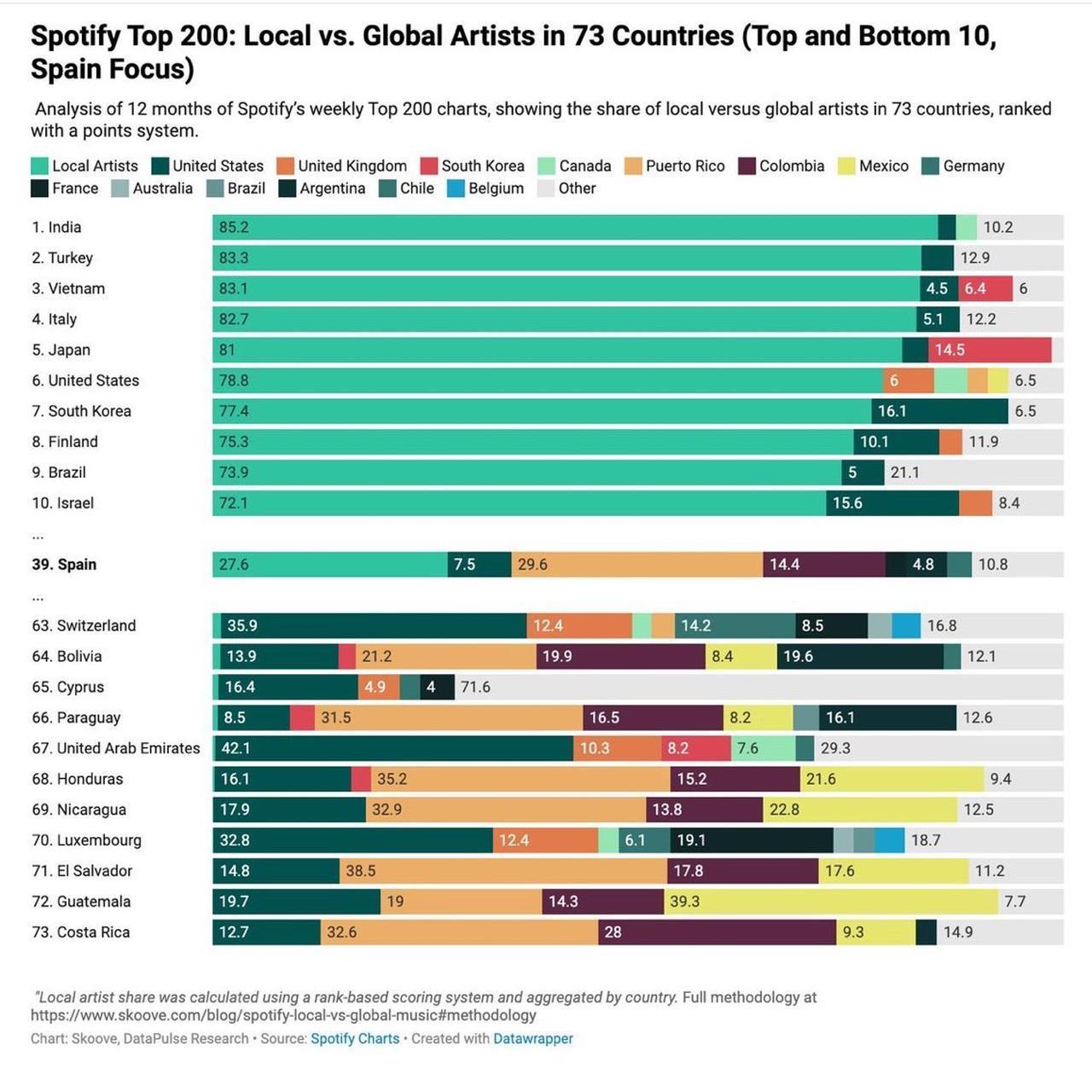

The statistical retreat of Anglo-American chart dominance is undeniable. Data reveals that among the top 10,000 most-streamed tracks worldwide, the share of English-language songs fell from 67% in 2021 to 54%.
Even within the United States, historically the world's primary exporter of pop culture, the English-language share of on-demand audio streams slipped to 86%, while Spanish-language streaming climbed to 9.5%.
On Spotify, over half of the 66,000 artists who earned at least $10,000 in royalties in 2023 come from countries where English is not the first language.
In research published by London School of Economics economists Will Page and Chris Dalla Riva, this phenomenon is identified as "glocalisation"—the power shift that occurs when interactive, on-demand streaming replaces linear broadcast radio.
Unbound by radio programmers pushing centralized Western hits, listeners overwhelmingly choose local artists singing in native tongues.
Domestic acts captured 70% of top tracks in Italy and Poland, and 80% of top artists in Germany. In markets like Türkiye and India, domestic artists command 83% and 85% of weekly Spotify Top 200 streams, respectively.

Does the decline of English-language chart dominance mean American influence has disappeared? Not quite. While the lyrics and stories have localized, the sonic blueprints and production tools remain heavily influenced by American traditions.
Take corridos tumbados, one of the fastest-growing genres globally. Young Mexican creators blend 19th-century regional storytelling ballads and acoustic guitars with urban American trap hi-hats, 808 sub-bass, and hip-hop cadences.
Similarly, European rap superstars in France and Poland use American hip-hop production to articulate hyper-local street politics and regional slang. In West Africa, Afrobeats megastars like Rema weave native polyrhythms together with Western pop arrangements and trap percussion, driving hits like "Calm Down" past 1 billion streams.
For some, songs and performers are increasingly local, but underlying genres and production methodologies are thoroughly globalized. American musical codes have not been destroyed; instead, they have become the open-source infrastructure upon which the world builds its own regional movements.
The modern global music economy operates under a crossover inversion. Where artists once had to conform to American language and style, contemporary critics note that "the market has crossed over into them".
Recognizing this reality, Western music conglomerates like Universal Music Group have pivoted from exporting Anglo-American stars to acquiring equity stakes in regional powerhouses, such as Lagos-based Afrobeats label Mavin Global.
America provided the production tools and urban rhythms, but global creators now use those tools to tell their own stories in their own voices.


 Set as preferred source
 Set as preferred source


 1 min read

 1 min read