Sign in
 Newsletters




London Museum opened its new home in a former Victorian meat market in Smithfield, central London, on Saturday, Nov. 28, after a 10-year transformation costing £437 million ($570 million).
Billed as the world's largest city museum, it tells the British capital's story through royal belongings, everyday objects, artworks and items reflecting its darker past. By some estimates, the project exceeded its initial budget by at least £100 million.
The institution, formerly the Museum of London, marks its 50th anniversary this year. Director Sharon Ament said she wants it to draw millions of visitors like the British Museum, including people who do not usually go to museums.
A restaurant, cocktail bar, shops and a cafe open 24 hours on certain days will be accessible from the street outside the museum during those hours.
The collection includes Queen Victoria's black mourning dress, a stained vest associated with King Charles I's execution and a leather chair that author Charles Dickens is believed to have used while writing.
Visitors can also see ballerina Anna Pavlova's costume from "The Dying Swan," an old Selfridges department store elevator, an Olympic torch from the London 2012 Games, the swim trunks diver Tom Daley wore at the competition that brought him early fame, fragments from a 1970s IRA bombing and newspaper headlines on the July 7, 2005, terrorist attacks in London.
One of the more unusual exhibits is a piece of the Whitechapel Fatberg, a 130-ton mass of fat, wet wipes and other waste that blocked a sewer in East London in 2017.
Smithfield, a meat market for centuries, was also a site of public executions, including that of Scottish leader William Wallace in 1305. In 1945, a V-2 rocket attack by Nazi Germany there killed more than 100 people.
Visitors start at Real Time, an entrance designed as an old street. It features Banksy's "Piranhas," a clock tower with the last bell cast at the Whitechapel Bell Foundry and a data wall on subjects ranging from London's bee population to listening habits.
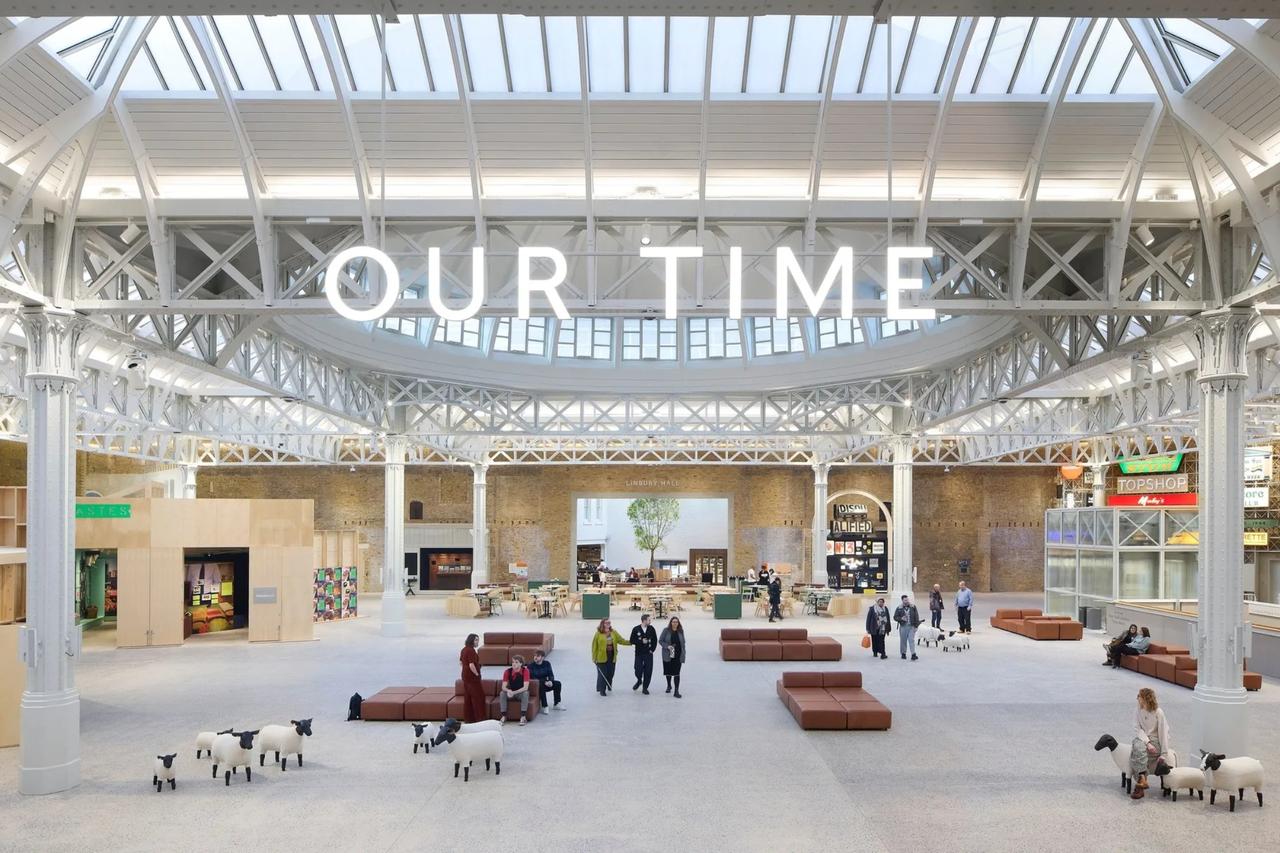
Our Time, in the old trading area of the General Market, focuses on the memories of people who have lived in London in recent years. The Lord Mayor's golden state coach and a Buckingham Palace switchboard linked to the prime minister share the space with a memorial section for victims of the 2017 Grenfell Tower fire.
The permanent Past Time gallery, set at Roman street level, spans prehistoric inhabitants to present-day migrant communities. It does not strictly follow a timeline; some sections are arranged under themes such as "London as lesson" and "London as prayer." Writers and poets provide some of the historical commentary. Its highlights include the Cheapside Hoard, about 500 pieces of 16th- and 17th-century jewelry uncovered during construction work in 1912.
A large window lets visitors watch trains in a railway tunnel running through the museum. Teams from Stanton Williams, architect Asif Khan and conservation architect Julian Harrap led the redesign of the General Market, which opened in 1883 and was long neglected after closing in the 1990s.
Khan said the basement is twice the size of the floor above and has become a testing ground for museums' future.
In spring 2027, the basement vaults will host "Londinium: The Making of a Roman City," a free exhibition on the formation of the Roman settlement. The former Poultry Market is due to be completed in 2028 with temporary exhibition spaces, a learning center and collection stores.
Unlike the former museum, opened in 1976 on an elevated walkway linked to the Barbican Center, the new site connects directly to local streets and transport. Ament wants people to drop in without planning a special visit.


 Set as preferred source
 Set as preferred source


 2 min read