Newsletters




Archaeological research near Szigetvar Castle in Hungary has revealed that the Ottoman settlement built around the presumed place where Sultan Suleiman I died during his final military campaign was considerably larger and wealthier than previously thought.
Research carried out by Hungary's University of Pecs in 2024 and 2025 found Ottoman-era artifacts spread across roughly 80 hectares around the site associated with Suleiman the Magnificent, pointing to a substantial settlement that extended well beyond the central tomb complex.
The discoveries have shed new light on Turbek, the Ottoman settlement that grew up around a tomb built in Suleiman's honor after his death during the siege of Szigetvar on the night of Sept. 6-7, 1566.
Suleiman, the longest-reigning sultan in Ottoman history, ruled for nearly 46 years before setting out from Istanbul on May 1, 1566, for his 13th and final military campaign.
Despite his declining health, he traveled with the army and had his imperial tent set up on a hill overlooking Szigetvar Castle, at what researchers now believe was the location of the later tomb complex.
Suleiman died in his tent during the night of Sept. 6-7, shortly before Ottoman forces captured the fortress. Historical accounts say his death was initially kept from the army to preserve morale and discipline and allow his son, Selim II, to take over peacefully.
According to historical accounts, Suleiman's internal organs were removed as part of efforts to preserve his body, which was treated with amber and musk before being temporarily buried beneath the throne inside his tent. Some sources maintain that the organs themselves were buried at the encampment.
His body was reportedly exhumed about 42 days later and taken away by carriage, while officials continued to act as though the sultan were still alive until Selim II reached Belgrade.
After taking the throne, Selim II ordered a tomb to be built where his father was believed to have died and where his internal organs were thought to have been buried.
The tomb later developed into an important pilgrimage destination, drawing visitors to a wider complex that included a mosque, a dervish lodge used by members of a Sufi religious community, a guesthouse and guard barracks.
A wooden palisade, or defensive barrier made from timber, protected the complex, while civilian buildings gradually went up around it and developed into the settlement known as Turbek.
Turbek disappeared after Ottoman rule in the region came to an end, and its location was eventually forgotten as vineyards and gardens spread across the former settlement.
Modern attempts to track down Suleiman's tomb moved forward after the Turkish Cooperation and Coordination Agency and the Municipality of Szigetvar signed an agreement in 2012.
An interdisciplinary team led by University of Pecs Professor Norbert Pap examined historical documents, maps, and land records, along with a plan of the tomb complex drawn in 1664.
Researchers concluded that the original complex stood on Vineyard Hill in the Turbek-Zsibot area, about 4.2 kilometers northeast of Szigetvar Castle.
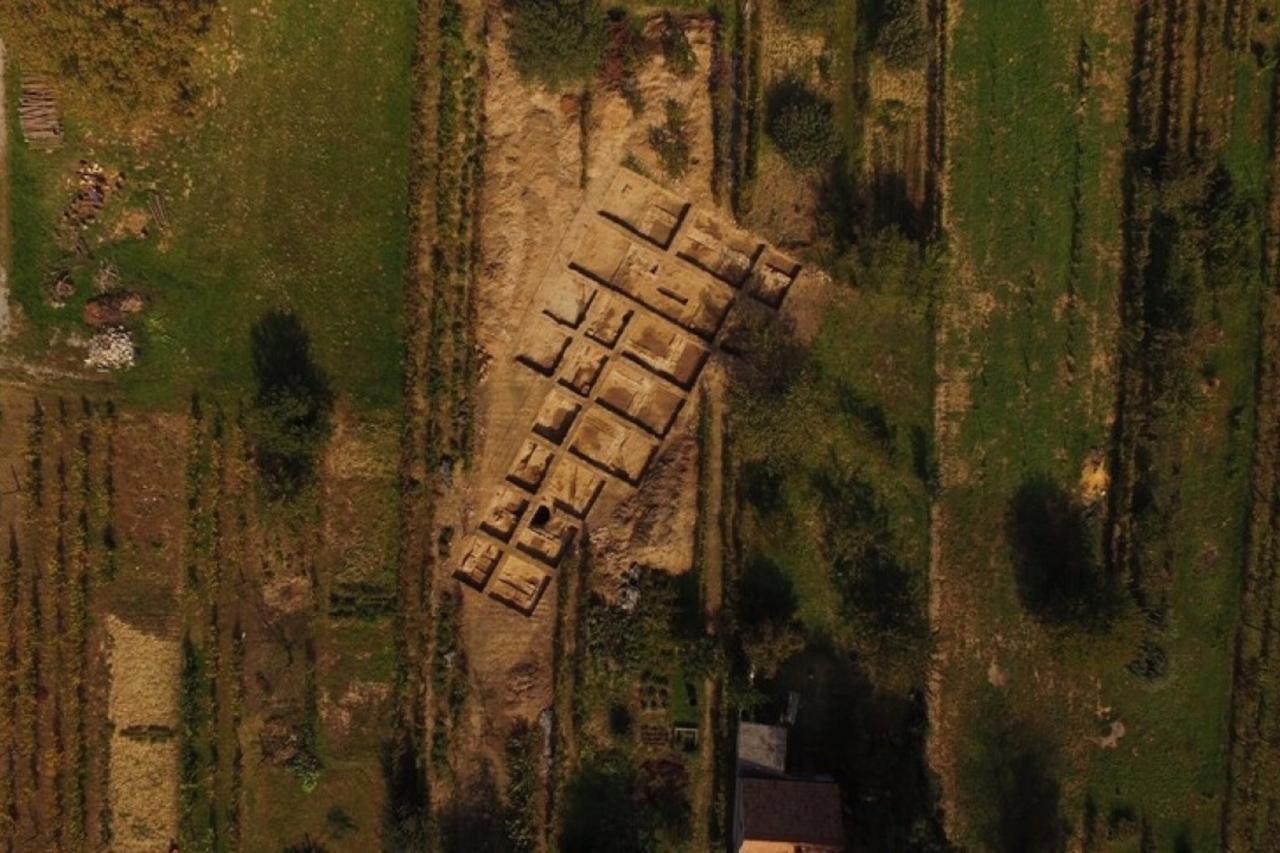
Excavations that began in 2015 uncovered a square structure identified by researchers as the tomb built in Suleiman's honor. Later work brought to light traces of the mosque, dervish lodge, guesthouse, barracks, wooden defenses, and civilian buildings surrounding it.
The 2024-2025 research expanded beyond the core complex as Turkish and Hungarian researchers led by the University of Pecs carried out surface studies and geophysical surveys across the wider area.
The teams found ceramics, coins, jewelry, Ottoman metalwork, and everyday objects around buildings, some of which had been built from brick and covered with roof tiles.
A well and large storage pits containing traces of grain were also uncovered, alongside terracotta components from heating systems, footed bowls, fragments of porcelain cups, and pieces of painted glass vessels.
Among the more distinctive discoveries were a rare 16th-century gold coin, a silver coin from the Crimean Khanate, Ottoman tableware, rings, decorated buckles, and ornaments used on horse harnesses.
Researchers said the concentration and range of material across the wider site showed that Turbek stretched well beyond the tomb complex and that some of the people who lived there or visited it were relatively affluent by the standards of the period.


 Set as preferred source
 Set as preferred source


 2 min read