Newsletters


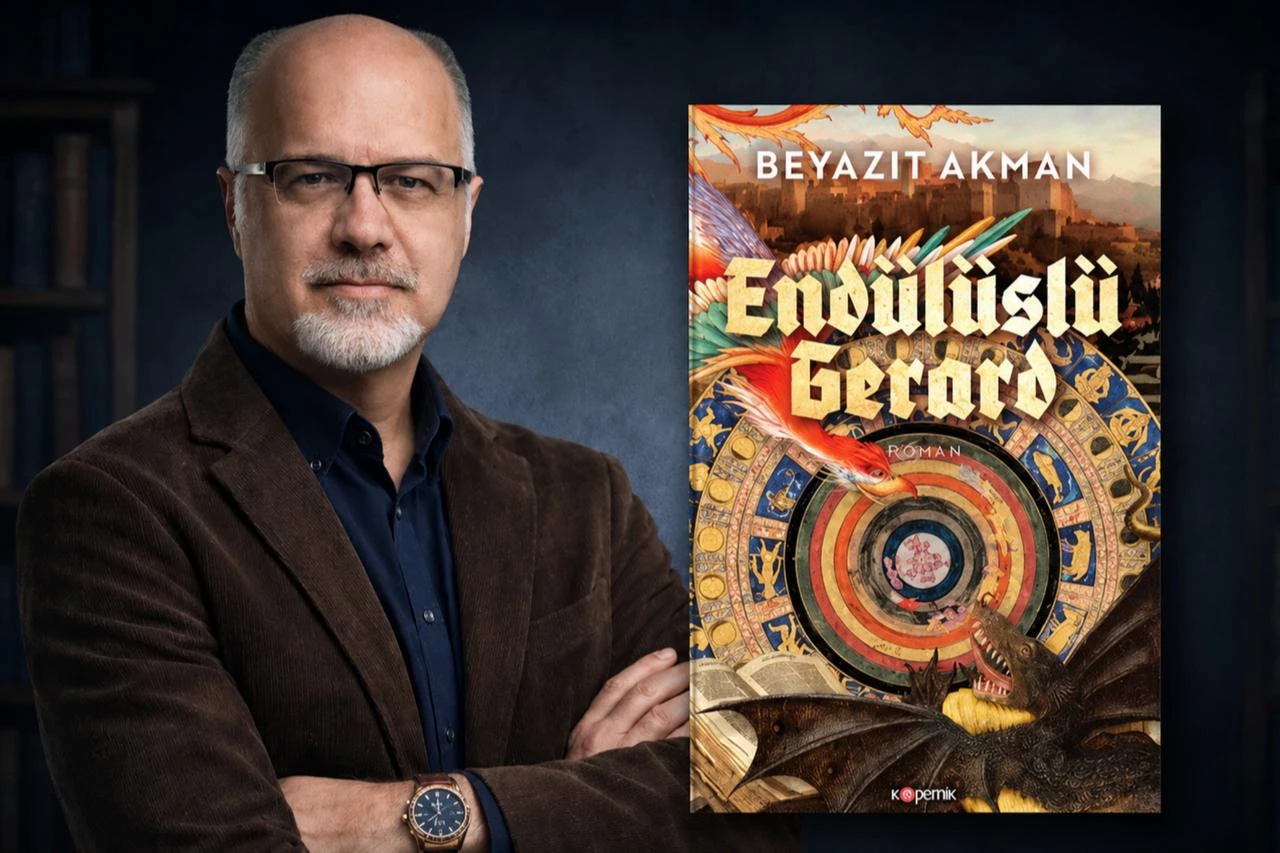


A 12th-century scholar who left Italy in search of a single astronomy book ended up translating more than 80 works from Arabic into Latin, helping scientific knowledge developed and preserved in the Islamic world reach medieval Europe, according to Turkish academic and historical novelist Beyazit Akman.
Akman has brought the story of Gerard of Cremona into focus in his new historical novel, "Gerard of Andalus," portraying the translator's decades-long pursuit of knowledge and the intellectual world he encountered after setting out to find Ptolemy's "Almagest," a foundational work of astronomy.
Akman, known for research-based historical fiction and years of academic work in the U.S., describes Gerard as "one of the most important figures who brought the Renaissance to the West."
Gerard could not find the "Almagest" anywhere in the 12th-century Latin world, Akman told Anadolu Agency, prompting him to leave Cremona, in present-day Italy, and head toward Al-Andalus, the name commonly used for the Muslim-ruled parts of the Iberian Peninsula during the Middle Ages.
Once there, however, his search opened up a much wider world of scientific and philosophical knowledge.
"When Gerard arrived, he discovered not only an Arabic copy of the "Almagest" but also an extraordinary treasury of knowledge extending from Aristotle and Hippocrates to al-Khwarizmi and Ibn Sina," Akman said.
Gerard then learned Arabic and began working alongside an Andalusian scholar named Galib, eventually spending about four decades translating works covering astronomy, medicine, mathematics and philosophy.
Among the authors whose works he helped bring into Latin were Euclid, Ibn al-Haytham, al-Farabi and al-Kindi.
Although Gerard's translations had a far-reaching impact, Akman said the translator himself largely slipped into the background of history.
Akman first came across Gerard while carrying out doctoral research in the U.S. and later looked more closely into his life while working on his 2012 novel 1492: The Gates of Heaven.
"He continued to appear at different stages of my academic research for nearly 15 years," Akman said, adding that he nevertheless found Gerard usually reduced to only a few lines in encyclopedia entries.
What drew him further into the story was Gerard's decision to leave behind his familiar world in pursuit of one book, only to come across what Akman described as a vast accumulation of knowledge built up over centuries.
Akman said Gerard's devotion to learning convinced him that the story should reach a wider audience, particularly because it also brings forward figures such as Ibn Sina, al-Khwarizmi and al-Farabi and their role in the movement of knowledge between civilizations.
Akman said the intellectual conditions of medieval Latin Europe should not simply be summed up through the label "Dark Ages," although scientific and cultural activity in the Islamic world was flourishing during periods when intellectual production in Latin Europe remained relatively limited.
Direct access to the ancient Greek intellectual tradition was restricted in the Latin world, he said, while religious institutions played a major role in shaping intellectual life.
Akman pointed to debates over faith and reason, noting that figures such as Peter Abelard faced opposition for emphasizing critical inquiry, while some works by Aristotle and Ibn Rushd were prohibited in 13th-century Paris.
Against that backdrop, Gerard's translations helped open up access to knowledge that had been preserved, interpreted and further developed in the Islamic world.
"By transferring into Latin the knowledge that had been preserved and developed in the Islamic world for centuries, he established a powerful foundation for Europe's scientific transformation—in other words, the Renaissance," Akman said.
Akman also rejected the idea that scholars including Ibn Sina, al-Khwarizmi and Ibn Rushd simply passed along ancient Greek knowledge unchanged.
"They did not simply translate the knowledge that came before them. They interpreted it, criticized it, and advanced it through their own original methods," he said.
He pointed to Ibn Sina's "Canon of Medicine," which systematically classified diseases and remained an important textbook at European universities for centuries, as well as al-Khwarizmi's contribution to establishing algebra as an independent field.
The spread of Hindu-Arabic numerals and zero also made complex calculations—which were exceptionally difficult to carry out using Roman numerals—significantly easier, according to Akman.
He noted that the word "algebra" comes from the title of al-Khwarizmi's work, while "algorithm" developed from the Latinized form of the mathematician's name.
"So behind today's artificial intelligence and algorithms stands al-Khwarizmi. The name of a mathematician who lived more than a thousand years ago continues to exist at the heart of modern technologies, from artificial intelligence to banking," Akman said.
Akman's novel turns Gerard's pursuit of the Almagest into a historical adventure that moves through Rome, Paris, Cordoba and Toledo while tracing the routes through which numerals, medicine, astronomy and philosophy reached Europe.
The story begins with one unavailable book but gradually expands as Gerard follows clues connected to a larger mystery involving monasteries, burned libraries and forbidden manuscripts.
"On one side are those who have declared war on knowledge; on the other are those who risk their lives to protect it," Akman said.
As Gerard encounters new texts, each discovery leads him further into another search and exposes him to greater danger.
According to Akman, one question runs through the novel until its final page: whether a single book can change the fate of one person, or even an entire civilization.


 Set as preferred source
 Set as preferred source


 3 min read