Sign in
 Newsletters


 Featured


The final whistle had blown on a World Cup match in Miami that produced 10 goals, exhausted 22 footballers and left 65,000 spectators wondering what might happen next.
They expected trouble. They got a prayer meeting.
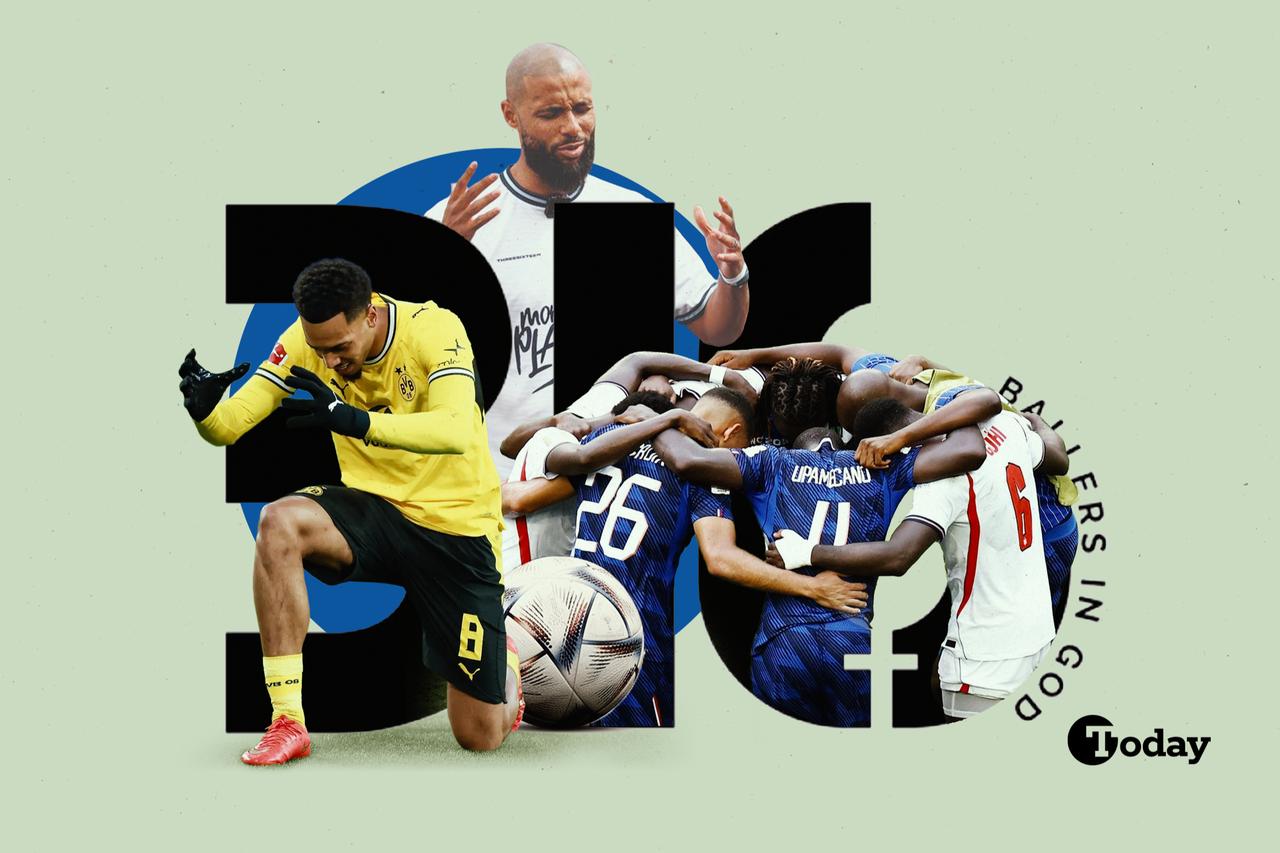
Bukayo Saka, England’s three-goal hero, rounded up three teammates and steered them toward a troika of French opponents.
A moment earlier, these men had been trying to kick one another out of the 2026 World Cup. Now, they stood together, heads bowed, communing with a higher authority than FIFA, football’s almighty governing body.
It was no accident.
All seven belonged to Ballers in God, or BIG, a network of more than 600 evangelical Christian footballers who have discovered that the world's most popular game offers a splendid pulpit.
Not everyone is pleased with the sermons.
Club executives are nervous. Coaches are uncomfortable. Supporters are arguing.
The players have begun taking religion rather more seriously than their employers would like.
The man responsible is John Bostock, who once looked destined to become a star footballer himself.
A prodigy at Crystal Palace, Bostock was the youngest player ever to appear for the club. The newspapers discovered him early, which is not always a blessing. His career never quite caught up with the headlines.
The familiar footballer's itinerary followed: England, France, Türkiye and Belgium. The hotels changed; the substitutes' benches remained much the same.
At Royal Antwerp, lonely and uncertain of his place in the game, Bostock found comfort among players who believed there were more important things than a place in the starting eleven.
He founded BIG a decade ago. It has since recruited footballers with an efficiency that might make Real Madrid envious.
Recent acquisitions include Desire Doue, Paris Saint-Germain's dazzling young forward, and Manchester City's Jeremy Doku. They have enormous talent, substantial incomes and audiences running into the millions.
They have also acquired a habit of taking their religion to work.
Germany has become the principal battleground.
Felix Nmecha, Borussia Dortmund's immensely valuable midfielder, recently celebrated a goal by removing an imaginary crown from his head and placing it reverently on the turf.
The gesture is known as the King's Return. The king in question is not the president of Borussia Dortmund.
FIFA forbids religious slogans on shirts and equipment but permits gestures. This leaves considerable theological territory between a player's fingertips and the grass.
Dortmund's management was not amused.
"We don't want to see that kind of thing in our home," said chief executive Hans-Joachim Watzke, who warned BIG against using footage of the celebration on social media.
BIG used it anyway.
Dortmund supporters joined the argument, some objecting less to Nmecha's devotion than to the conservative social beliefs associated with the movement.
Then the affair reached the national team.
Jurgen Klopp, himself a practicing Christian, called Nmecha into the German squad and asked him to retire the crown.
"I saw Felix's celebration and then the gesture. I thought nothing of it at the time. But then all this started," Klopp explained. "He will not be celebrating like that again."
Klopp has won the Champions League, Premier League, FA Cup and Bundesliga. His judgment on football is generally sound. Whether these qualifications extend to deciding the proper manner of addressing the Almighty is another matter.
The evangelicals point out, reasonably enough, that religion did not arrive in football last Thursday.
Catholic and Orthodox players have been crossing themselves for generations. In Glasgow, religious differences have sustained one of the game's fiercest rivalries, though the results have not always been conspicuously Christian.
Coaches have appealed to heaven, too.
Giovanni Trapattoni sprinkled holy water on pitches during the 2002 World Cup. Italy won once, drew once and lost twice. The celestial coaching staff evidently had other engagements.
In 2014, Türkiye witnessed its own theological dispute. When Besiktas striker Demba Ba celebrated goals by prostrating himself in Muslim prayer, Islamic scholars began arguing over whether he was facing Mecca. One prominent cleric declared the practice sinful. Others saw nothing objectionable.
Ba's teammate, goalkeeper Tolga Zengin, joined the ritual. Besiktas's management preferred not to discuss the matter. The club had signed a goal scorer, not a theological controversy. Unfortunately, the two had arrived in the same pair of boots.
But BIG represents something different.
Its players are predominantly evangelical Christians, many with African family roots, where Christianity often occupies a more commanding place than in Western Europe.
Saka and fellow Miami worshipper Eberechi Eze have Nigerian ancestry. Marc Guehi's parents come from Ivory Coast. Trevoh Chalobah's family is from Sierra Leone. The three Frenchmen also have African parents.
A University of Roehampton study of second-generation Black Britons found religion "central to personal identity," sometimes more important than nationality or ethnicity.
This helps explain why a player might regard his faith as more important than the club's latest marketing campaign.
The trouble is that evangelical Christianity often carries conservative views on social questions. Football, meanwhile, has spent considerable money presenting itself as a champion of diversity.
The two ambitions do not always fit comfortably into the same dressing room.
Guehi discovered this while captaining Crystal Palace.
Asked to wear a rainbow armband supporting LGBTQ+ inclusion, he agreed, then wrote "I Love Jesus" on it.
The Football Association objected. For the next match, he altered the inscription to "Jesus Loves You."
The authorities had won a grammatical concession. The theological argument remained unsettled.
Modern football clubs pay salaries that would once have financed small kingdoms. In exchange, they expect loyalty, discipline and an absence of unpleasant surprises for sponsors.
BIG has introduced an awkward complication. Its members appear to believe that the obligation to God outranks the obligation to the commercial department.
Worse still, the movement has commercial ambitions of its own.
BIG operates a multilingual website and podcasts in seven languages. It sells footballs, shirts, wrist tape, socks and crucifix-decorated shin pads, a favorite of Nmecha.
There is even a ministry for footballers' wives and girlfriends, known as BIG WAGs. Its online following has passed one million.
Bostock, who once struggled to find a place in a professional football team, has assembled an organization that reaches supporters across continents without a television rights broker.
BIG declines to enter public controversies but supports players who proclaim their beliefs.
"We are encouraged by player-led movements such as The King's Return, where footballers themselves take the initiative to express their faith in Jesus," reads the gospel according to BIG.
It’s not a message calculated to soothe Dortmund's executives.
Dortmund heads to Arsenal for a Champions League showdown on Nov. 24. Nmecha will be there. So will Saka and Eze. The three may find themselves on opposite sides of a fierce contest, with money and professional pride at stake.
There will be tackles, goals perhaps, and the usual arguments with the referee.
Afterward, some of them may gather to pray.
The men in the directors' boxes will be praying, too.
For something quite different.


 Set as preferred source
 Set as preferred source


 6 min read